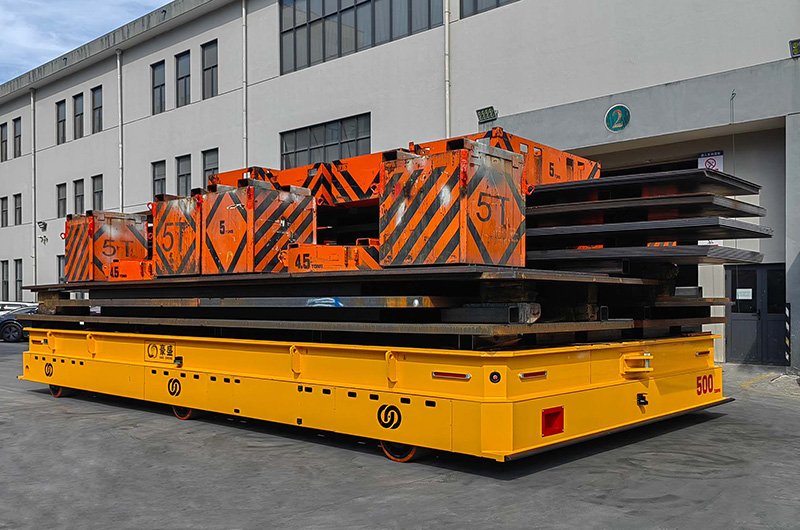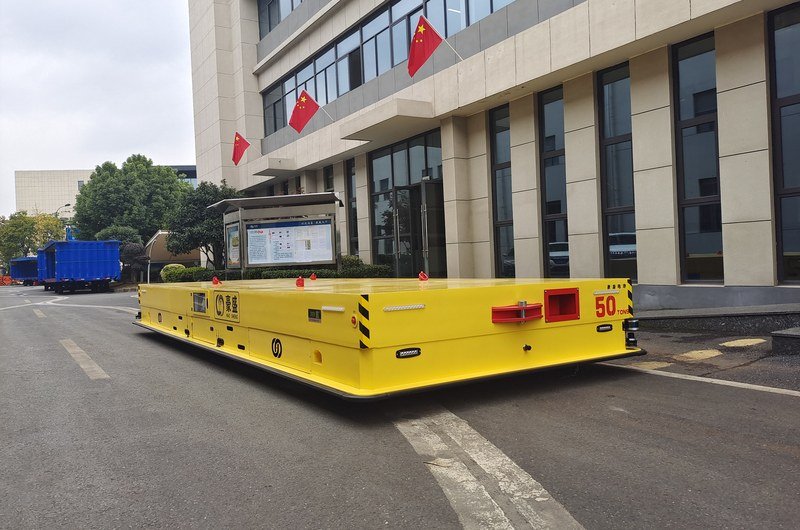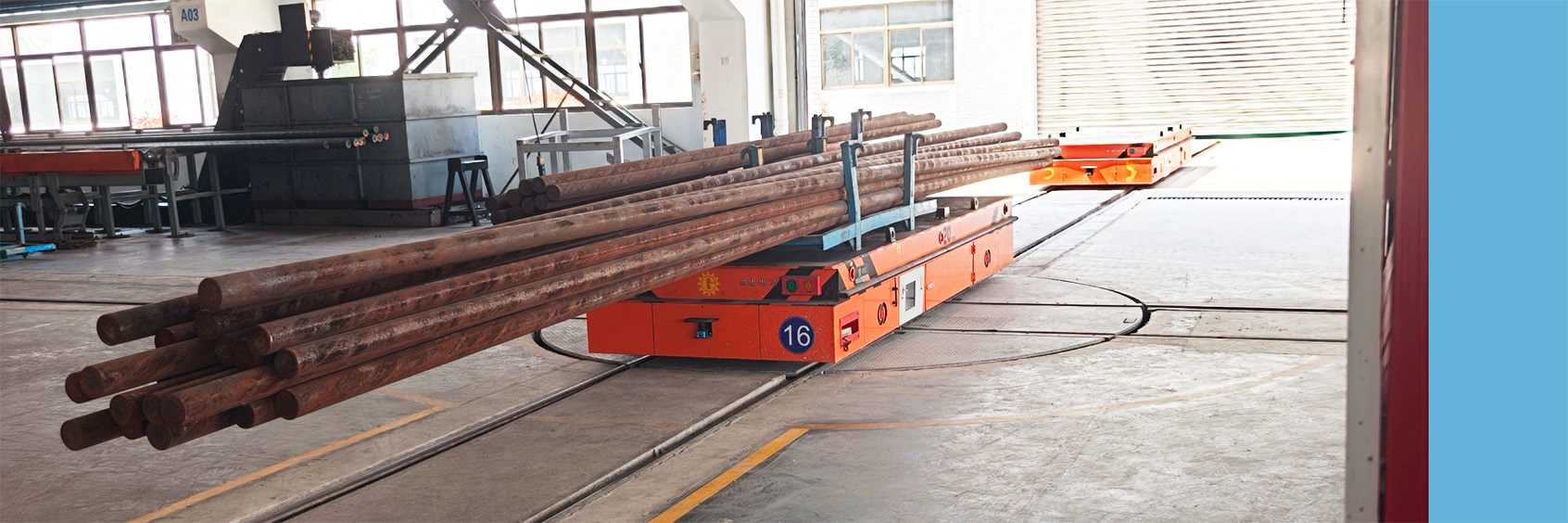
87 machines. 7.5 kilometers of track. 13 fully connected workshops. In a single greenfield plant, this is one of the largest heavy-duty RGV transport systems ever deployed in the machine-tool and heavy-machinery sector—and the entire fleet is dispatched by one operator tapping a tablet.
Behind that headline is a hard engineering problem. The plant machines precision machine-tool shafts up to 12 meters long and 20 tons in weight, routed through more than ten processes and 3,000+ workstations that rarely flow in a straight line. This is the story of how HENSEN engineered a custom rail AGV system—built around heavy-duty RGVs and electric transfer turntables—to make non-linear, ultra-heavy logistics run automatically.
The Challenge: When Linear Logistics Meets a Non-Linear Reality
Machine-tool shafts are the backbone of heavy manufacturing. A single shaft can be 12 meters long and weigh 20 tons, and it must survive a long, looping journey: quenching and tempering, surface hardening, turning, milling, grinding, hard-chrome plating, polishing, inspection, assembly, and finally the warehouse. Every step means moving a multi-ton workpiece between different workshops.
In the client’s old plant, that movement was brute-force and manual. 10-ton-plus parts rode on manually driven rail carts running back and forth on single, straight tracks. Every cart needed its own driver, and the site ran on 200+ workers. The pain was structural:
- One operator per cart, with little track crossover—so routes were single-lane, slow, and impossible to monitor in real time.
- No live visibility into material flow or transfer frequency between workshops.
- Capacity planning and order scheduling relied on human experience instead of data.
- Manual driving of 20-ton loads created constant safety exposure.
These problems are typical across heavy electromechanical manufacturing. For three to four decades, the logistics model in this industry barely changed. When the client built a 100,000+ m² greenfield plant with 13 workshops, they decided to rethink it completely—and they needed a partner who could turn 7.5 km of track into a single intelligent network.
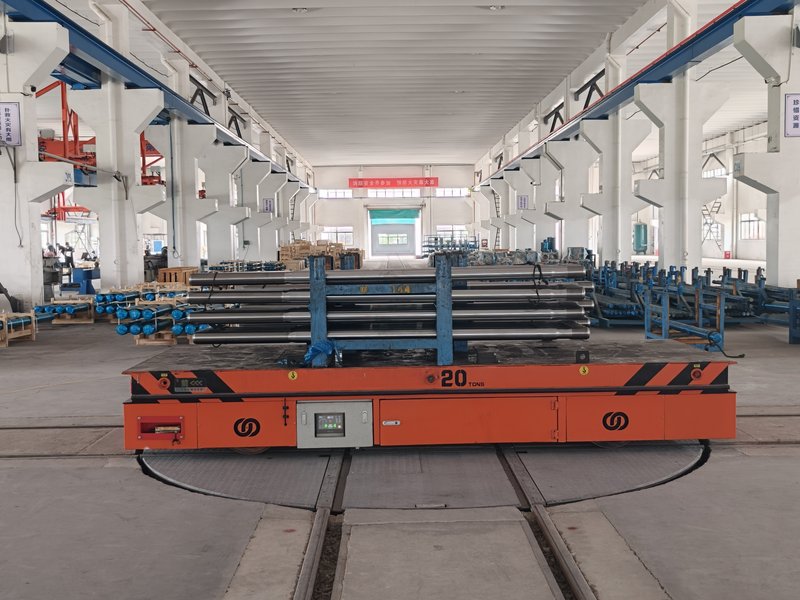
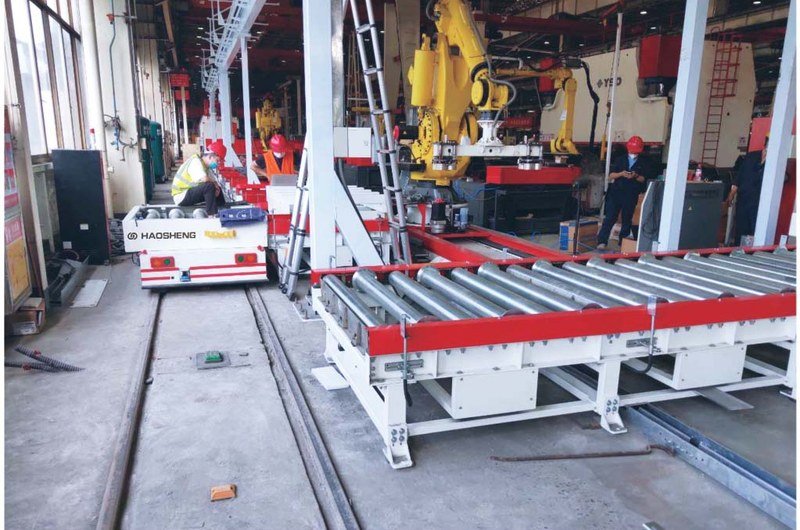
A 20-ton custom RGV transfers long bar stock between bays via an electric turntable.
Three problems that break standard material handling
1. Highly non-linear process routing. A workpiece might go to coating after assembly, then loop back to welding for rework. Real flow looked like “1→2→3→4” running in parallel with “3→1” and “4→2”—reverse reflux and multi-source merging that fixed-route dispatch logic simply cannot handle.
2. Long-distance, multi-unit coordination. 87 units spread across 13 workshops and 7.5 km of track have to communicate in real time. Metal shielding, electromagnetic interference, and temperature swings all stress the wireless link. A single dropout could desync multiple 20-ton vehicles on a shared rail network.
3. Dense workstations and traffic conflicts. In some zones, a dozen machines sit within a few meters but share only two load/unload points. When the MES pushes several tasks to the same point, multiple RGVs converge and—because a single rail offers no overtaking—one stalled cart can chain-block the whole line.
Any one of these three problems is enough to sink a standardized smart logistics system. Here, all three showed up at once—because they are inherent to heavy machinery manufacturing.
The HENSEN Solution: A Custom 87-Unit Rail AGV Network
HENSEN’s answer was not an off-the-shelf cart. It was an end-to-end, highly customized rail AGV system engineered around the plant’s real physics: 20 heavy-duty RGV transport vehicles, 67 electric transfer turntables, plant-wide wireless, a flexible dispatching engine, and a full safety stack—all integrated with the customer’s MES.
1. Heavy-duty RGVs built around the largest part
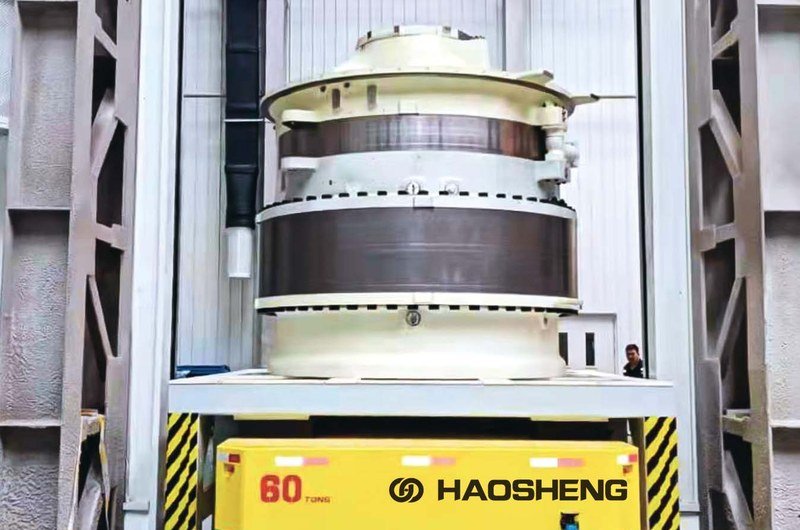
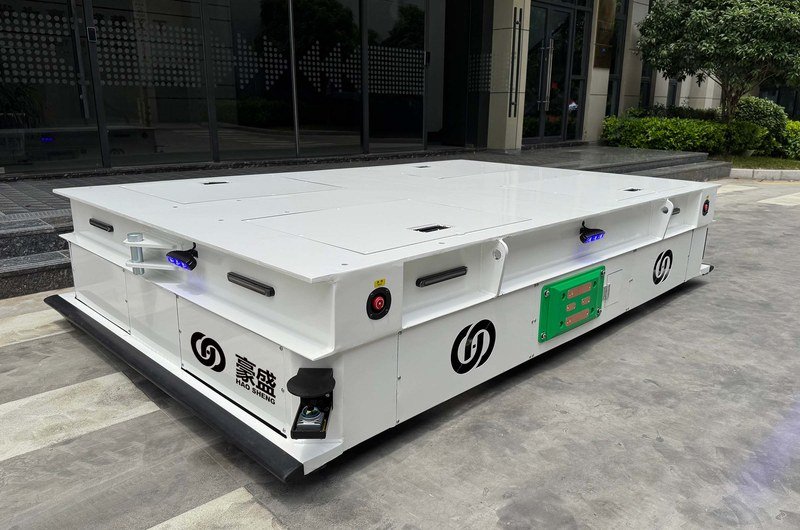
Each of the 20 rail-guided vehicles is a 20-ton-capacity heavy-duty RGV, custom-sized to the biggest workpiece on site. The deck measures 4,000 mm × 1,500 mm and carries a center-of-gravity positioning fixture so a 12 m, 20-ton shaft stays balanced in transit. Drive is a three-phase asynchronous motor through a reducer, powered by an onboard lithium iron phosphate (LiFePO4) battery with automatic charging. The same vehicles handle every smaller part class in the plant, so one fleet covers the full product range.
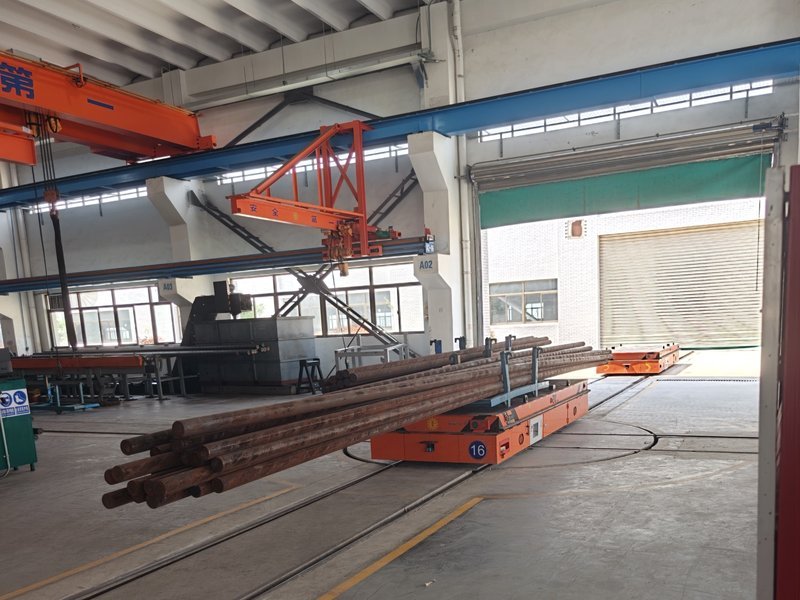
A custom RGV moves 12 m shafts out of a bay—deck and fixtures sized to the largest workpiece on site.
2. 67 electric transfer turntables for track switching
On a 7.5 km rail grid, vehicles need to change direction without curves everywhere. HENSEN supplied 67 electric transfer turntables (3.9 m class, 25-ton) that rotate an RGV onto an intersecting track. Each turntable is engineered for its position: ±90° units for standard junctions, ±45° units that feed vehicles onto the charging spur, and ±120° units where geometry demands it. Encoders, proximity switches, and hard limits guarantee the deck stops exactly on the rail before a vehicle rolls across.
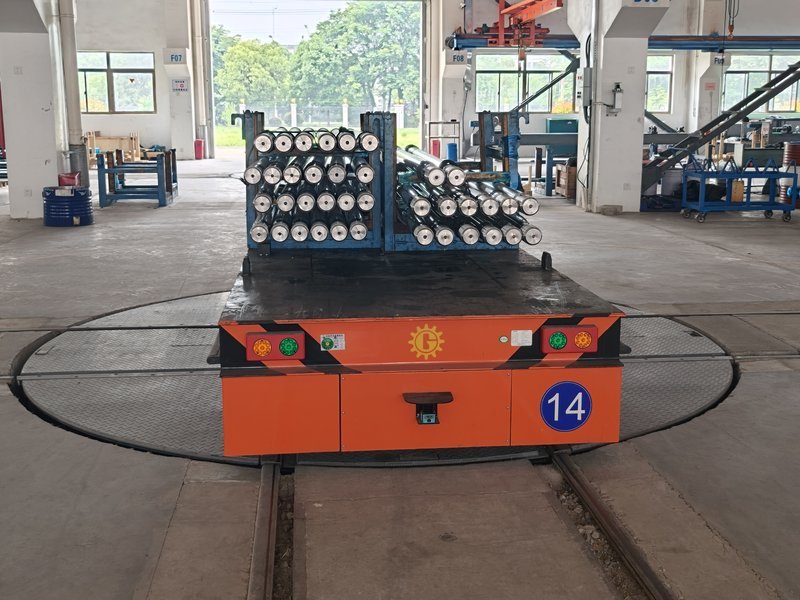
An electric transfer turntable rotates a loaded RGV onto an intersecting rail line—no curve required.
3. A flexible dispatching engine for non-linear routing
Software is the heart of the project. HENSEN developed a flexible dispatching engine that breaks from traditional linear path planning. It supports multi-source merging, dynamic avoidance, and reverse reflux, so no matter how the process route changes, the system computes the optimal path in real time. To tame congestion in dense zones, it adds virtual stop points and regional flow-threshold control, cutting multi-vehicle conflict probability where machines cluster around a single load point. In the busiest bay—the plating workshop—the team also configured a one-way corridor, because allowing two-way traffic there only made gridlock worse.
4. Plant-wide wireless and MES integration
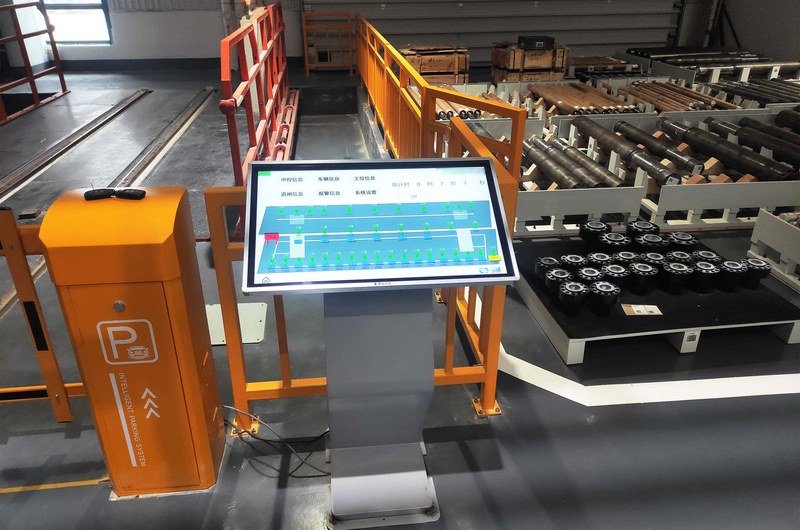
HENSEN delivered full wireless coverage across the 100,000+ m² site, linked over fiber, so every vehicle and turntable stays connected end to end. The RGV system then integrates directly with the customer’s MES for fully automatic material dispatch. The result is a dual-mode network: the MES auto-dispatches jobs, while workstation PCs and handheld tablets (PADs) let floor staff call an RGV on demand—“auto dispatch + manual call” in one system. Load-presence sensing on each deck reports back to the dispatch screen so the system knows which carts are loaded.
5. Safety engineered for 20-ton loads
Moving 20 tons on shared rail demands layered safety. Every RGV carries forward and rear laser obstacle scanners, emergency-stop, and audible/visual alarms. Above the turntables, two-dimensional laser scanners mounted on plant columns watch for intrusion—if a person steps near a rotating deck, the turntable stops immediately. Roughly one scanner covers every two to three turntables, sized to each location.
Real customization is not stripping a mature system down. It is adding—even multiplying—capability under hard physical constraints.
Manual Rail Carts vs. HENSEN Heavy-Duty RGV System
| Metric | Old Plant – Manual Rail Carts | New Plant – HENSEN Custom RGV System |
| Labor | 200+ workers (one driver per cart) | Under 60 staff; 1 dispatcher runs the fleet from a tablet |
| Output | Limited by manual handling | Higher throughput—capacity rose after go-live |
| Routing | Single straight track, no crossover | Non-linear routing: multi-source merge, dynamic avoidance, reverse reflux |
| Load | Manual driving of 10–20 t parts | 20 RGVs at 20 t + 67 turntables at 25 t, 12 m × 20 t shafts |
| Visibility | No real-time data; experience-based planning | Full MES visibility: per-cart, per-station flow data |
| Safety | Manual operation risk | Laser scanning, e-stop, alarms, turntable intrusion detection |
The Results: Fewer People, More Output, Full Visibility
After go-live, the impact was immediate and measurable:
- Labor cut from 200+ workers to under 60—while output rose. One dispatcher now calls and manages every vehicle from a single tablet.
- Full data visibility. MES integration captures transfer frequency and material flow for every cart and every workstation, giving reliable data for capacity planning and order scheduling—a leap from “word of mouth” to “the data decides.”
- Safer heavy handling. Laser obstacle avoidance, emergency stop, and audio-visual alarms sharply reduced the risk of moving 20-ton loads.
“Thank you HENSEN for this intelligent RGV transport solution—it perfectly solved our old problems of slow, difficult, and costly material movement.” — Plant project team
Why It Matters: A Blueprint for Heavy-Machinery Logistics
As one of the largest single-site RGV deployments in the domestic machine-tool and heavy-machinery industry, the project became a recognized model plant, drawing site visits and strong reviews from industry peers. It proves a point that matters far beyond one factory: even the heaviest, most complex, most “traditional” production scenarios can be automated—if the RGV manufacturer brings genuine customization rather than a catalog product.
The vast majority of heavy manufacturers still run on manual logistics. The technical path proven here—custom heavy-duty RGVs, electric transfer turntables, a flexible dispatching engine, and MES integration—is replicable. That repeatability is the real industry value and a concrete step toward Industry 4.0 on the shop floor.
Frequently Asked Questions (FAQ)
Q: What is a heavy-duty RGV, and how is it different from a forklift?
A: An RGV (rail-guided vehicle) is a powered cart that runs on fixed rail rather than driving freely on the floor. A heavy-duty RGV is built for multi-ton loads—here, 20 tons per vehicle—with a reinforced chassis, center-of-gravity fixtures, and laser safety. On a long, repeatable transport route, rail delivers higher precision, lower running costs, and far better safety than manual forklifts.
Q: How does a rail AGV change direction or switch tracks without curves?
A: Through electric transfer turntables. The RGV drives onto a rotating deck that turns ±45°, ±90°, or ±120° to align with an intersecting rail, then the vehicle rolls off. This project used 67 turntables to weave 13 workshops into one connected grid.
Q: Can the system handle non-linear, looping process routes?
A: Yes. HENSEN’s flexible dispatching engine supports multi-source merging, dynamic avoidance, and reverse reflux, so workpieces can loop back to an earlier process (for example, returning to welding for rework) without breaking the schedule. Virtual stop points and flow thresholds prevent gridlock in dense zones.
Q: How does the RGV system connect to our MES or production software?
A: The dispatch system integrates directly with the plant MES for fully automatic material dispatch and also exposes a client on workstation PCs and handheld tablets for manual calls. You get a dual-mode “auto dispatch + manual call” network, with full flow data fed back to the MES.
Q: What safety features protect people around 20-ton vehicles?
A: Forward and rear laser obstacle scanners on each RGV, emergency-stop, and audio-visual alarms, plus column-mounted laser scanners that halt a turntable the moment someone enters its rotation zone.
Ready to Automate Your Heavy Logistics?
From 2-ton parts to 800-ton modules, HENSEN designs, manufactures, and installs custom heavy-duty RGVs, rail AGVs, electric transfer turntables, and trackless transfer carts for 150+ industries. If standard equipment isn’t enough for your plant, go custom.
Talk to a HENSEN engineer about your project → Contact Us.