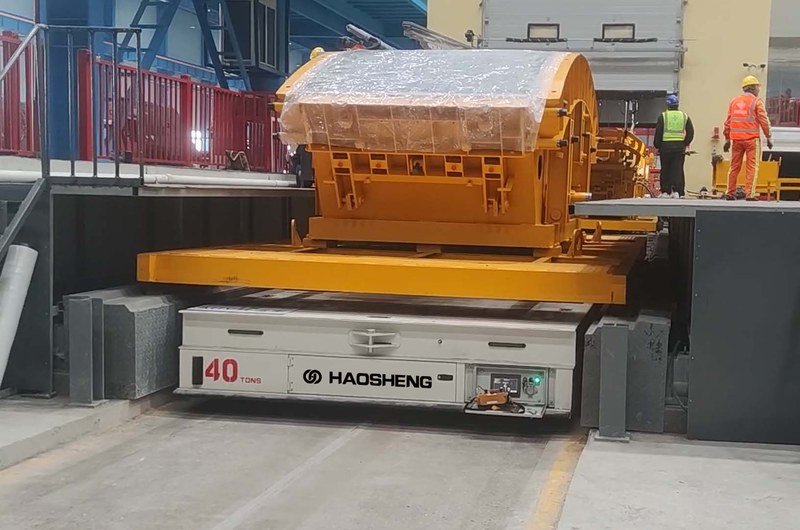
A precast tunnel segment plant has a logistics problem hiding in plain sight. Every segment — typically several tons of curved, reinforced concrete — must move from the casting mould to curing, from curing to the storage yard, and from storage to the loading bay, hundreds of times per week. In most plants, that job belongs to gantry cranes and a small fleet of trailers, which means every move waits for a crane slot, ties up riggers, and swings suspended concrete over a busy floor.
Heavy-duty AGVs change the model: segments travel at floor level, automatically, on a vehicle built around segment-specific tooling. This article explains how tunnel segment AGVs work, what they replace, and how to plan capacity, navigation, and floors for a segment plant — with lessons that apply equally to box culverts, girders, and other large precast elements.
Why Segment Logistics Outgrows Cranes
Gantry and overhead cranes are excellent at lifting — and slow at transporting. Each crane cycle involves rigging, a careful traverse across the hall, and un-rigging; the crane then becomes the bottleneck every other process queues behind. Three pressures push segment plants toward floor-level automation:
- Throughput — a tunnel boring machine consumes rings on a relentless schedule; the plant must produce and ship on takt, and crane queues break that takt.
- Safety — suspended multi-ton concrete over workers is a permanent risk; floor-level transport removes the suspended load entirely.
- Crane time is expensive — cranes should serve the moulds (demoulding, turning), not spend their day as taxis between curing and storage.
How a Tunnel Segment AGV Works
Segment-specific deck tooling
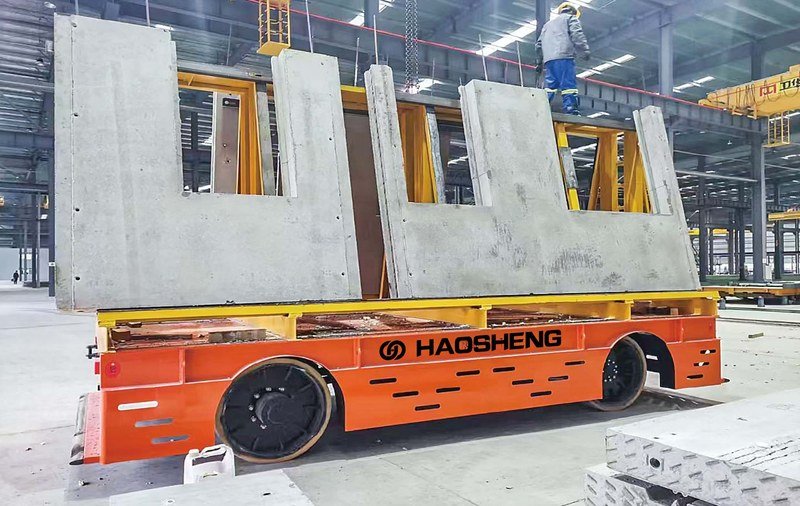
The heart of the vehicle is the deck. Segments are curved, so the AGV carries contoured supports or A-frame racks matched to the segment radius, protecting edges and gaskets and locating each piece repeatably. Decks are commonly configured to carry a part-ring or a full ring set per trip, so one vehicle movement equals one meaningful unit of production.
Payload and structure
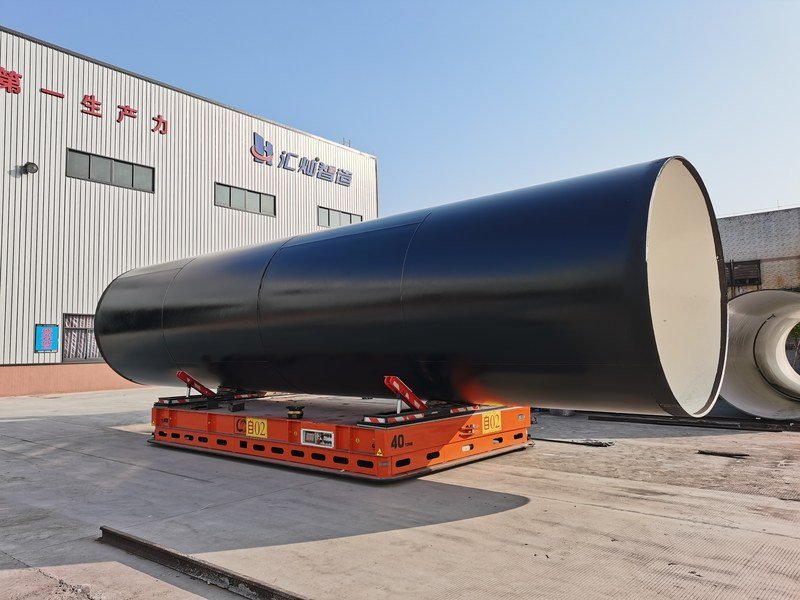
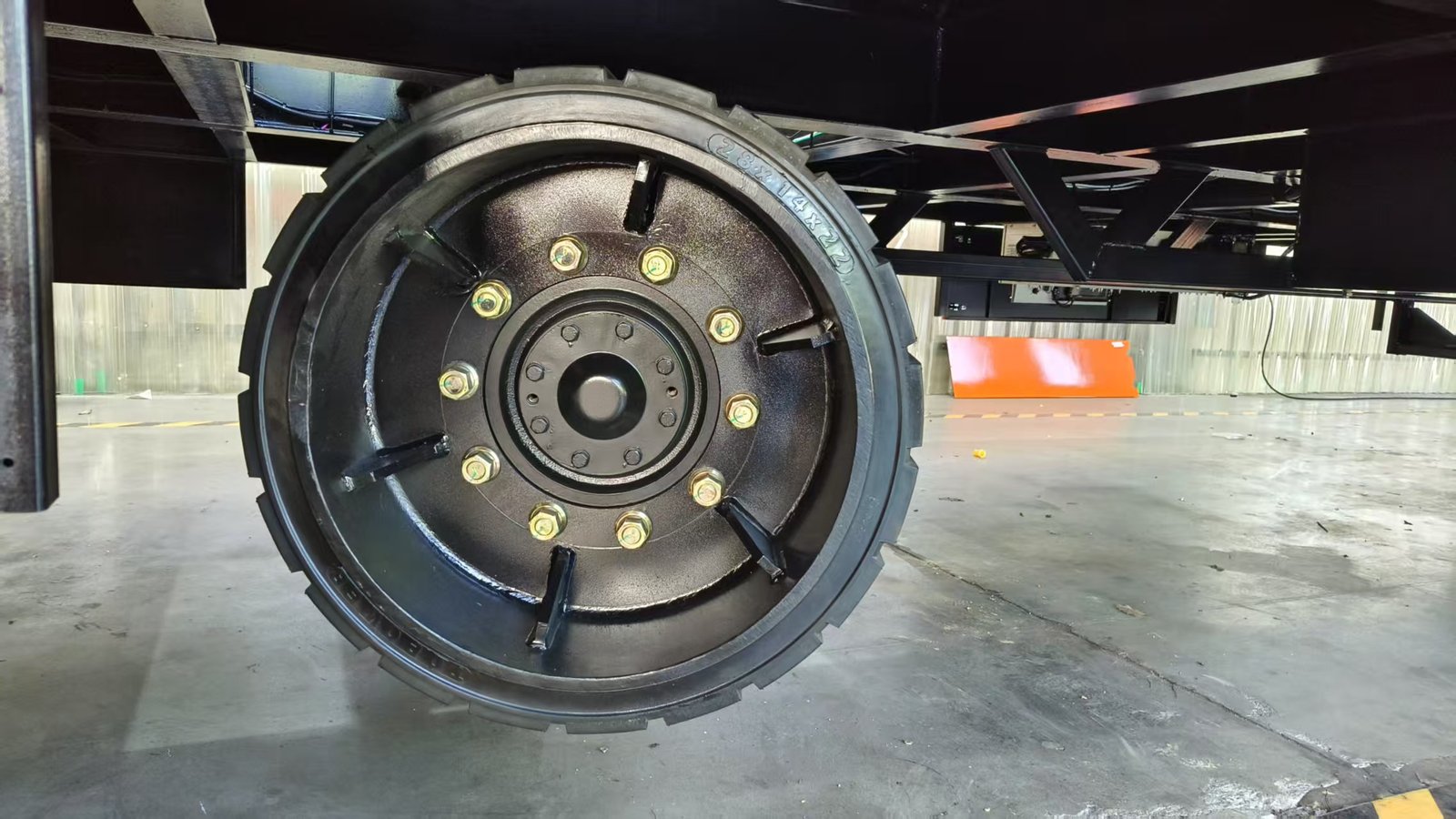
Segment sets and stacks put the requirement into genuine heavy-AGV territory. Vehicles follow the same engineering rules as any heavy-load AGV: Q345 box-beam welded frames, stress-relief annealing, machined wheel seats, and deck deflection held to about L/1000 of the wheelbase — covered in depth in our AGV frame and chassis design guide. Reference projects in this family include oversized pipe transporters and 100-ton class vehicles on infrastructure production lines.
Navigation for indoor and outdoor routes
Segment plants almost always straddle indoors and outdoors: casting and curing inside, storage yards outside. That makes navigation choice decisive:
3D SLAM laser navigation indoors
Reflector-free laser SLAM maps the hall itself, so no infrastructure is bolted to a building full of moving stock. Accuracy around ±10–15 mm is ample for rack and stand alignment.
RTK satellite navigation outdoors
In the open yard, RTK positioning keeps the vehicle on route across large, feature-poor concrete aprons, and fuses with the laser system so one vehicle runs a single continuous mission indoors and out.
The Segment Flow, Step by Step
- 1. Demoulding — the crane lifts the fresh segment from the mould onto the AGV’s contoured supports; this is the crane’s only touch.
- 2. Curing transfer — the AGV delivers the segment to the curing area or chamber, stopping repeatedly at assigned positions.
- 3. Yard transfer — after curing, the vehicle carries segments to the outdoor storage yard, switching to RTK guidance on the way.
- 4. Stacking and retrieval — segments are set onto stands or stack racks; inventory positions are tracked by the scheduling system.
- 5. Dispatch — when a ring is called for the tunnel, the AGV collects the set and delivers it to the truck loading bay in ring order.
Floors, Yards and Route Planning
Because AGVs run on ordinary floors rather than rails, the floor is the infrastructure. Plan three things early: floor flatness and bearing capacity along the routes (wheel loads concentrate under a loaded heavy AGV), drainage and surface quality in the outdoor yard, and route widths at corners where a long vehicle sweeps. A site survey against these points belongs in the technical agreement — the same discipline described in our custom RGV design guide, applied to a segment plant.
Sizing the Fleet: Cycle-Time Math
Vehicle count falls out of simple arithmetic: rings per day, segments per ring, and minutes per move (travel at 0–20 m/min plus loading and setting time at each end). Run the numbers for the peak week, not the average one — a tunnel project’s demand curve has a long plateau at maximum output, and a fleet sized for the average will spend that plateau behind schedule. Most single-TBM segment plants land on one or two vehicles; a second vehicle also buys redundancy, so a service day never stops shipments. If moves cluster into bursts, station buffers (extra stands at curing and dispatch) smooth the peaks more cheaply than an extra vehicle.
What Changes Operationally
| Aspect | Crane + trailer model | Segment AGV model |
| Crane usage | Cranes transport and lift | Cranes only demould; transport is automated |
| Safety | Suspended loads cross the floor | Loads travel at floor level |
| Throughput | Queued on crane availability | Deterministic cycles on takt |
| Labor | Riggers and drivers each shift | Automated, supervised by dispatch |
| Inventory | Paper- or memory-based yard | Positions tracked by scheduling software |
Plants making other large precast elements see the same effect — our guide to precast concrete AGVs covers the PC-component side of the family.
Specifying a Tunnel Segment AGV
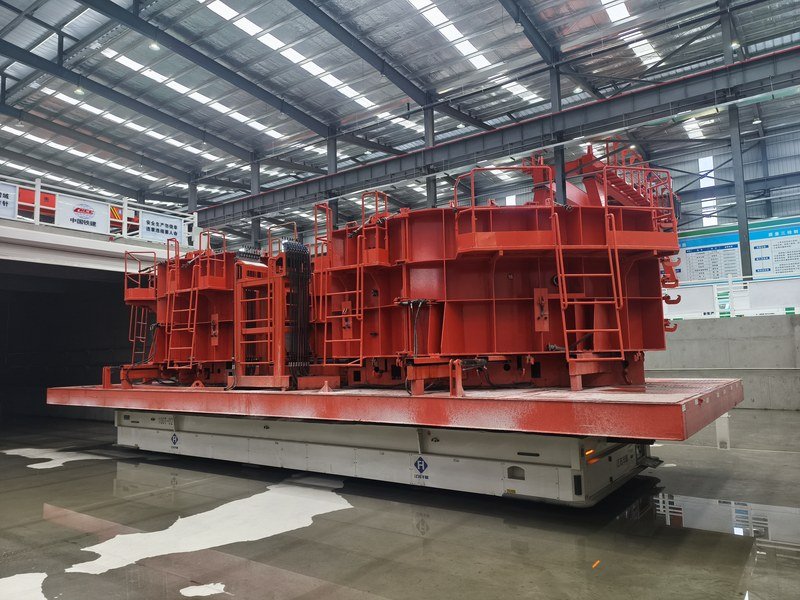
Give the manufacturer the segment drawings (radius, weight, lifting points), the ring logistics (segments per ring, rings per day), the route layout with indoor and outdoor sections, floor and yard conditions, and how dispatch should be triggered — manual call, schedule, or MES integration over WiFi or 5G. From those inputs, engineering resolves vehicle count, deck tooling, navigation mix, and charging strategy (LiFePO4 with automatic charging is the norm for around-the-clock plants).
HENSEN (Hangzhou Haosheng Electric Vehicle Co., Ltd.) builds heavy-duty AGVs up to 800 tons and RGVs from 1 to 500 tons, including tunnel segment transporters, oversized pipe carriers and precast component vehicles, with in-house control and scheduling software, CE marking and ISO 9001 certified manufacturing. Send us your segment drawings and plant layout, and our engineers will propose a vehicle and route design with budget pricing.
FAQ
Q: How much weight does a tunnel segment AGV carry?
A: Vehicles are sized to the segment set: single segments of a few tons up to full ring sets and stacked loads that reach into the tens of tons. The heavy-AGV platform itself scales far beyond that, so payload is rarely the limiting factor.
Q: Can one AGV work both inside the hall and in the outdoor yard?
A: Yes. 3D SLAM laser navigation handles the indoor sections, and RTK satellite positioning takes over outdoors, fused so the vehicle runs one continuous route. Weather protection for outdoor duty is specified at design time.
Q: Do segment AGVs replace the gantry crane completely?
A: No — the crane still demoulds and handles mould-side work it is best at. The AGV removes the transport share of crane time, which is typically the majority, and with it the queues and suspended-load traffic.
Q: What floor quality do heavy segment AGVs need?
A: A sound industrial concrete floor with adequate bearing capacity and reasonable flatness along the routes. The manufacturer states wheel loads and flatness requirements during design; weak or broken slabs are repaired locally rather than rebuilding the whole floor.
Q: How do AGVs compare with rail carts (RGVs) for segment plants?
A: RGVs suit fixed, repetitive indoor routes and are covered in our complete RGV guide. Segment plants usually prefer AGVs because routes span indoor and outdoor areas and storage layouts change; no rails also means the yard stays flexible.
Conclusion
Tunnel segment logistics rewards the plants that stop treating cranes as transport. A heavy-duty AGV with segment tooling moves every piece at floor level, on takt, with positions tracked and cranes freed for the moulds — and the same platform serves pipes, culverts and precast components across the infrastructure industry. Plan the floors, choose the navigation mix, and the segment flow becomes one less thing between the plant and the tunnel boring machine’s schedule.



Leave a comment