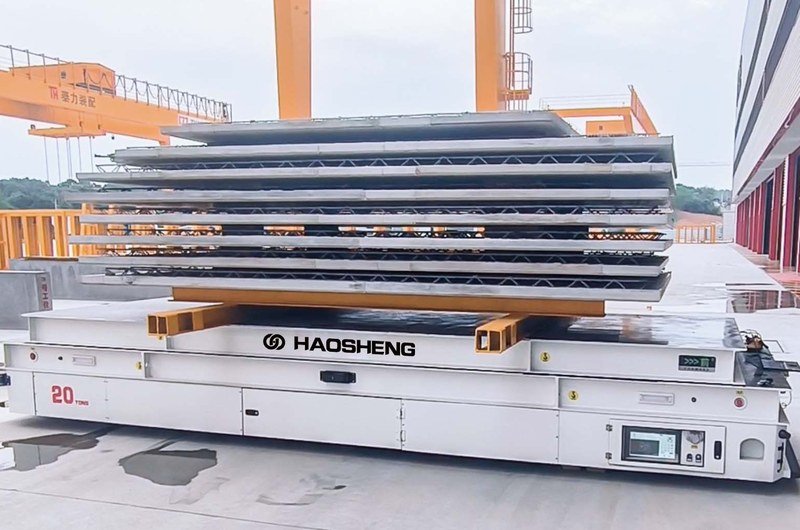
Walk through most precast concrete plants and you will find the same bottleneck: the overhead crane. It strips molds, it turns panels, it stacks finished units — and in between, it is asked to carry every wall panel, floor slab and stair flight from the curing area to the storage yard. Production waits while the crane travels, and the one step that adds no value consumes the most contested resource in the building.
Precast concrete AGVs break that dependency. Battery-powered and driverless, they carry layer pallets and finished PC components between casting lines, curing racks, buffer zones and outdoor storage yards — at floor level, without rails, and without tying up a crane hook or a forklift driver.
This guide explains how AGV automation works in a prefab plant: the vehicle types, the curing-line-to-yard flow, the navigation and design details that matter around concrete, and how to specify a system for your own layout.
Why PC Component Logistics Is the Hidden Bottleneck in Prefab Plants
A prefabricated construction plant lives on cycle time. Molds must turn over daily, curing chambers must load and unload on schedule, and dispatch must pull the right components in the right erection sequence. Yet in most plants, all of these flows compete for the same overhead cranes — and every low-value transport lift steals hook time from casting and demolding, the operations that actually earn money.
The alternatives are not much better. Heavy forklifts struggle with wide, fragile panels; a single clipped corner can scrap a finished architectural element. Towed trailers need drivers, spotters and generous aisles. And as prefab volumes grow, plants discover that transport labor scales linearly with output while crane capacity does not scale at all.
- Crane hours: internal transport can occupy a large share of hook time that casting and demolding need.
- Damage: chipped edges and cracked corners on finished PC components mean rework or scrap.
- Labor: every manual transfer needs a driver, and often a rigger and a spotter as well.
- Safety: suspended concrete loads travelling over workstations are a permanent hazard.
What a Precast Concrete AGV Actually Moves
Layer-pallet transport AGVs
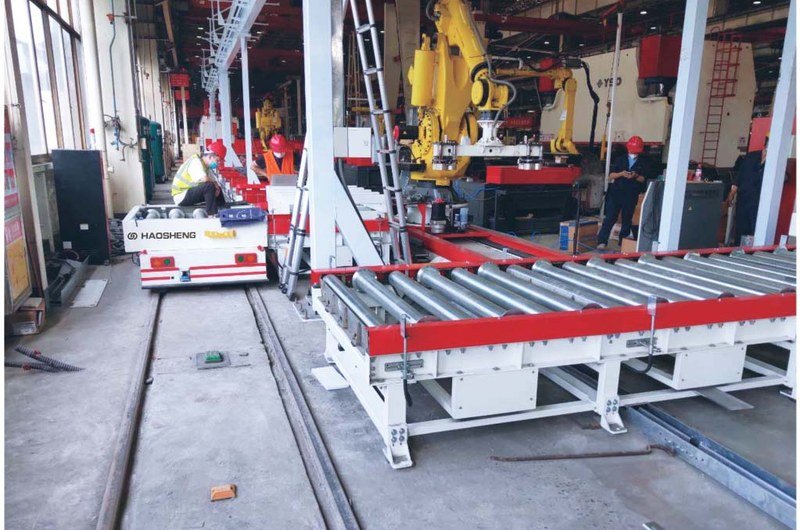
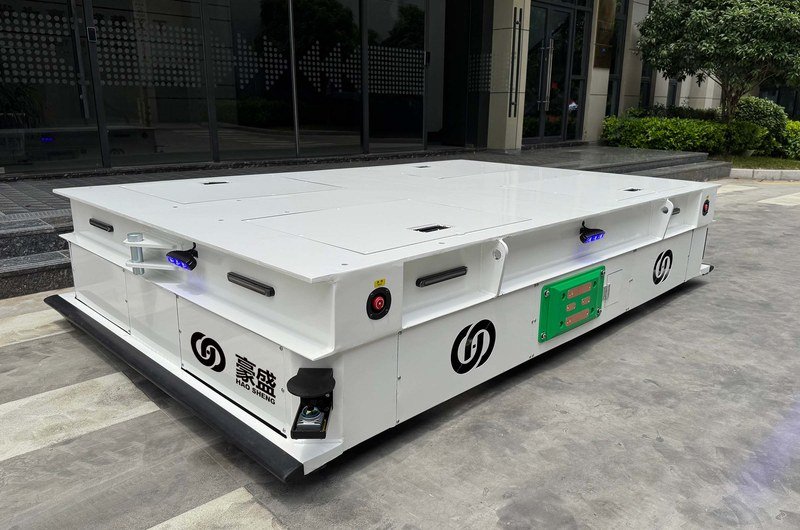
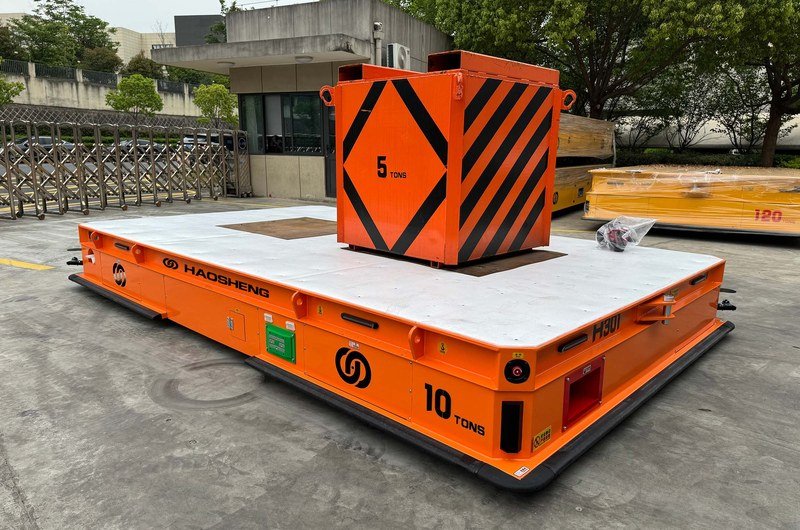
In carousel and pallet-circulation plants, the unit of transport is the steel layer pallet that carries panels through casting and curing. A layer-pallet AGV drives beneath the pallet, raises it on a hydraulic lifting deck, and shuttles it between the casting line, curing racks and the demolding station. HENSEN has delivered exactly this class of vehicle — a custom PC component layer-pallet transport AGV — for prefabricated building producers.
Platform AGVs for finished components
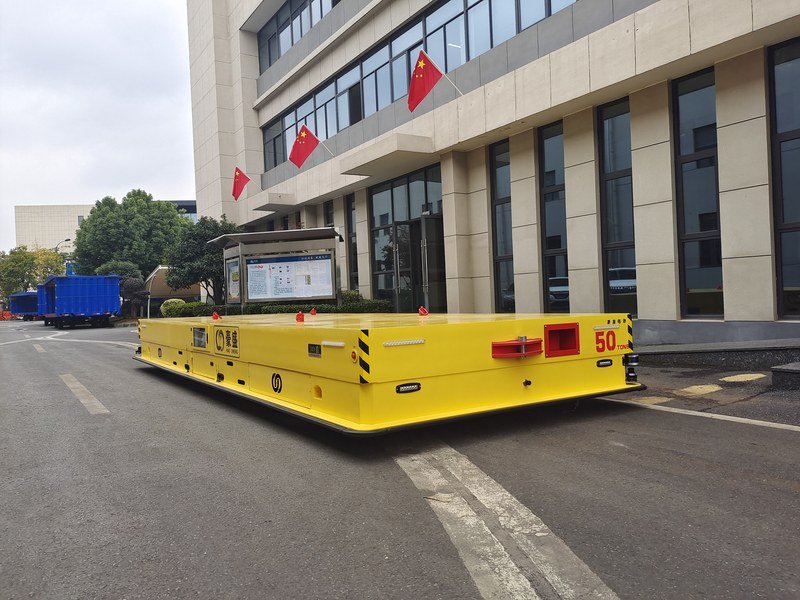
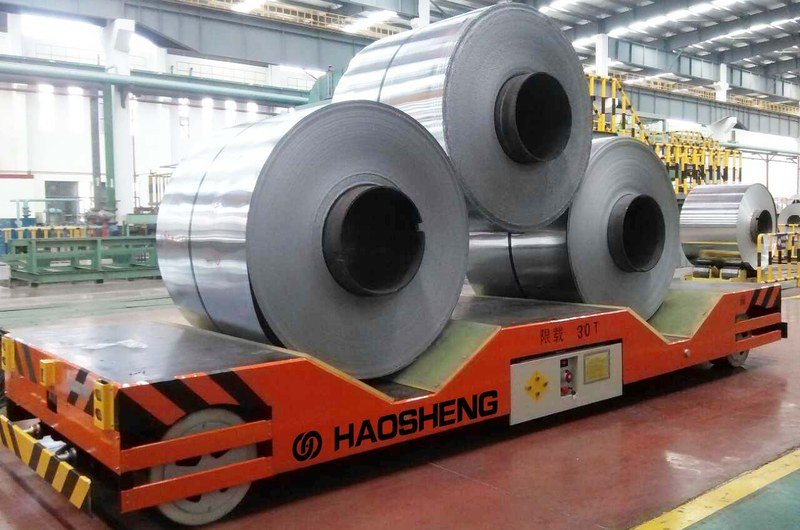
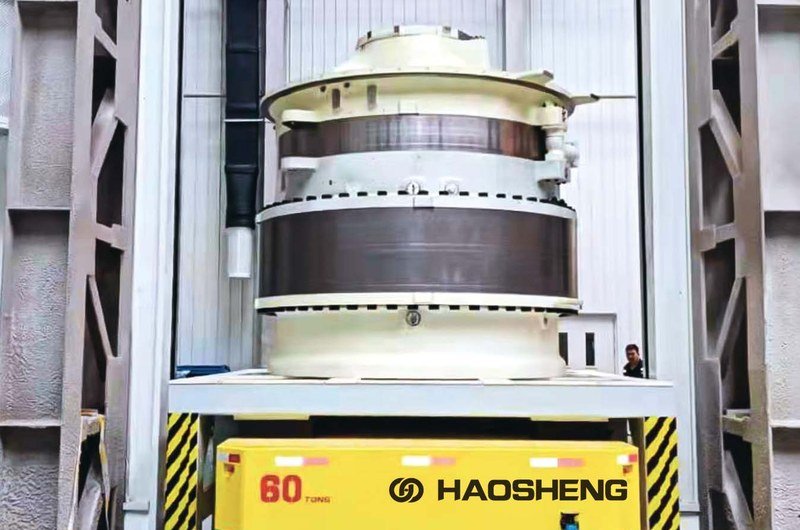
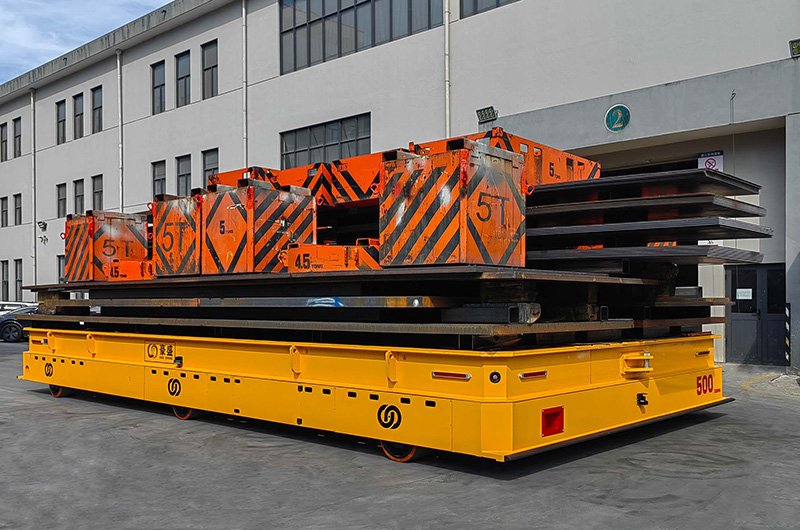
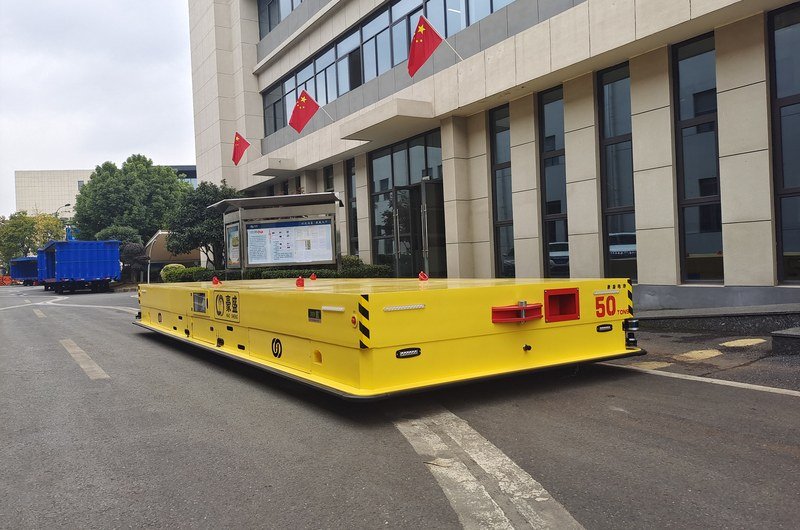
Once components are demolded, a flat-deck platform AGV takes over: stacked floor slabs, wall panels on A-frames, beams and columns ride on a steel deck fitted with timber or custom bolsters. Typical precast duty sits in the 10–50 ton range, though the same platform architecture scales far beyond that — HENSEN builds heavy-duty AGVs up to 800 tons for other industries.
From Curing Line to Storage Yard: How the Automated Flow Works
A typical automated cycle in a PC plant looks like this:
- 1. Task — the plant MES or WMS issues a transport order: collect pallet 14 from curing rack B, deliver to demolding.
- 2. Pickup — the AGV drives under the pallet or load frame and lifts it clear on its hydraulic deck.
- 3. Transit — the vehicle travels the route at up to 20 m/min with soft start and stop, so green concrete is never shock-loaded.
- 4. Handover — at the destination, it lowers the load onto stands or racks and confirms position to the system.
- 5. Next task — the AGV takes the next order or returns to its charging point; task data and location are reported back over industrial WiFi or 5G.
Navigation that survives both the hall and the yard
Precast logistics is an indoor-outdoor problem: components cure inside and store outside. Navigation has to work in both worlds.
3D SLAM laser navigation
Modern precast AGVs use 3D SLAM laser navigation, which maps the environment itself instead of relying on reflector boards, achieves roughly ±10–15 mm accuracy, and — critically for prefab plants — handles the transition between indoor halls and outdoor aprons.
RTK satellite guidance for open yards
In large storage yards with long stacking rows and few wall features, RTK satellite positioning supplements the laser system, keeping the vehicle on route in open ground and in all weather.
Drive layout matters just as much as navigation. Omnidirectional steering-wheel drives let the AGV crab sideways into a tight yard row, travel diagonally between stacks, or rotate on the spot at the end of an aisle — maneuvers that make dense component storage possible without wide turning lanes.
Vehicle Design Details That Matter Around Concrete
Lifting deck and tooling
Layer pallets and component racks are lifted on hydraulic decks with 150–400 mm of stroke. Multi-cylinder synchronization holds the deck level within ±1 mm across the lift — important when the payload is an uncured panel that must not twist, or a stack of slabs that must stay square.
Frame and floor loading
The chassis is a welded Q345 box-beam frame, stress-relieved by post-weld annealing and machined in a single gantry setup, with deflection held to about L/1000 of the wheelbase under rated load. The AGV runs on polyurethane wheels, and wheel-to-floor contact pressure is a genuine design constraint: yard slabs and hall floors must carry the load without rutting, so wheel count and footprint are engineered around your floor specification.
Power and charging
LiFePO4 lithium batteries with automatic and opportunity charging keep the fleet running around the clock — the vehicle tops up during loading and unloading dwell times, so multi-shift prefab production never stops for a charge cycle.
Safety equipment follows heavy-AGV practice: 270-degree laser obstacle scanners front and rear, emergency stops at each corner, sound-and-light alarms and electromagnetic braking — essential in yards where riggers and inspectors walk among the stacks.
Beyond Wall Panels: Other Precast Loads AGVs Handle
The same vehicle platform adapts to the wider precast world. Precast tunnel segments are the closest cousin — rings of curved segments moving from casting to curing to stockyard on dedicated tooling — and we cover that application in detail in our guide to tunnel segment AGV transport.
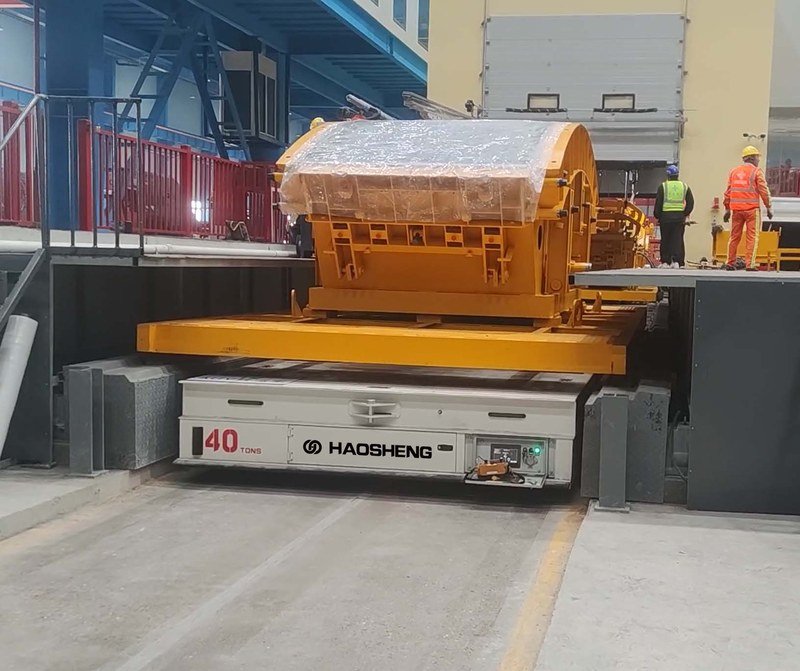
Bridge beams, utility vaults, box culverts and precast stairs all follow the same logic: heavy, repetitive, damage-sensitive transfers between fixed process areas. HENSEN’s delivered fleet includes both PC component AGVs and tunnel segment AGVs, alongside 50-ton platform vehicles serving general precast yards.
Specifying a Precast AGV Project
| Payload class | Typical precast load | Typical configuration |
| 5–15 t | Layer pallets, single wall panels | Lifting-deck pallet AGV, SLAM navigation |
| 20–50 t | Stacked slabs, beams, loaded A-frames | Platform AGV with omnidirectional drive |
| 50 t and up | Oversized elements, segment sets | Custom heavy AGV with project tooling |
To get a buildable quotation, collect the following before you talk to a manufacturer:
- Load list: component types, weights, dimensions, and how each is supported during transport.
- Routes: indoor and outdoor legs, door widths, ramps, and the surface condition of halls and yard.
- Cycle demand: transfers per hour at peak, and which flows must run in parallel.
- Floor data: slab thickness and bearing capacity along the route, indoors and out.
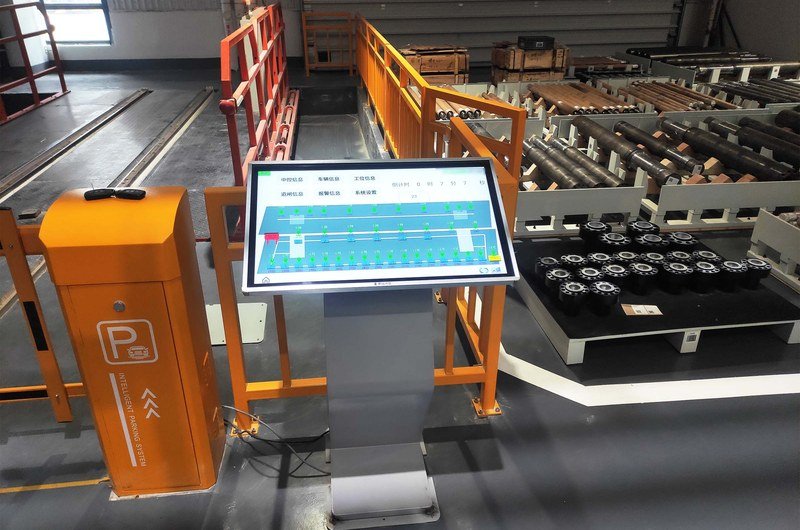
- Integration: which MES/WMS issues tasks, and what status reporting you need back.
- Environment: outdoor temperature range, rain exposure, and yard lighting for night shifts.
These points map directly onto the ten-specification framework in our custom RGV design guide — the discipline is identical even though the vehicle is trackless. Expect a delivery time of about 3–4 months from signed technical agreement to factory acceptance, a 1.1× rated-load test before shipment, a service life of 10–15 years or more, and — in multi-shift prefab operations replacing crane time and transport crews — a payback period in the region of 2–4 years.
HENSEN designs and builds precast concrete AGVs — layer-pallet carriers, platform vehicles and tunnel segment transporters — from 1 to 500 tons as rail vehicles and up to 800 tons as heavy-duty AGVs, with in-house control and scheduling software, CE marking and ISO 9001 certified manufacturing, delivered to prefab, infrastructure and construction machinery plants worldwide. Send us your component list and a plant layout, and our engineers will propose a vehicle configuration and traffic plan with budget pricing.
FAQ About Precast Concrete AGVs
Q: How heavy a precast component can an AGV carry?
A: Standard precast duty falls in the 10–50 ton range — layer pallets, stacked slabs, and loaded A-frames. The platform architecture scales far higher: HENSEN builds heavy-duty AGVs up to 800 tons, so even oversized bridge or tunnel elements stay within reach.
Q: Can the same AGV work indoors and in the outdoor storage yard?
A: Yes. 3D SLAM laser navigation handles the indoor-to-outdoor transition without reflector boards, and RTK satellite guidance takes over in open yards. The vehicle itself is built for outdoor duty with weather-protected electronics.
Q: Does an AGV damage the yard or hall floor?
A: It should not, if specified correctly. Polyurethane wheels and a calculated wheel layout keep contact pressure within what your slab can bear — which is why floor bearing data along the route is part of every serious AGV proposal.
Q: How does the AGV know which pallet or component to move?
A: Transport tasks come from your MES or WMS over TCP or MQTT, and the vehicle reports position and task status back over industrial WiFi or 5G. Plants without a host system can run the fleet from HENSEN’s own scheduling software or in semi-automatic mode from the onboard touchscreen.
Q: What is the realistic payback period for a precast plant?
A: Multi-shift operations that recover crane hours and remove transport crews typically see payback in about 2–4 years. The stronger driver is often throughput: freeing the crane for casting and demolding lifts mold turnover without any new building.
Conclusion
Prefab construction wins on factory discipline, and factory discipline breaks down when every component movement waits for a crane. Precast concrete AGVs move layer pallets and finished PC components on the floor, on schedule and without drivers — returning crane hours to casting, cutting damage and labor, and connecting the curing line to the storage yard as one continuous automated flow. Start with your component list and floor data, and let the vehicle be engineered around your plant rather than the other way round. For more solutions, contact us now.

Leave a comment