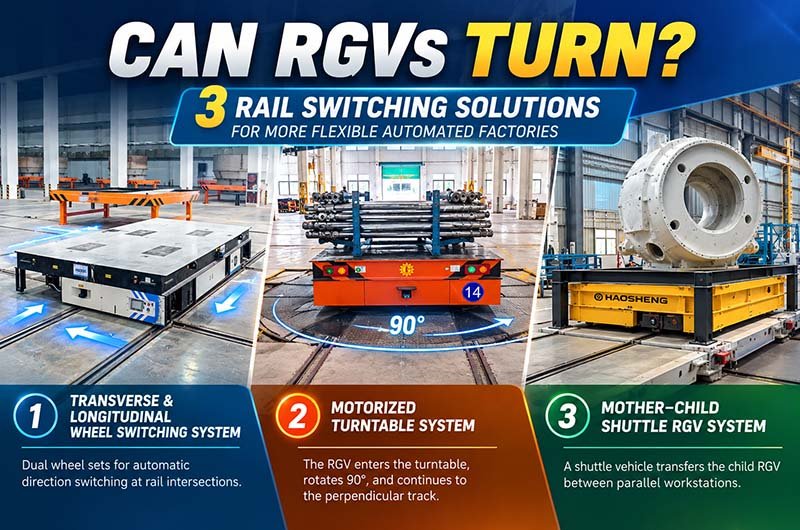
An RGV (rail-guided vehicle) follows fixed tracks—but that does not mean it can only travel back and forth along one straight line. When production areas meet at perpendicular intersections or when several parallel workstations need to be connected, engineers can design different ways for an RGV to change its route.
At HENSEN, three commonly used approaches are a dual-direction wheel switching system, a motorized turntable, and a mother–child shuttle arrangement. Each solves a different layout problem. Choosing between them depends on traffic volume, load characteristics, track geometry, space, and the required production sequence.
Why rail switching matters in an automated factory
Straight rail runs are simple to operate, but real factories are rarely arranged in one line. A transfer vehicle may need to connect two perpendicular aisles, serve several machines, or move between parallel process bays. Without a suitable transfer interface, these movements can require extra handling equipment, additional loading steps or a less efficient layout.
The objective is not simply to make an RGV “turn.” It is to connect material flow safely and repeatably while keeping the production process practical to maintain and expand.
1. Transverse and longitudinal wheel switching: change direction on the vehicle
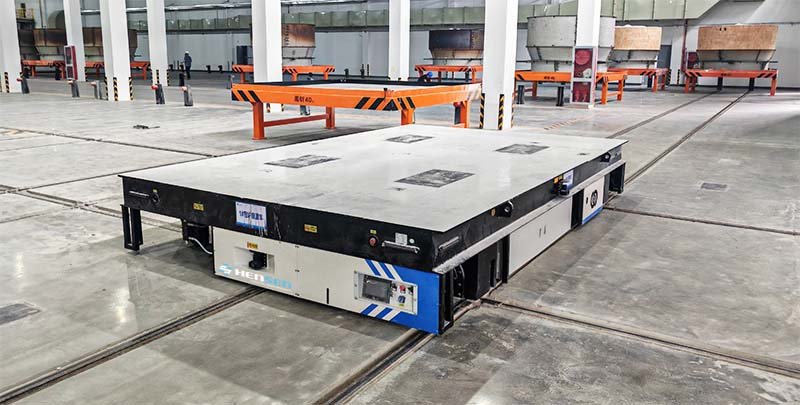
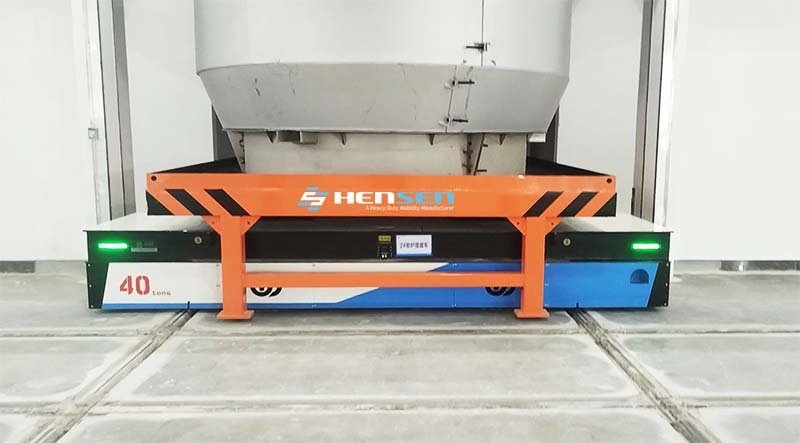
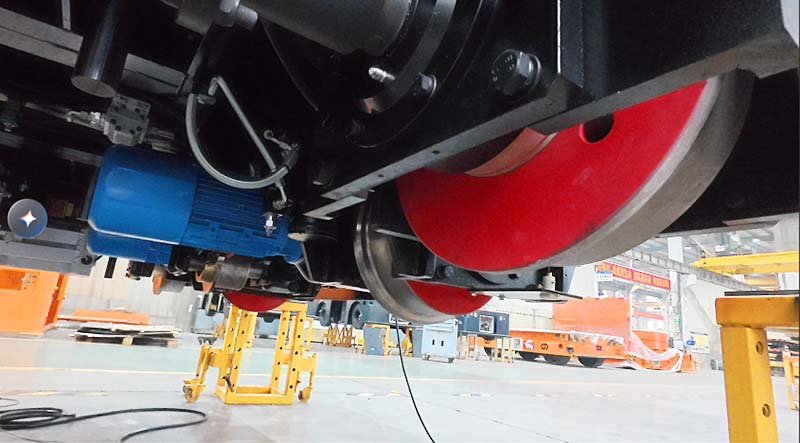
In this configuration, the RGV incorporates two wheel systems oriented for longitudinal and transverse travel. At the designed rail intersection, the vehicle stops at the switching position and changes which wheel set supports and drives the vehicle. It can then continue along the perpendicular rail direction without rotating the entire vehicle.
The control sequence is managed by the vehicle controller, including the relevant position and interlock logic. HENSEN uses an in-house-developed controller for this type of application.
Where it works well
This approach is useful when the layout includes intersecting tracks and the vehicle needs to switch between them. It can be considered for a single RGV or for lines with several vehicles, provided that the traffic and intersection-control strategy are designed accordingly.
Design considerations
The vehicle chassis is more specialized because it houses two directional wheel arrangements. Engineers must verify track elevation and alignment, the switching mechanism, load distribution, clearance at intersections, and how multiple vehicles will be prevented from entering the same crossing at once.
2. Motorized turntable: rotate the track interface
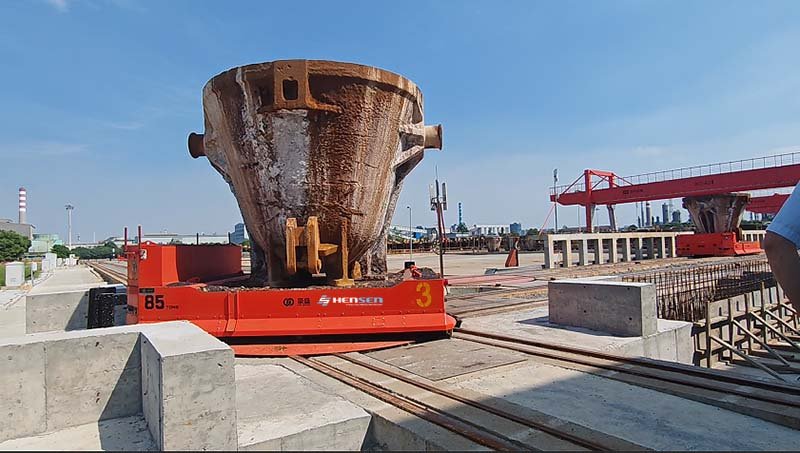
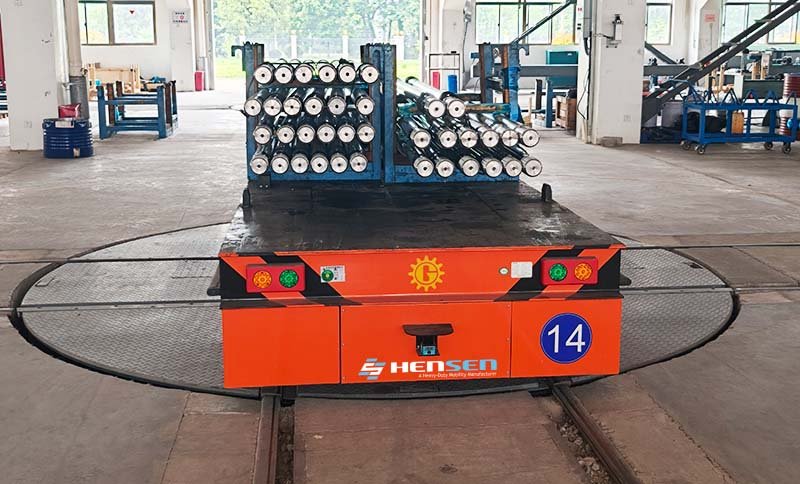
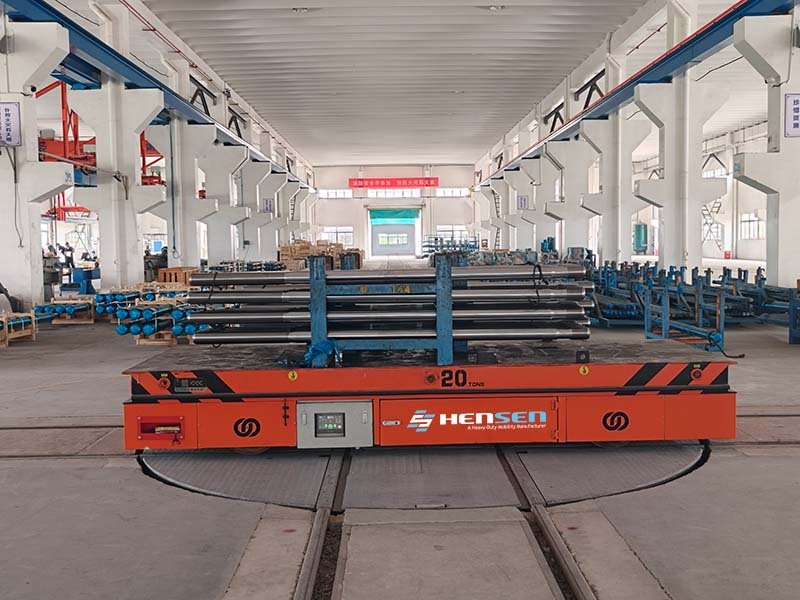
A turntable takes a different approach: the RGV itself can remain a conventional single-direction rail vehicle. A motorized platform is installed at the intersection with a short section of rail mounted on top. The RGV drives onto the platform; the turntable rotates—typically 90° for a perpendicular connection—and aligns its rail section with the exit track.
Once the turntable is correctly positioned and secured, the RGV travels off onto the next rail. A single turntable may serve multiple RGVs, which can be attractive when many vehicles share a common intersection.
Where it works well
A turntable can suit production lines where several rail vehicles use the same crossing point, and the layout provides enough space for the rotating platform. It can also help when a manufacturer prefers to avoid a more complex two-direction wheel arrangement on every vehicle.
Design considerations
A shared turntable may reduce repeated vehicle-side switching hardware, but it also becomes a common traffic resource. Throughput depends on approach time, turntable rotation, alignment, departure, and queueing. The design must account for foundation works, turntable diameter, load and overhang clearance, accurate rail alignment, position verification and safe access for maintenance.
3. Mother–child shuttle RGV: move vehicles between parallel tracks
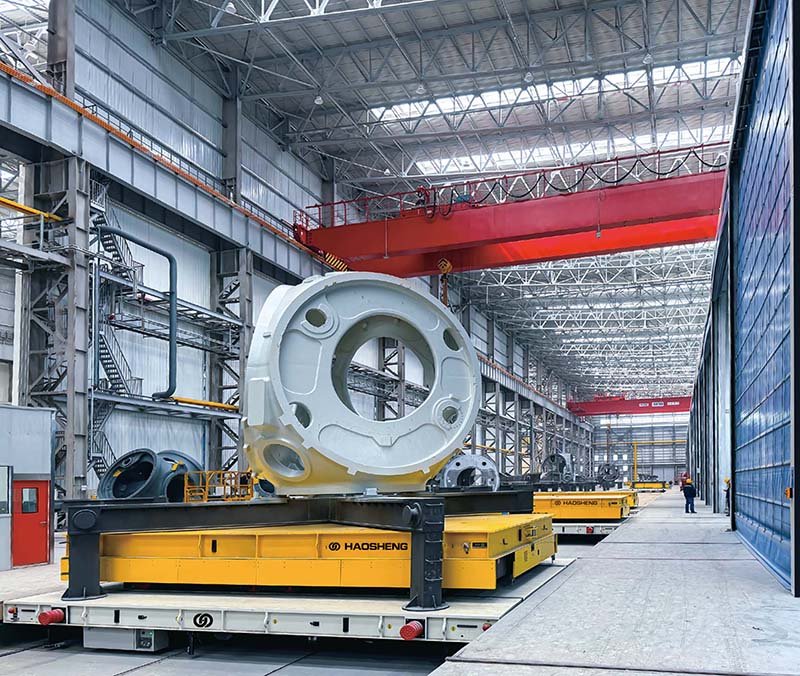
For production areas with several parallel bays, a shuttle arrangement can be more appropriate than a single intersection. In the described mother–child system, a smaller “child” RGV travels out of a process bay and onto a larger transfer or ferry vehicle. The mother vehicle carries it laterally to the selected bay, stops and aligns the rails; the child RGV then travels into that workstation.
This concept is particularly relevant to painting and blasting operations, where multiple enclosed work bays may need to be served without building a continuous network of connecting tracks inside every process area.
Where it works well
Consider a shuttle system when workstations are arranged in parallel, and the process calls for a vehicle to enter a specific bay, set down or collect a load, and move to another bay. It is also useful when separating cross-bay transfer from in-bay movement makes the layout easier to operate.
Design considerations
The transfer sequence requires dependable alignment between the mother vehicle and each bay track, suitable locking and position confirmation, and coordinated control between the two vehicles. The number of bays, child-vehicle availability, process cycle time, and environmental requirements (such as those in coating areas) should all be considered.
Comparing the three RGV rail switching approaches
| Criterion | Dual-direction wheels | Motorized turntable | Mother–child shuttle |
| Basic principle | Switch between two wheel directions on the RGV | Rotate a shared rail platform | Ferry a child RGV between parallel tracks |
| Typical layout | Perpendicular crossing tracks | Common intersection with perpendicular exits | Several parallel process bays |
| Main advantage | Direction change without rotating whole vehicle | One shared turntable may serve several RGVs | Connects separated parallel workstations |
| Primary design focus | Vehicle chassis and intersection control | Turntable capacity, alignment and queueing | Vehicle-to-vehicle transfer and bay alignment |
| Common application | Cross-aisle industrial transfer | Multi-RGV production line intersection | Painting, blasting and multi-bay processing |
How to select the right system for your plant
Begin with the material flow, not the vehicle catalog. An engineering assessment should establish the load weight and dimensions, center of gravity, travel distances, frequency of transfers, number of vehicles, and the locations of each loading and unloading point. Then review track geometry, available turning or transfer space, foundations, process cycle time, safety zones, and required automation interfaces.
For a small number of crossings, a dual-direction wheel system may be straightforward. For a high-use shared intersection, a turntable may be worth evaluating. For multiple parallel process bays, a shuttle arrangement may be the most natural fit. These are engineering starting points—not universal rules. The most economical solution depends on the whole production line and its operating pattern.
Frequently asked questions
Can an RGV travel sideways?
Yes, if it is designed with a suitable transverse/longitudinal wheel switching mechanism and the matching rail layout. A standard single-direction RGV cannot simply move sideways without that equipment and track arrangement.
Does every RGV need its own turntable?
No. A motorized turntable is generally installed at a fixed track intersection and may be shared by multiple vehicles. Its capacity and scheduling must be assessed against the line throughput.
What is the difference between a turntable and a shuttle RGV?
A turntable rotates a vehicle and its short rail segment to connect tracks at different angles. A shuttle system transfers a child vehicle between parallel rail lines or work bays without requiring the child to traverse the entire cross-bay route itself.
Which option is best for painting or shot blasting?
A mother–child shuttle arrangement is one possible choice for multiple parallel booths. The final design depends on booth spacing, process sequence, load handling, safety requirements and any hazardous-area classifications.
Can these systems be integrated into automated production lines?
Yes, these concepts can be designed with vehicle controls, position confirmation, interlocks and production-line dispatching. The integration scope depends on the equipment, plant systems and safety architecture of the project.
Engineering the route around the process
RGV rail switching is not a single product feature. It is a choice about how vehicles, tracks, workstations and control systems work together. With more than 20 years of industry experience and a reported portfolio of over 2,000 project cases (figures to be confirmed before publication), HENSEN develops customized heavy-duty RGV and industrial transfer solutions for different manufacturing environments.
Planning a new automated production line or upgrading an existing rail transfer system? Share your plant layout, payload, workstation arrangement and required cycle time with HENSEN. We can help evaluate the most suitable rail switching concept for your process.
Explore customized AGV and RGV solutions. Contact us now!

Leave a comment