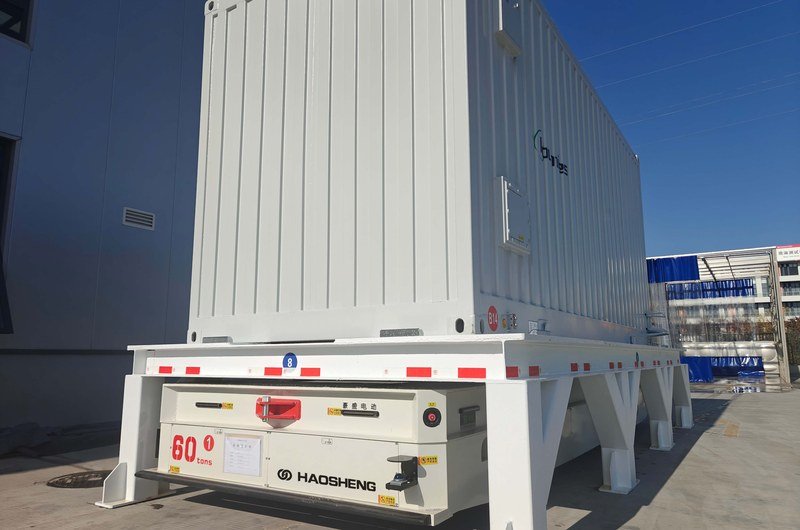
Battery energy storage is one of the fastest-scaling manufacturing sectors in the world, and its factories have a material handling problem that almost no other industry shares: the finished product is a fully built container or cabinet packed with battery modules — enormous, heavy, expensive, and sensitive to shock. It has to move from assembly to integration, into aging and test bays, out to a staging yard, and finally onto a truck.
Most plants start with gantry cranes, forklifts, and hired mobile cranes. Then production ramps, takt times shrink, and the handling method that worked for two containers a week collapses at two a day. This article explains how heavy-duty AGVs solve container and battery cabinet handling in energy storage plants — what they move, how they serve production and test lines, how they bridge indoor and outdoor routes, and what to specify when you evaluate one.
Why Energy Storage Factories Outgrow Cranes and Forklifts
A containerized BESS unit combines the worst properties of every cargo type: it is as large as a shipping container, as fragile as electronics, and as scheduled as a production line. Cranes handle the weight but serialize every move behind one hook, need riggers, and swing suspended loads over people and product. Heavy forklifts need wide aisles, skilled drivers, and lifting pockets, and they concentrate damage risk exactly where batteries live.
| Method | Strength | Weakness in a BESS plant |
| Gantry / mobile crane | Raw lifting capacity | One move at a time, rigging labor, suspended loads over finished product |
| Heavy forklift | Flexible, familiar | Wide aisles, shock and tilt risk to modules, driver-dependent precision |
| Heavy-duty AGV | Repeatable, automated, gentle | Requires route planning and decent floors — the subject of this article |
An AGV carries the load on its deck rather than under a hook, accelerates and brakes softly under stepless 0–20 m/min speed control, and repeats the same path with laser-guided accuracy of about ±10–15 mm — a difference battery warranties quietly appreciate.
What Heavy AGVs Move in a BESS Plant
Containerized storage systems
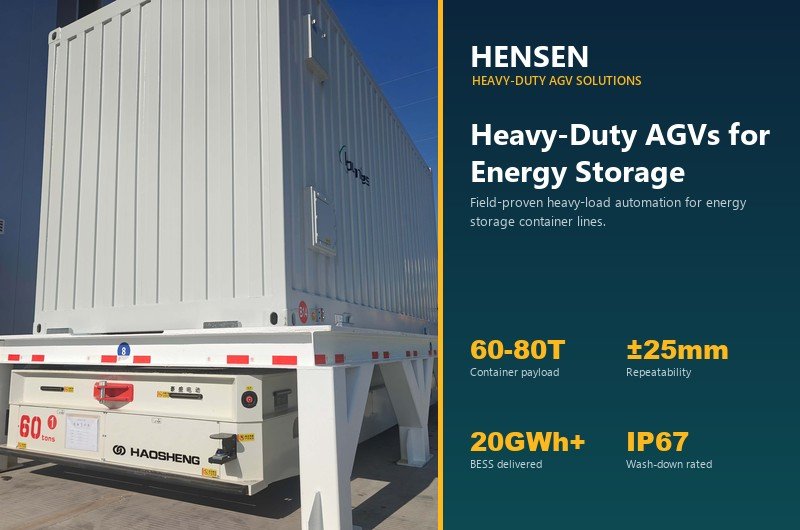
The headline load: 20-foot-class containers fitted out with racks, modules, cooling and power electronics. HENSEN builds AGVs from 1 to 800 tons, so a finished container — including its transport frame — sits comfortably within range. The deck is sized to the container base with locating features that engage corner castings or a dedicated skid, so the unit cannot slide in transit.
Battery cabinets and racks
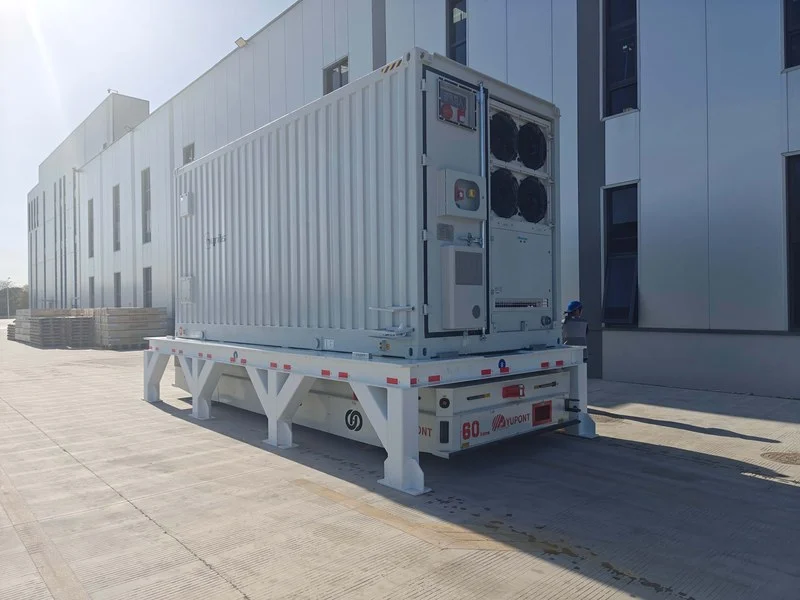
Outdoor cabinet products and pre-assembled racks are smaller but move far more often: from assembly cells to testing, from testing to packing, in batches all day. A lower-tonnage omnidirectional AGV shuttling cabinets on standardized fixtures typically becomes the workhorse of the plant, feeding several lines at once.
Pallets, packs and subassemblies
Upstream of integration, module pallets and power electronics ride the same logic at lighter weights. Many plants standardize on one AGV control system across sizes so scheduling, traffic management and maintenance stay uniform.
AGVs on the Production and Test Line
Station-to-station flow
A hydraulic lifting deck with a 150–400 mm stroke lets the AGV drive under a container or cabinet stand, lift the load off its supports and carry it to the next station. Multi-cylinder synchronization holds the deck level within ±3 mm during lifting — which matters when the load is an electronics-filled cabinet rather than a steel billet.
Feeding aging and test bays
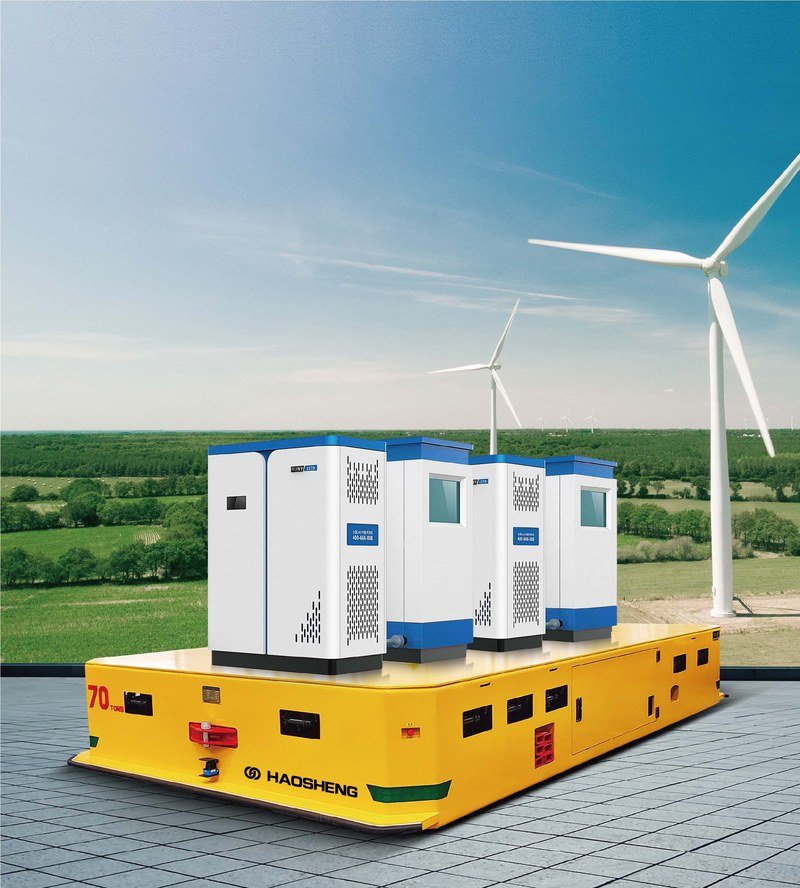
Test and aging areas are the densest real estate in a BESS factory: rows of bays, each with power connections, occupied for hours or days. Omnidirectional steering-wheel drive lets the AGV crab sideways, travel diagonally, and rotate on the spot, slotting a container into a bay with millimeter-level repeatability and no shunting maneuvers. Bays can therefore be packed tighter than any forklift layout would allow.
Scheduling and MES/WMS integration
The AGV fleet connects to the plant MES or WMS over industrial WiFi or 5G using TCP or MQTT, so test-bay assignments, mission queues, and traffic control run from production data instead of radio calls. LiFePO4 batteries with automatic opportunity charging keep vehicles available 24/7 — the AGV tops up during natural idle windows instead of disappearing for a shift.
The Indoor-Outdoor Problem
The defining route in an energy storage plant crosses a wall: finished units leave the assembly hall for outdoor test pads, staging yards and truck loading areas. Most AGVs are indoor machines; a BESS plant needs one that treats the doorway as just another waypoint.
Navigation that works on both sides of the door
3D SLAM laser navigation
Reflector-free 3D SLAM builds its map from the environment itself, achieves roughly ±10–15 mm accuracy, and — critically — handles the indoor-outdoor transition, where sunlight and open space defeat simpler 2D systems.
RTK satellite guidance
In open yards with long sightlines and few features, RTK satellite positioning takes over, giving centimeter-class guidance across large outdoor areas without any infrastructure on the ground.
Hybrid switching
Well-engineered systems blend the two, handing over between SLAM and RTK in defined transition zones so a single mission can run from an indoor station to a yard slot without stopping.
Weather protection and sealing
Outdoor duty means rain, dust, and washdown near the coast or in the desert. Specify sealed electrical cabinets, protected connectors, and covered sensor housings rated for the site’s exposure, plus drainage-aware routing so the AGV never wades.
Ground, ramps, and yard surface
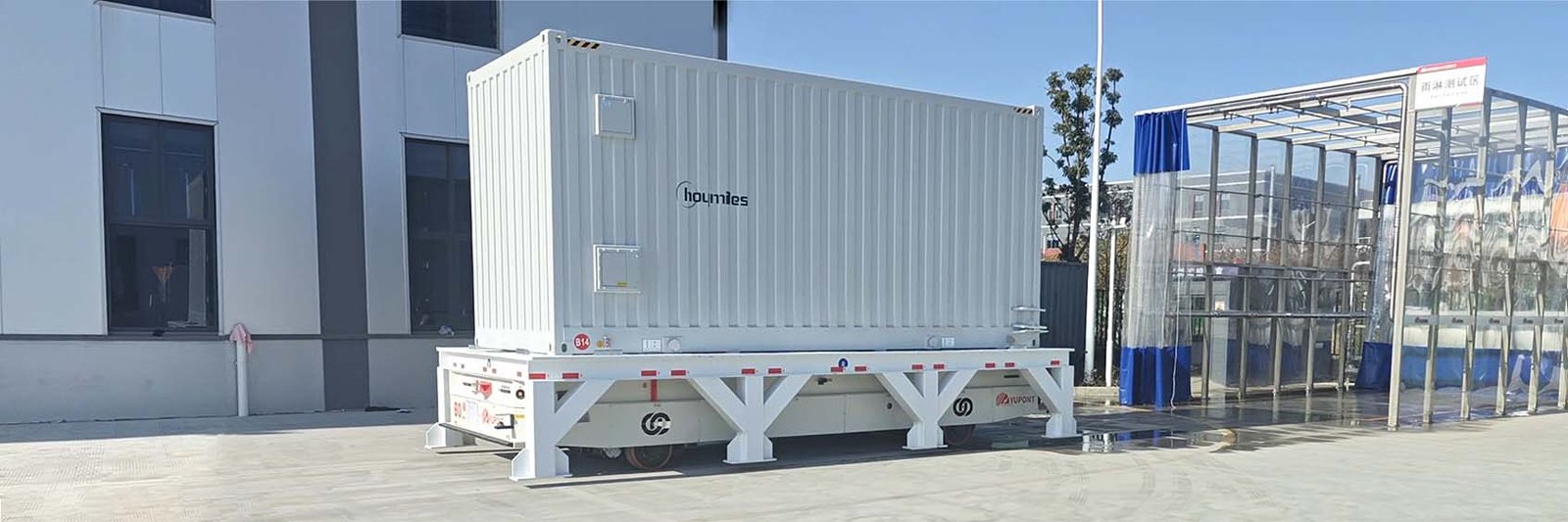
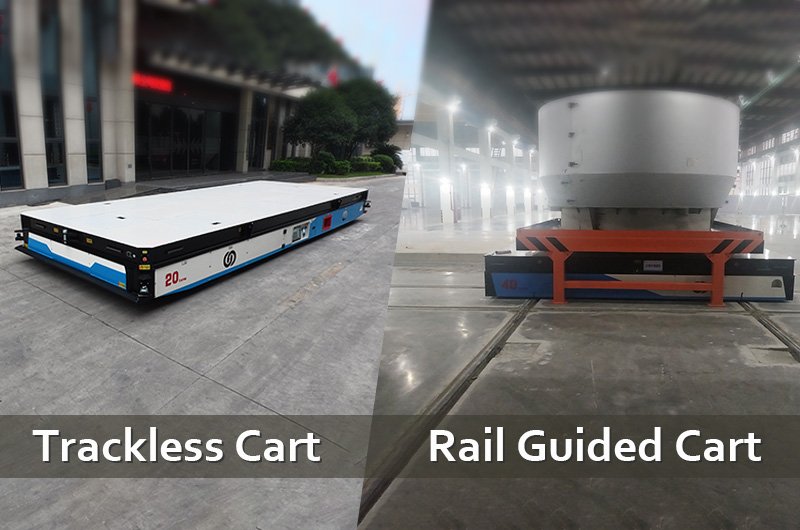
Heavy AGVs run on polyurethane wheels, and wheel pressure on the floor is the governing design constraint at high tonnage. The concrete path from hall to yard — including thresholds, expansion joints and any ramp — must be specified together with the vehicle, because a perfect AGV on a poor slab is still a poor system. Where the route is fixed and permanent, it is also worth checking whether a rail-guided cart is the cheaper answer; see our complete RGV guide for that comparison.
Key Specifications to Nail Down
- Payload including tooling: container or cabinet weight plus the transport frame or skid the AGV actually lifts.
- Deck dimensions and interface: corner castings, skid pockets or custom fixtures — and who designs them.
- Lift stroke and synchronization: 150–400 mm hydraulic stroke with ±1 mm multi-cylinder leveling for sensitive loads.
- Navigation mix: 3D SLAM indoors, RTK outdoors, and the handover zones between them.
- Route survey: floor flatness, joint details, ramp grades, door widths, and outdoor surface quality.
- Charging strategy: LiFePO4 with opportunity charging positioned where idle time naturally occurs.
- Integration: MES/WMS interface over TCP or MQTT, traffic management, and test-bay assignment logic.
- Safety package: 270° laser scanners front and rear, four-corner emergency stops, sound-and-light alarms, electromagnetic braking.
From First Layout to a Running System
A typical project starts with load data and a plant drawing, moves through route simulation and a signed technical agreement, and reaches factory acceptance with a load test at 1.1× rated capacity before shipment. Delivery runs about 3–4 months from technical agreement to factory acceptance. Once running, a heavy AGV is a long-term asset: a 10–15-year (or longer) service life, and in multi-shift BESS production the payback period against crane hire and forklift crews typically lands around 2–4 years.
HENSEN (Hangzhou Haosheng Electric Vehicle Co., Ltd.) designs and builds heavy-duty AGVs for energy storage container and battery cabinet handling — part of an AGV range from 1 to 800 tons and transfer carts from 1 to 500 tons — with in-house control and scheduling software, CE marking and ISO 9001-certified manufacturing, delivered across wind power, metallurgy, sheet metal and construction machinery plants worldwide, including dedicated energy storage AGV projects. Send us your container and cabinet data, plant layout, and takt time, and our engineers will propose a vehicle and navigation configuration with budget pricing.
FAQ About Energy Storage AGVs
Q: How heavy are the loads AGVs handle in an energy storage plant?
A: Typical duties range from battery cabinets and module pallets up to fully fitted containerized systems on transport frames. HENSEN AGVs cover 1 to 800 tons, so even the heaviest integrated container with its tooling sits well within range.
Q: Can one AGV work both inside the hall and out in the yard?
A: Yes — that is the core requirement in BESS plants. Reflector-free 3D SLAM handles indoor areas and the doorway transition at about ±10–15 mm accuracy, RTK satellite guidance takes over in open yards, and the vehicle is sealed for outdoor exposure.
Q: How does the AGV pick up a container without a crane?
A: It drives under the container stand or skid, then raises a hydraulic lifting deck with a 150–400 mm stroke. Multi-cylinder synchronization keeps the deck level within ±1 mm, so the unit is lifted evenly and never swings — there is no hook and no rigging.
Q: How do AGVs keep running in 24/7 production?
A: LiFePO4 batteries with automatic opportunity charging: the vehicle tops up during natural idle moments at charging points along its route, so no shift is lost to a charging bay.
Q: What safety systems protect people around a moving container?
A: 270° laser scanners at both ends project slow-down and stop fields, four-corner emergency stops and sound-and-light alarms cover the vehicle, and electromagnetic brakes engage at every stop and on any power loss.
Conclusion
Energy storage manufacturing scaled faster than its material handling, and the gap shows wherever a finished container waits for a crane. Heavy-duty AGVs close that gap: deck-carried loads instead of suspended ones, ±10–15 mm laser-guided repeatability through production and test, and a single vehicle that treats the assembly hall, the doorway and the yard as one route. Specify the payload with its tooling, survey the floor as seriously as the vehicle, and make container handling stops the constraint on your ramp-up. Click Contact Us to get the solution for your project.

Leave a comment