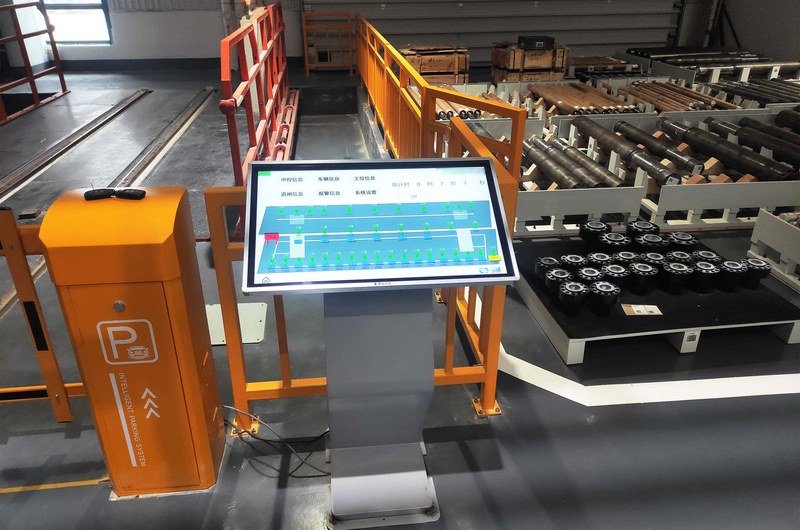
Most material flow questions get framed as a choice: AGV or RGV, trackless or rail. But walk through a real heavy-industry plant and the honest answer is often both. The main production line runs the same heavy route ten thousand times a year — a job rails were born for. Around it sit warehouses, outdoor yards, subcontract bays and layouts that change every season — territory where a free-navigating AGV wins without argument.
A hybrid AGV + RGV system stops forcing that choice. It puts rail guided vehicles on the fixed, high-repeat, high-tonnage spine of the flow and AGVs on the flexible edges, then joins the two with engineered handover points and a single scheduling system. This article is not another AGV-versus-RGV comparison — we cover that decision in our complete RGV guide. It is about the combination: when a hybrid makes sense, how the two fleets physically hand loads to each other, and what it takes to run them as one system instead of two.
Why Combine AGVs and RGVs at All?
Because the economics of each vehicle are route-shaped. On a fixed route with heavy loads and relentless repetition, a rail cart is cheaper to buy, simpler to maintain, and positions with about ±5 mm repeatability — as covered in our complete RGV guide, that is why production lines keep choosing rails. But every rail meter is civil work, and rails cannot follow a layout that changes. An AGV needs no floor construction, re-routes in software, and covers many low-frequency destinations with one vehicle — at a higher price per ton of payload and with navigation, not rails, defining its precision.
A hybrid takes each technology only where it is strongest. The result is usually fewer total vehicles, less rail, and a flow that survives layout changes — because the parts most likely to change were given to the trackless fleet from the start.
The Division of Labor in a Hybrid System
RGVs hold the spine
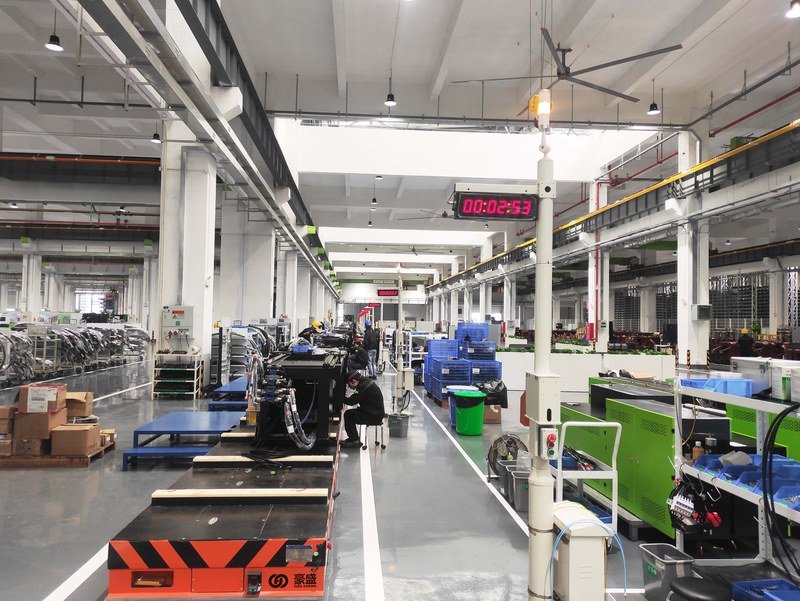
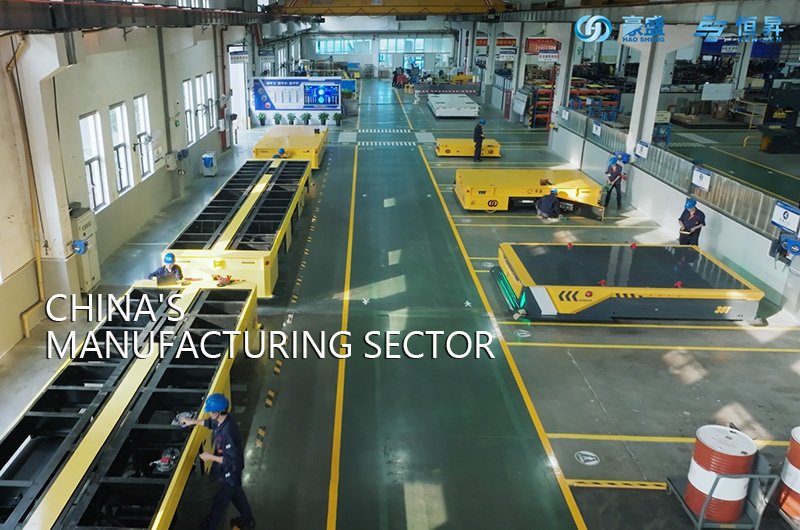
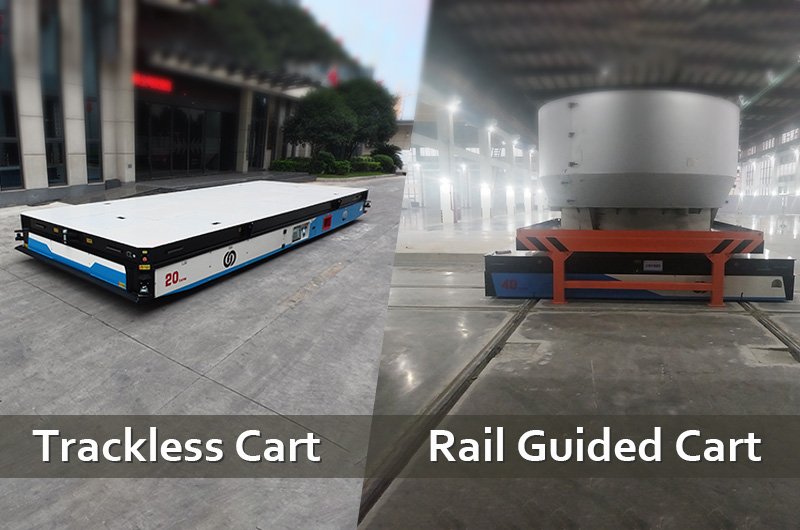
Production-line RGV covering the fixed high-repeat route
The spine is the segment with the heaviest loads, the highest cycle counts and the least layout uncertainty: line-to-line transfer in a machining or assembly shop, furnace feeding in metallurgy, press-to-press moves in heavy fabrication. Here rail carts from 1 to 500 tons run 0–20 m/min in automatic mode with soft start and stop, day after day, with wheels on steel rail carrying loads no factory floor could take on tires.
AGVs work the edges
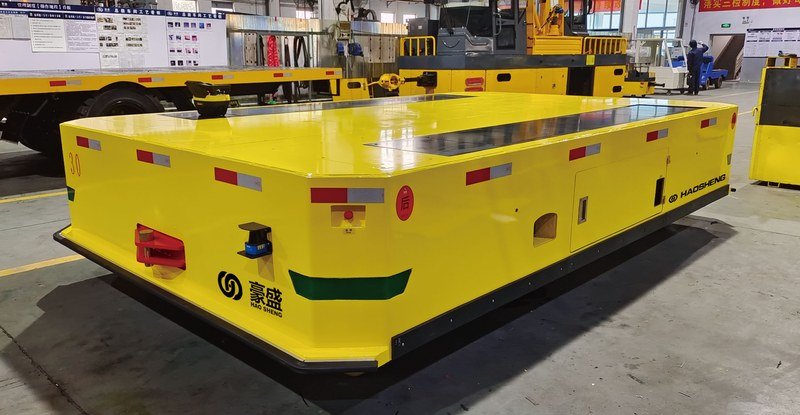
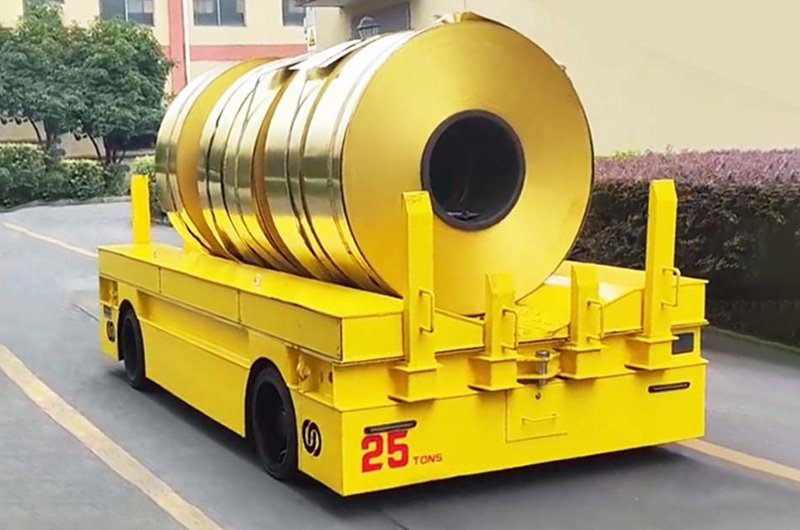
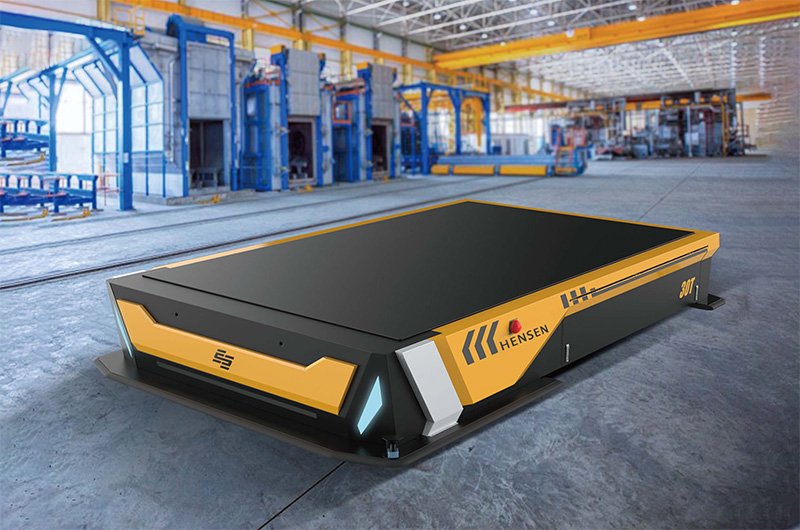
30-ton lifting AGV handling loads outside the rail network
Everything around the spine — warehouse to line-side, dock to buffer, building to building, indoor to yard — goes to AGVs. Heavy-duty models reach 800 tons, navigate by 3D SLAM laser without reflectors or by RTK satellite outdoors, and their omnidirectional steer-wheel drives let them crab sideways and turn on the spot in aisles no rail layout could reach. A delivered example: a 30-ton lifting AGV collecting loads from stations scattered outside the rail network and bringing them to the rail head.
Four Hybrid Patterns That Work
1. Rail spine with AGV feeders
An RGV shuttles along the production line; AGVs ferry material between warehouse, buffer areas and the line-side handover stations. The most common pattern in machining, PC component and energy-storage container plants.
2. Ferry cart bridging rail zones
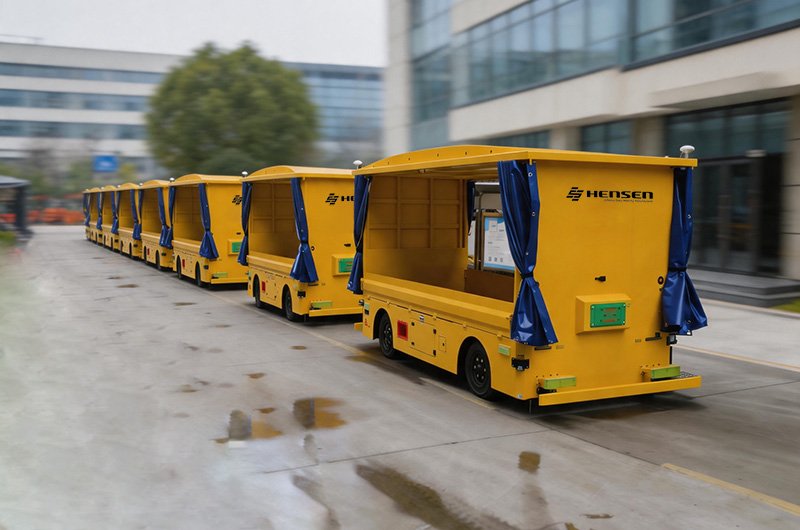
A ferry RGV — a cart wide enough to carry another vehicle — links parallel rail lines across a bay, and AGVs use it too: the AGV drives onto the ferry deck, rides across, and drives off into the far zone. One delivered system pairs a drag-cable ferry cart in the 20-ton class with the vehicles it carries.
3. Indoor rails, outdoor AGVs
Rails stay in the climate-controlled halls where precision matters; RTK-navigated AGVs handle the yard, crossing thresholds and rough aprons that rails handle badly. Handover happens at stations just inside the doors.
4. Hybrid by phase
Some plants start with an RGV line and add AGVs as the site grows — or run AGVs first and lay rails once a route proves permanent and heavy. Designing the handover stations and scheduling interfaces on day one keeps that evolution cheap.
The Handover Point: Where Hybrids Succeed or Fail
Two fleets meeting means a load physically changing vehicles, and this interface deserves the same engineering respect as any machine-to-machine transfer. Three handover designs dominate.
Static transfer stations
The simplest: a fixed stand or set of support stands. The RGV (often a lifting cart) places the load on the stand and departs; the AGV arrives, drives under or alongside, lifts, and leaves. The stand decouples the fleets in time — neither vehicle waits for the other — which is why it is the default choice.
Direct deck-to-deck transfer
Roller or chain conveyor decks on both vehicles push the load straight across while both hold position. It is faster and needs no floor hardware, but it demands verified alignment: the RGV contributes its ±5 mm stopping accuracy from RFID station identification plus laser ranging, the AGV must dock to a compatible tolerance, and interlocks release the conveyors only when both vehicles confirm position and brakes.
Ferry decks
When the vehicle itself must cross zones, the ferry cart described above carries it — rails on the ferry deck align with rails on the ground for an RGV passenger, or a plain deck with guides receives an AGV. Alignment interlocks mirror those of mother-child systems.
One Brain: Unified Scheduling and Traffic Control
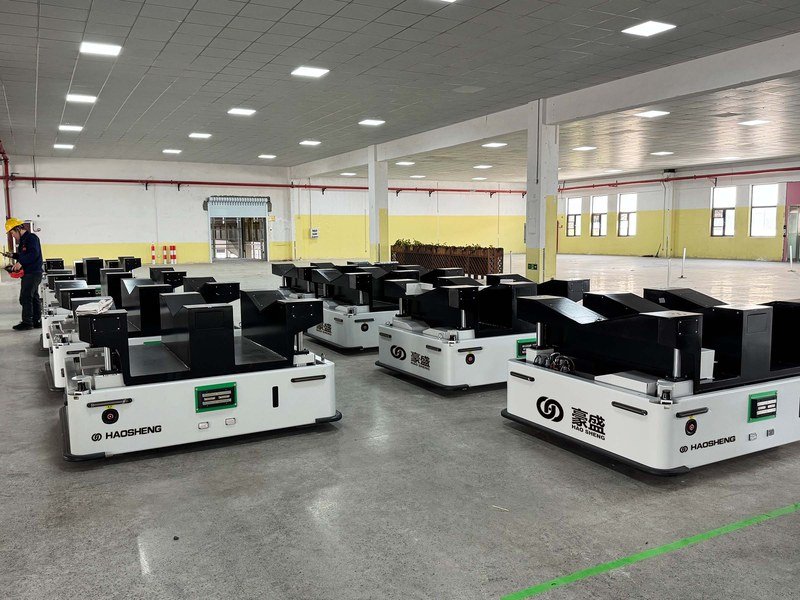
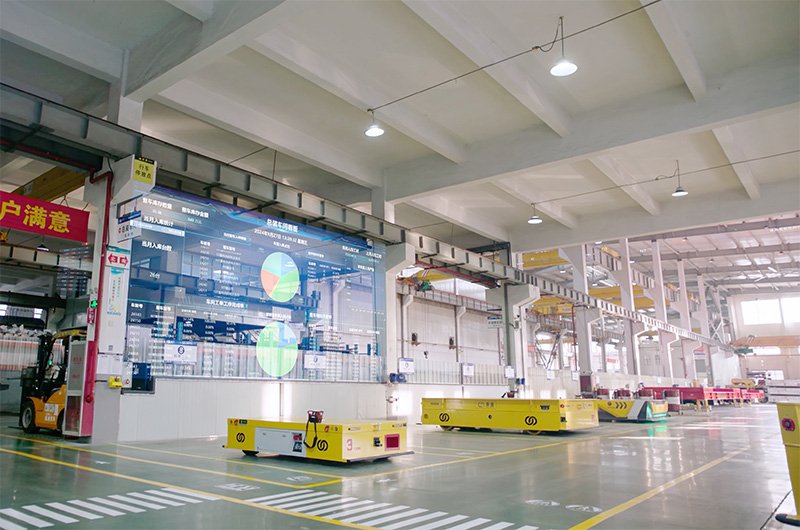
Smart factory production line supported by custom AGVs
A hybrid with two separate control systems is two systems with a gap in the middle — and the gap is where loads wait and faults hide. The goal is one scheduling layer that sees every vehicle, every station and every task.
Practically, that layer talks to the plant MES or WMS over TCP or MQTT, receives transport orders, and decomposes each into legs: AGV leg, handover, RGV leg. It allocates tasks by availability and battery state, tracks each load across the vehicle change, and reports one status back to the host — not two half-journeys. Vehicles connect over industrial WiFi or 5G; each carries its own PLC and 7-inch touchscreen with automatic, semi-automatic and manual modes, so a fault on one leg degrades gracefully instead of stalling the plant.
Traffic rules at the seam
Where AGV paths cross rail lines, the scheduler enforces zone locks: an AGV may not enter a rail crossing while a cart holds the block, and vice versa. Both vehicle types carry their own 270-degree laser obstacle scanners, four-corner emergency stops and audible-visual alarms, but fleet-level interlocks — not onboard sensors — are what prevent deadlocks and near-misses at the interface.
One procurement note: a hybrid works best when one supplier owns both fleets and the scheduling software, because split responsibility at the handover point is the classic failure mode. Our RGV manufacturer checklist covers how to test for genuine software ownership.
When a Hybrid Is the Right Answer — and When It Is Not
| Situation | Better choice |
| One fixed heavy route, stable layout | RGV fleet only |
| Many changing routes, moderate loads, no dominant spine | AGV fleet only |
| Heavy fixed spine plus flexible or growing edges | Hybrid |
| Indoor precision line plus outdoor yard transport | Hybrid |
| Very heavy loads on the flexible legs too | Heavy-duty AGVs throughout, rails where floors cannot cope |
The test is whether your flow really has two different route personalities. If everything is fixed, rails alone are cheaper. If nothing is fixed, skip the rails. A hybrid pays when the spine and the edges genuinely differ — which, in heavy manufacturing, they usually do.
Specifying a Hybrid System
- Map the flow first: mark every route with its payload, cycles per day and likelihood of change. The map decides which legs are rail and which are trackless.
- Define each handover: load type, transfer method (stand, deck-to-deck, ferry), takt time and alignment tolerances.
- Specify one scheduling scope: MES/WMS interface, task decomposition across fleets, zone locks at crossings, and single-point status reporting.
- Match power strategies: LiFePO4 batteries with automatic or opportunity charging support 24/7 duty on both fleets; rail-side AC36V or drag-cable supply remains an option on the RGV spine.
- Plan the factory acceptance test to include the handover: both vehicles, real load, 1.1x rated load test on each cart, and a full task executed end to end.
- Leave growth hooks: spare scheduler capacity and pre-agreed station designs make adding vehicles a purchase, not a project.
HENSEN (Hangzhou Haosheng Electric Vehicle Co., Ltd.) designs and builds complete AGV + RGV hybrid systems — rail carts from 1 to 500 tons, heavy-duty AGVs up to 800 tons, ferry and transfer stations — with in-house control and scheduling software that runs both fleets as one, CE marking and ISO 9001 certified manufacturing, delivered across wind power, metallurgy, sheet metal and construction machinery plants worldwide. Send us your flow map and load data, and our engineers will propose a hybrid layout with handover designs and budget pricing.
FAQ About AGV + RGV Hybrid Systems
Q: When does a hybrid beat a single-fleet solution?
A: When your material flow has a fixed, heavy, high-repeat spine and flexible or changing edges. Rails serve the spine at lower cost per move; AGVs serve the edges without civil work. If the whole flow is fixed — or nothing is — a single fleet is simpler and cheaper.
Q: How does a load physically pass from an AGV to an RGV?
A: Usually via a static transfer stand: one vehicle places the load, the other collects it, and neither waits for the other. Faster systems transfer deck-to-deck with conveyors under verified alignment, and ferry carts can carry a whole vehicle between zones.
Q: Can one scheduling system really control both fleets?
A: Yes — and it should. A unified scheduler receives orders from MES or WMS over TCP or MQTT, splits each task into AGV and RGV legs, manages the handover, and enforces zone locks where paths cross. Two separate systems create a responsibility gap exactly where the load changes hands.
Q: Do AGVs and RGVs in a hybrid use the same safety equipment?
A: Largely yes: 270-degree laser obstacle scanners, four-corner emergency stops, audible-visual alarms and electromagnetic braking on both. The hybrid adds fleet-level interlocks at crossings and handover stations, which onboard sensors alone cannot provide.
Q: Can I start with one fleet and add the other later?
A: Yes, and many plants do — rails first with AGVs added as the site spreads, or AGVs first with rails laid once a route proves permanent. Design the handover stations and scheduling interfaces at the start so the second fleet plugs in instead of forcing a retrofit.
Conclusion
AGV versus RGV is the wrong question for a plant whose flow has both a spine and edges. Put rails under the heavy, repetitive core; give the changing periphery to free-navigating AGVs; engineer the handover points with the same rigor as any docking interface; and run everything under one scheduler that owns the whole journey. Built that way, a hybrid system delivers rail economics where routes are fixed and trackless freedom where they are not — without asking you to pretend your factory is only one kind of place.

Leave a comment