How to Choose the Right Solid Tires for AGVs: Rubber, Press-On, or Polyurethane?

June 16, 2025

In the world of industrial vehicles and automated guided vehicles (AGVs), tire selection is a critical factor that directly impacts performance, durability, safety, and overall operating costs. Among the most common non-pneumatic tire types are:

  • Solid Rubber Tires
  • Press-On Solid Tires
  • Polyurethane Solid Tires

Each of these tire types offers unique benefits and limitations depending on the application scenario. This article provides a detailed comparison and selection guide to help you make the best decision for your AGV or material handling equipment.


1. Solid Rubber Tires – Heavy-Duty Basic Option
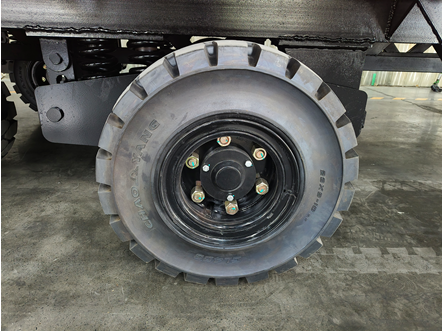
Solid rubber tires are made entirely of vulcanized rubber and mounted directly onto the wheel rim without an inner tube. They are known for their ruggedness and ability to operate in tough environments.

Advantages:

  • Maintenance-Free: No risk of punctures or air pressure loss. Ideal for construction sites, mines, and debris-prone areas.
  • High Load Capacity: Can support static loads of over 11 tons (e.g., 14.00–24 tire size).
  • Wide Temperature Range: Operates reliably from -40°C to +100°C; resistant to oil and chemical corrosion.

Limitations:

  • Poor ride comfort due to low elasticity
  • High rolling resistance and energy consumption
  • Not suitable for speeds above 25 km/h due to heat buildup

Best For: Bulldozers, mining vehicles, fixed-position heavy equipment


2. Press-On Solid Tires – High Precision for Industrial Vehicles
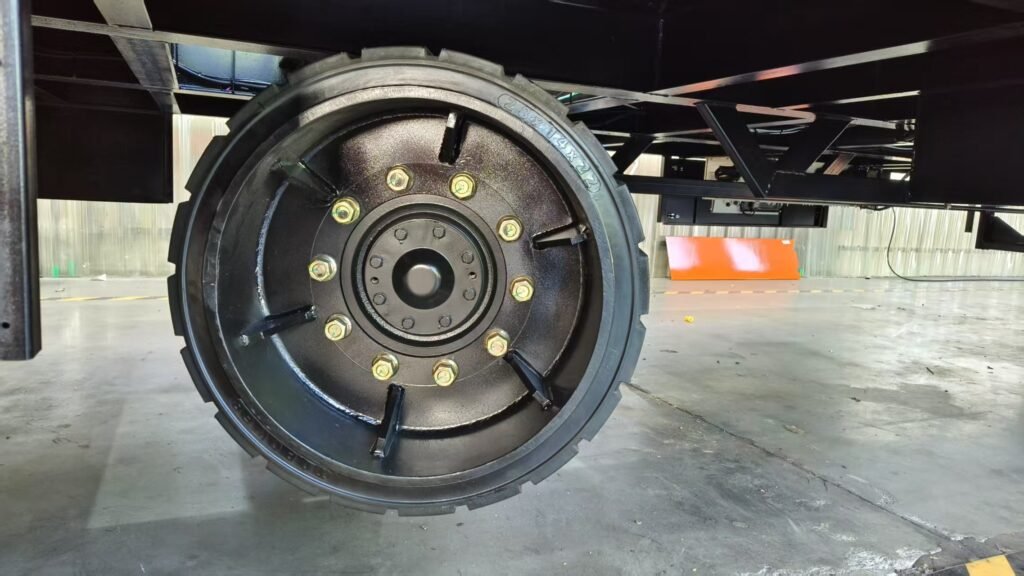
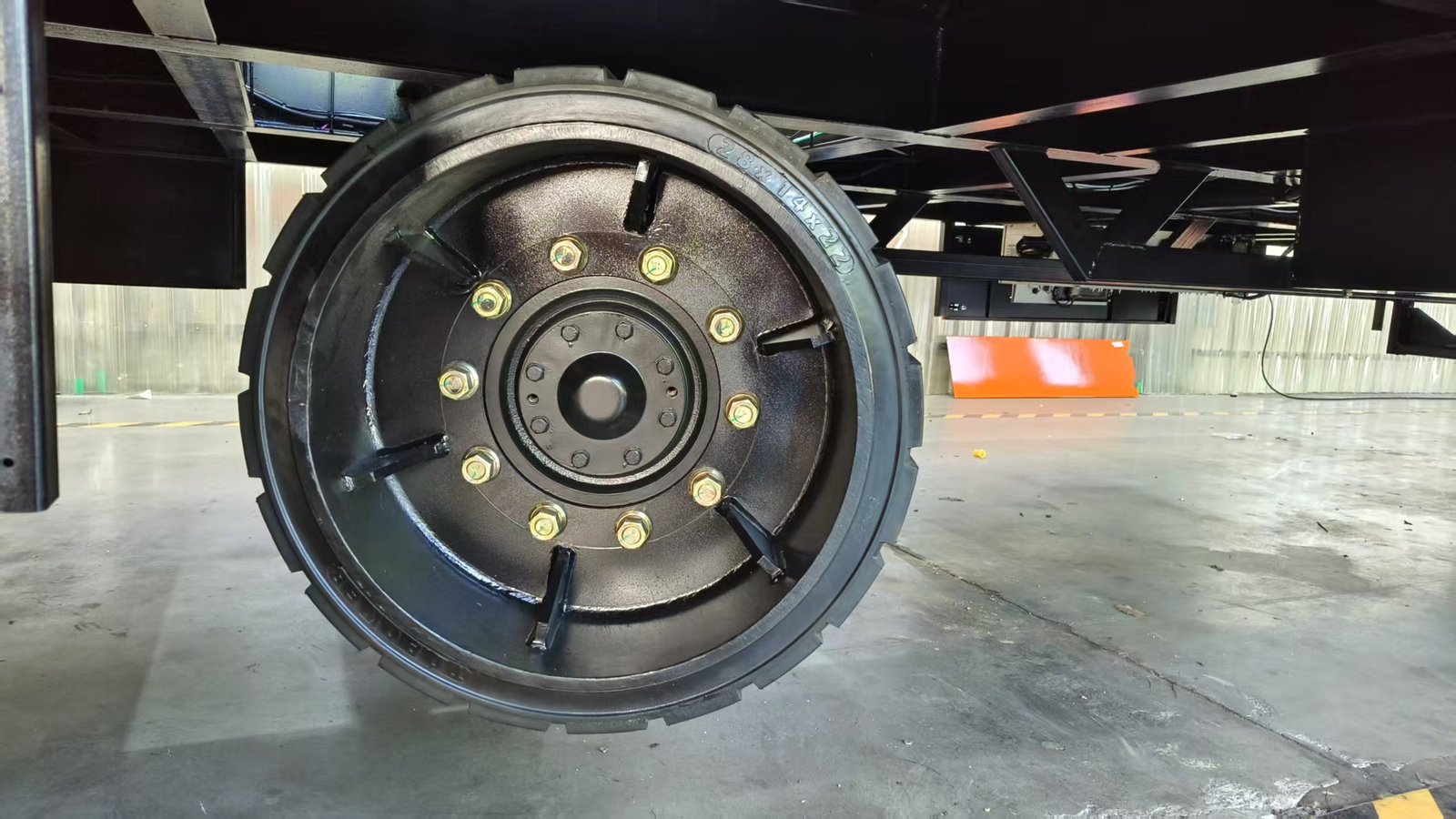
Press-on tires feature a layered construction with a rubber tread bonded to a steel base ring. They are mounted using an interference fit (±0.64 mm), making them ideal for indoor or precision applications.

Advantages:

  • Secure Fit: Eliminates risk of tire slippage, especially under frequent steering or load changes
  • Application-Specific Options: Anti-static, non-marking, oil-resistant, cold-resistant, etc.
  • Heat Dissipation: High-end models include heat-reducing vent designs for continuous use

Limitations:

  • Higher manufacturing cost due to precise steel ring machining
  • Complex to replace; requires special tools and skilled labor

Best For: Electric forklifts, port tow tractors, in-plant transport AGVs


3. Polyurethane Solid Tires – Lightweight, High Performance
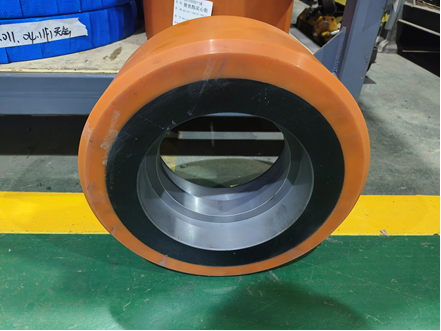
Advantages:

Made from synthetic polyether or polyester-based elastomers, polyurethane tires combine excellent wear resistance with chemical and thermal stability, making them suitable for high-end logistics and clean environments.

  • Lightweight & Durable: Up to 15% lighter than rubber, 3x longer lifespan
  • Superior Dynamic Performance: Generates less heat at high speeds
  • Environmental Adaptability: Excellent resistance to hydrolysis, UV exposure, and harsh chemicals

Limitations:

  • Higher cost (1.5–2x rubber tires) due to material and production complexity
  • Slightly lower grip on wet surfaces unless tread is optimized

Best For: Cold storage vehicles, airport baggage AGVs, cleanroom logistics


Quick Comparison Chart

FeatureSolid RubberPress-On TirePolyurethane
Load CapacityVery High (>10T)High (for forklifts)Medium-High
Rolling ResistanceHighMedium-HighLow (energy-saving)
Wear Life1–3 years3–5 years5–8 years
CostLowMediumHigh
Speed Rating≤25 km/h≤25 km/h≤40 km/h
Best UseMining, DozersForklifts, TrailersCleanrooms, Cold Chain

Selection Tips

  • For heavy loads + low cost, choose solid rubber
  • For precision industrial use, go with press-on tires
  • For high-frequency or long-life operations, polyurethane is the best fit

Conclusion: Match Tires to Your Operating Conditions

Each tire type has its place in industrial logistics. Whether you’re managing a fleet of AGVs in a clean factory or supporting rugged outdoor operations, the key is to match tire features to your working conditions — not just aim for the most advanced material.

As material science continues to evolve, innovations such as nanocomposite polyurethane and lightweight steel rings will further expand the capabilities of solid tires in smart logistics.


🔍 Looking for a customized AGV solution with the right tire setup?

At HENSEN, we don’t just manufacture AGVs — we engineer complete transport solutions, including load-specific tire configurations tailored to your application.

📩 Contact us today to discuss your project needs.
You May Also Like

Heavy-Duty AGVs in Energy Storage: Field Lessons from Moving 60–80 t BESS Containers

Heavy-Duty AGVs in Energy Storage: Field Lessons from Moving 60–80 t BESS Containers

June 15, 2026

Energy storage is scaling faster than almost any factory floor was designed for. Walk into a modern battery energy storage system (BESS) plant and the front of the line—module assembly, cell stacking, inspection—is already highly automated. Then you reach the back end, where a finished 20-foot container weighs about 60 tonnes and a 40-foot unit can

Why Diverse Industrial Sectors Turn to a Custom Omnidirectional Heavy Load AGV Supplier in China

Why Diverse Industrial Sectors Turn to a Custom Omnidirectional Heavy Load AGV Supplier in China

June 8, 2026

Modern industrial facilities face a growing contradiction between increasing product scales and restricted floor space. As manufacturers in sectors like wind power, energy storage, and prefabricated construction push the boundaries of tonnage, the demand for agility has never been higher. Traditional transport methods often fail to navigate the narrow aisles and complex intersections of legacy

Top 4 Factors to Evaluate When Selecting a Custom Trackless Transfer Cart Factory for Steel & Metallurgy

Top 4 Factors to Evaluate When Selecting a Custom Trackless Transfer Cart Factory for Steel & Metallurgy

June 4, 2026

The modern steel production environment demands an uncompromising level of operational reliability and mechanical endurance. High temperatures, abrasive metallic dust, and the movement of massive payloads create a logistical landscape where standard transport equipment often fails. Consequently, metallurgy facilities must transition toward specialized automation to maintain safety and efficiency standards. Selecting a partner that understands

The Complete Buyer's Guide to Partnering with a Custom Heavy-Duty AGV Manufacturer for Heavy Industry Facilities

The Complete Buyer's Guide to Partnering with a Custom Heavy-Duty AGV Manufacturer for Heavy Industry Facilities

June 1, 2026

The transition toward high-capacity automation represents a monumental shift for heavy industry facilities across the globe. Unlike standard warehouse logistics, moving components that weigh hundreds of tons requires a level of engineering precision that few organizations can provide. Consequently, procurement teams often find themselves at a crossroads when selecting a technology partner for these high-stakes

Join HENSEN at the LET-a CeMAT Guangzhou Logistics Exhibition (June 3-5)

Join HENSEN at the LET-a CeMAT Guangzhou Logistics Exhibition (June 3-5)

May 29, 2026

Low Profile, Heavy Load, Steadily Driving the Future — HENSEN Ultra-Low Profile AGV Makes Its Debut! Are you still struggling with heavy-duty material handling in low-clearance spaces? With 20 years of expertise in intralogistics, HENSEN is about to unleash its latest masterpiece! Lower. Stronger. Smarter! With an overall height of just 245mm, this AGV can

Scaling Global Demand: China Leading Heavy Load AGV Factory Serving Metallurgy, Prefab Building & In-Plant Logistics

Scaling Global Demand: China Leading Heavy Load AGV Factory Serving Metallurgy, Prefab Building & In-Plant Logistics

May 28, 2026

The global industrial landscape currently faces a pivotal turning point as traditional manufacturing hubs transition toward intelligent automation. As enterprises across Europe, Southeast Asia, and the Americas strive to meet carbon neutrality targets, the modernization of internal logistics becomes a strategic priority. This shift is particularly evident in heavy industries such as metallurgy and construction,

How to Choose Between Trackless vs Rail Guided Cart for Your Needs?

How to Choose Between Trackless vs Rail Guided Cart for Your Needs?

May 26, 2026

When you’re trying to figure out the best way to move materials around, choosing between Trackless carts and Rail-Guided carts is a pretty important decision. Industry pro John Smith from Logistics Innovations puts it simply: “Getting a handle on what your operation really needs is the key to making the right call.” That advice hits

How an Advanced High-Speed Heavy-duty Outdoor AGV Supplier in China Handles Challenge in Large Industrial Park Logistics

How an Advanced High-Speed Heavy-duty Outdoor AGV Supplier in China Handles Challenge in Large Industrial Park Logistics

May 21, 2026

Large-scale industrial parks present a formidable environment for traditional material handling systems. The requirement to move heavy payloads across kilometer-long routes demands a unique blend of speed, stability, and environmental resilience. Standard indoor automated vehicles often struggle with the uneven surfaces and signal interference typical of outdoor zones. Consequently, facility managers require specialized technology to

HENSEN AGV: China Leading Heavy-Duty Automated Guided Vehicle Manufacturer Redefining Industrial Logistics

HENSEN AGV: China Leading Heavy-Duty Automated Guided Vehicle Manufacturer Redefining Industrial Logistics

May 19, 2026

The global industrial landscape currently undergoes a significant transformation as automation moves from light-assembly lines to the challenging environments of heavy industry. During the recent HUB EXPO 2025 in Turkey, international industry leaders observed a shift toward high-capacity autonomous systems designed for extreme conditions. Within this rapidly evolving sector, HENSEN AGV has established itself as

HENSEN AGV as a Reliable Heavy Load AGV Selection Guide Company: Matching the Right Vehicle to Every Industrial Scenario

HENSEN AGV as a Reliable Heavy Load AGV Selection Guide Company: Matching the Right Vehicle to Every Industrial Scenario

May 14, 2026

The global push toward industrial automation often encounters significant hurdles when transitioning from standard assembly lines to the extreme environments of heavy manufacturing. While light-duty robotics have become commonplace, the movement of massive components requires a specialized engineering approach that prioritizes both structural integrity and operational precision. During this complex transition, many enterprises struggle to

Next

Leave a comment