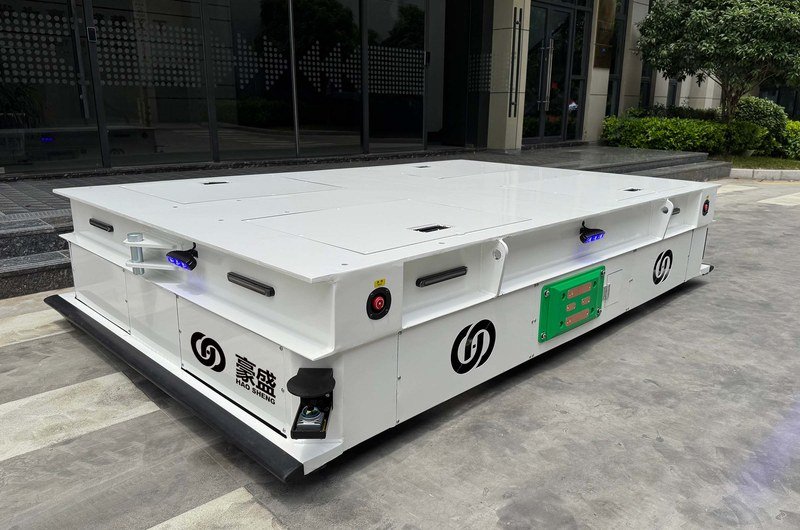
A heavy-duty AGV shares its aisles with people. A 60-ton vehicle cannot rely on being noticed, and it cannot stop the way a pedestrian steps aside — its safety has to be engineered into hardware that watches, warns, and stops the machine faster and more reliably than any human driver could. That hardware is what this article is about.
The safety system of a well-built heavy AGV is not one device but a layered stack: laser scanners that see trouble early, warning lights and voice announcements that make the vehicle impossible to ignore, contact bumpers and safety edges as the physical last line, four-corner emergency stops for humans to intervene, and electromagnetic brakes that hold everything when power is cut. We will walk through each layer as it exists on the vehicle — what it does, how the layers back each other up, and what to check when you evaluate a manufacturer. The standards behind it all, from CE marking to ISO 3691-4, get one section here and a full treatment in our guide to heavy-duty AGV and RGV safety standards.
Why Heavy AGV Safety Is a Layered System
No single sensor is trusted with a 60-ton vehicle. Every layer of the stack assumes the layer above it can fail: the scanner should prevent contact ever happening, but a bumper stands behind it; the automatic systems should never need a human, but e-stop buttons wait at every corner; the drive should stop the vehicle, but a brake that engages on power loss stands behind the drive. This defense-in-depth structure — detect early, warn constantly, stop on contact, stop on command, hold when dead — is the shape of every serious heavy AGV safety design, and it is what CE conformity for a driverless industrial truck fundamentally expects.
270° Laser Scanners: The Vehicle’s Eyes
The primary safety sensors are laser scanners mounted at the front and rear of the vehicle, each sweeping a 270-degree arc at shin height. Because each scanner sees around its own corner, the front and rear arcs together give protective coverage on all sides of the vehicle — there is no approach direction the AGV cannot see.
How the protective fields work
Each scanner monitors software-defined zones around the vehicle, and the vehicle’s response depends on which zone is breached.
Warning field
The outer zone. When a person or obstacle enters it, the AGV slows down and intensifies its warnings. Most encounters end here: the person passes, the field clears, and the vehicle resumes speed without ever stopping.
Protective field
The inner zone. Any breach triggers an immediate controlled stop — no negotiation, no waiting on the navigation computer. The vehicle stands still until the field is clear.
Fields that change with the mission
Field sets switch dynamically with the vehicle’s state: longer fields at higher speed, curved fields that sweep into a turn before the vehicle does, and narrowed fields for docking so the vehicle can approach a station without stopping itself on the equipment it is meant to reach. Verifying that field switching matches real vehicle states is one of the most important items in commissioning.
Contact Protection: Safety Edges and Bumpers
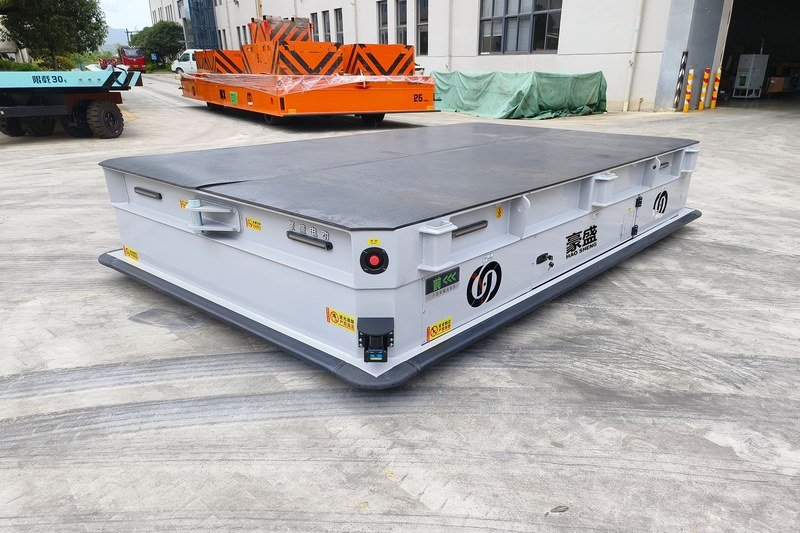
Behind the scanners stands the physical layer. Flexible safety contact edges and mechanical bumpers run along the vehicle’s exposed faces; any physical deflection triggers an immediate stop through hardwired safety circuits, independent of the navigation software. On a vehicle whose deck may overhang its scanner plane, or in dusty environments covered in our special-environment AGV guide, this contact layer is not a formality — it is the layer that catches whatever the optics missed. For rail-guided vehicles and fixed end-of-travel points, mechanical limit stops and buffers provide the same absolute backstop at the ends of the route.
E-Stops and Electromagnetic Braking
Four-corner emergency stops
Large red emergency stop buttons are mounted at all four corners of the vehicle, so a person standing anywhere beside it can reach one without walking around a moving machine. Pressing any of them cuts motion through the safety circuit directly. On vehicles with a pendant or remote station, the e-stop chain extends there too, and every button latches until deliberately reset — a stopped vehicle stays stopped.
Brakes that fail safe
Heavy AGVs use electromagnetic brakes that require electrical power to stay released. Cut the power — by e-stop, protective field breach, or any fault up to and including a dead battery — and the brakes engage by spring force. The vehicle’s default state is braked; motion is the exception that the safety system permits. This is the property that makes every other layer trustworthy: whatever goes wrong, the end state is a standing, held vehicle.
Being Seen and Heard: Lights and Voice Warnings
A quiet electric vehicle the size of a room must announce itself. Heavy AGVs carry audible and visual warning equipment as standard: perimeter warning lights that signal the vehicle’s state — running, turning, docking, fault — flashing beacons, and audible warnings including voice announcement, which broadcasts a clear spoken message as the vehicle moves or approaches a crossing. Voice beats a plain buzzer for one practical reason: workers habituate to beeps in an industrial hall, but a voice saying the vehicle is moving still turns heads. The warning layer escalates with the scanner layer — a person entering the warning field is met with both slowing and intensified warning at once.
Safe Docking, Lifting and Load Handling
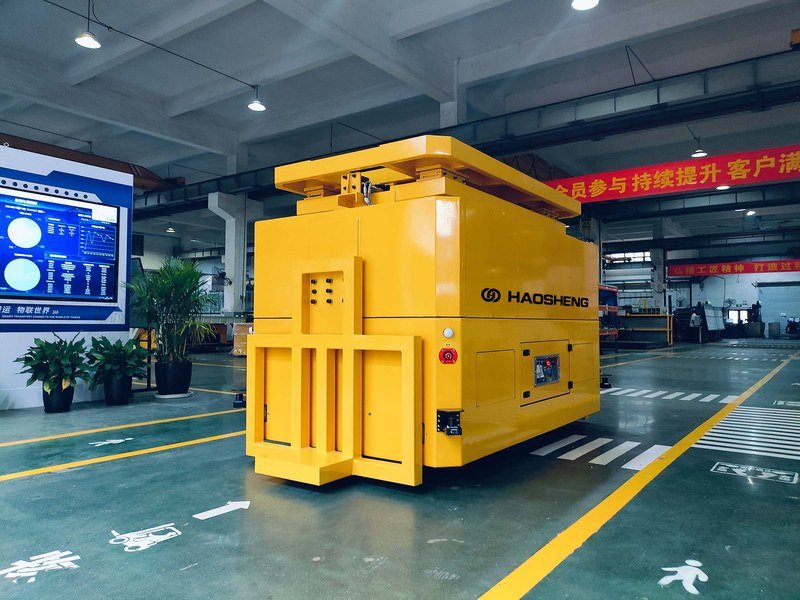
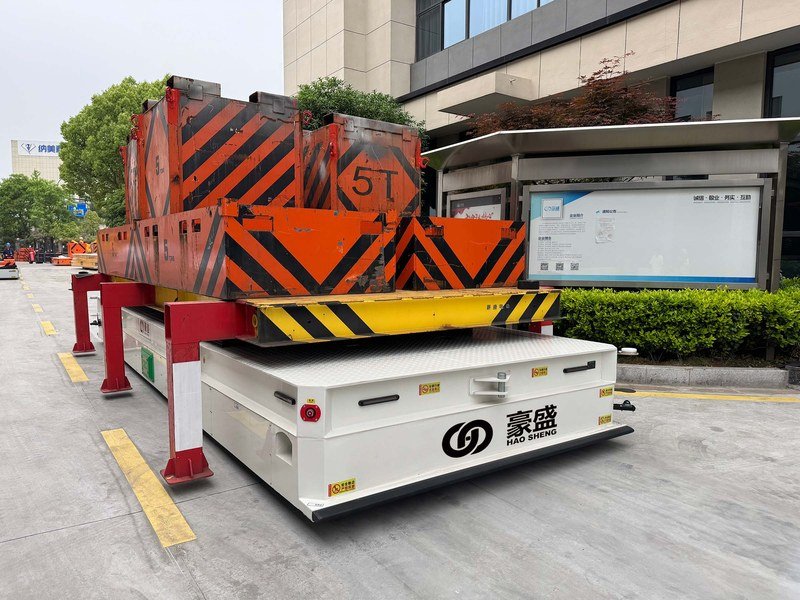
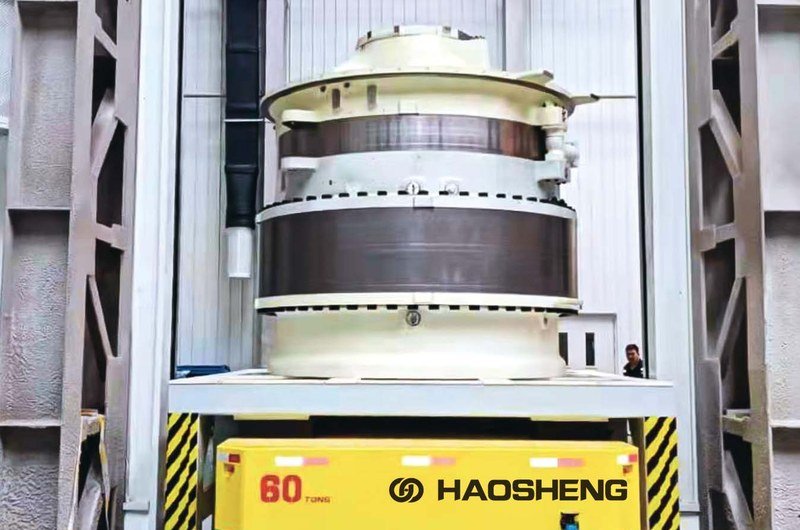
Some of the highest-consequence moments in a heavy AGV’s cycle happen at near-zero speed: driving under a load frame, lifting 40 tons on a jacking deck, docking against a station where a person may be working. Here safety is enforced by interlocks rather than distance. Lifting is only enabled when the vehicle is stopped and correctly positioned; docking approaches run at reduced speed with narrowed protective fields still active; hydraulic systems hold their load on valve failure rather than drifting down; and load presence and seating are verified by sensors before the vehicle is allowed to move. An under-ride AGV that disappears beneath a load frame keeps its sensor coverage and e-stop accessibility at the exposed ends — how these vehicles pick up their loads is detailed in our under-ride lifting AGV guide.
The Control Layer and CE Compliance
Underneath the visible hardware sits the safety-related control system. Scanner outputs, safety edges, e-stops and brake control are wired into dedicated safety logic rather than ordinary program code, so a protective stop does not depend on the navigation computer having a good day. The vehicle PLC and 7-inch touchscreen display safety status and fault history, and the three operating modes — automatic, semi-automatic, manual — are themselves a safety feature: manual mode enforces reduced speed under a physically present operator, and mode transitions require deliberate action, never happening silently.
Fleet-level behavior adds one more layer: the scheduling system manages traffic so two vehicles never contest the same zone, and reports every safety event upstream over industrial WiFi or 5G. All of it is designed and documented to carry CE marking under the applicable machinery requirements, with ISO 3691-4 as the international reference standard for driverless industrial trucks — the full standards landscape, including regional variants, deserves its own article and gets one.
| Layer | Hardware | What it does |
| Detect | Front + rear 270° laser scanners | Slows in warning field, stops on protective field breach |
| Warn | Perimeter lights, beacons, voice announcement | Makes vehicle state impossible to miss |
| Contact | Safety edges and bumpers, hardwired | Immediate stop on any physical touch |
| Command | Four-corner latching e-stops | Human intervention from any side |
| Hold | Electromagnetic fail-safe brakes | Vehicle braked by default on any power loss |
| Process | Docking and lifting interlocks | No lift or move unless position and load are verified |
HENSEN (Hangzhou Haosheng Electric Vehicle Co., Ltd.) designs and builds heavy-duty AGVs and rail transfer carts from 1 to 500 tons — plus heavy-duty AGVs up to 800 tons — with the full safety stack described here fitted as standard, in-house control and scheduling software, CE marking and ISO 9001 certified manufacturing, delivered across wind power, metallurgy, sheet metal and construction machinery plants worldwide. Send us your layout and traffic pattern and our engineers will propose a vehicle and safety configuration with budget pricing.
FAQ About Heavy-Duty AGV Safety
Q: What does 270-degree laser scanning mean on an AGV?
A: Each scanner at the front and rear of the vehicle sweeps a 270-degree arc, seeing ahead and around its corner. Together the two scanners cover all approach directions, monitoring an outer warning field that slows the vehicle and an inner protective field that stops it immediately.
Q: Will a heavy AGV stop if the scanners fail?
A: Yes — that is the point of the layered design. Safety edges and bumpers trigger a hardwired stop on any contact, e-stops at all four corners allow human intervention, and electromagnetic brakes engage automatically whenever power is cut, so any detected fault ends with the vehicle stopped and held.
Q: Why do AGVs use voice announcements instead of just beepers?
A: Habituation. In a busy hall, workers tune out repetitive beeps, but a spoken warning remains attention-grabbing. Voice announcement is paired with perimeter warning lights and beacons so the vehicle’s state is communicated both audibly and visually.
Q: What happens to the safety system during docking, when the AGV must get close to equipment?
A: The protective fields switch to narrowed docking field sets while speed is reduced, and process interlocks take over: lifting and load transfer are only enabled when the vehicle is verified stopped and in position, and load seating is confirmed by sensors before motion is allowed again.
Q: Are heavy-duty AGVs CE compliant?
A: A properly built one is designed and documented for CE marking, with ISO 3691-4 as the reference standard for driverless industrial trucks. Ask the manufacturer to show you the safety functions and documentation behind the mark, not just the label on the nameplate.
Conclusion
The safety of a heavy-duty AGV is not a sensor on a spec sheet — it is a stack of independent layers, each assuming the one above it can fail: scanners that prevent contact, warnings that prevent surprise, edges and bumpers that stop on touch, e-stops that answer to people, and fail-safe brakes that hold when everything else is gone. When you evaluate a vehicle, walk the stack: ask how the fields switch, press an e-stop, ask what happens when power dies mid-move. A manufacturer who has engineered these layers properly will enjoy answering — and that response tells you as much as the hardware does. Reach out to us to learn more.

Leave a comment