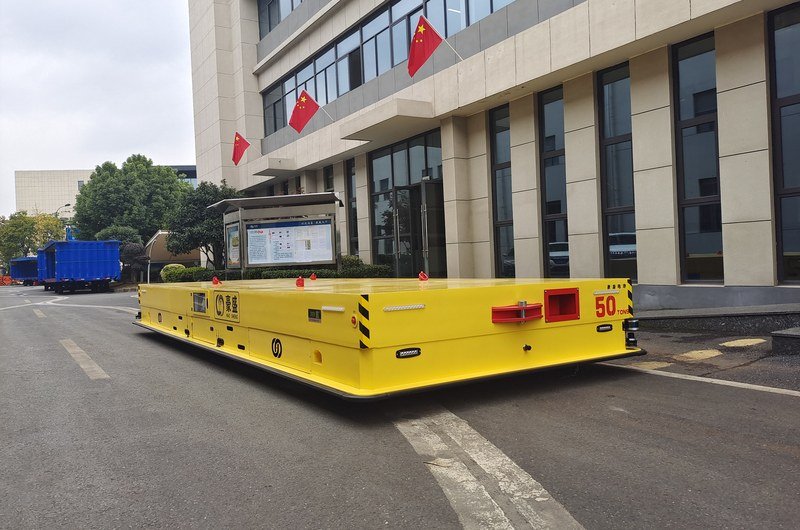
Two heavy-duty AGVs can carry identical brochure numbers — 50 tons capacity, laser navigation, millimeter-class stopping accuracy — and behave completely differently after three years of work. One still stops square at every station and lifts its load dead level. The other wanders off line, wears its wheels unevenly and needs its lifting hydraulics recalibrated every few months. The difference is rarely the software. It is almost always the structure underneath.
The frame is the least visible part of an AGV and the only part that cannot be fixed after delivery. Batteries can be swapped, sensors upgraded, software rewritten — a chassis that twists under load is a permanent condition. This article explains how a heavy-duty AGV chassis is actually built: the Q345 steel, welded box-beam construction, stress-relief annealing, gantry machining in a single setup, and the deflection limit of roughly L/1000 that separates a precision machine from a steel raft on wheels. Other articles on this blog mention these steps in passing; here we take each one apart.
Why the Frame Decides AGV Reliability
Every precision an AGV claims is measured from its frame. The navigation sensors are bolted to it, the drive units hang from it, and the lifting cylinders push against it. Heavy-duty AGVs carry anywhere from 1 to 800 tons on polyurethane wheels, and floor wheel pressure is one of the hardest design constraints in the whole vehicle — which means the structure’s first job is to keep every wheel loaded exactly as calculated, in every load case, on every meter of the route. A frame that deflects unevenly shifts load between wheels, overloads some of them, and quietly rewrites the wheel-pressure math the floor was checked against.
Frame problems also compound. A small permanent twist changes ride height at one corner; the changed geometry tilts the laser scanner and shifts the navigation reference; uneven wheel loading accelerates wear on the heavy corner, which changes the geometry further. None of these failures announces itself as a frame problem — they appear as navigation drift, tire cost and hydraulic trouble. That chain is why serious manufacturers treat frame fabrication as a controlled four-step process — material, welding, annealing, machining — rather than a welding job.
Q345 Steel and Box-Beam Construction
Why Q345 low-alloy steel
Heavy AGV frames are welded from Q345, a low-alloy structural steel broadly comparable to S355 in European practice. It offers roughly half again the yield strength of ordinary carbon steel while remaining fully weldable and tough at workshop temperatures. Higher strength alone is not the point — a frame sized purely by strength would still be far too flexible. The point is that Q345 lets the designer build deep, stiff sections with sensible wall thicknesses, so the frame can be engineered for rigidity, with strength arriving as a by-product.
Box beams versus I-beams
Rolled I-beams (H-sections) are the familiar building blocks of steel construction, and they are excellent in simple vertical bending. Their weakness is torsion. An open section twists easily, and twisting is exactly what an AGV frame experiences when one wheel rides a floor irregularity or an off-center load presses one corner. A welded box beam — four plates closed into a rectangular tube — resists torsion many times better for similar weight, because the closed section forces shear to flow around a continuous loop. Heavy AGV main frames are therefore welded up from box-section main beams and cross members, with internal diaphragm plates at load introduction points such as wheel boxes and cylinder seats.
| Property | Rolled I-beam frame | Welded Q345 box-beam frame |
| Vertical bending stiffness | Good | Good |
| Torsional stiffness | Poor – open section twists | Excellent – closed section |
| Local load introduction | Web buckles without stiffeners | Internal diaphragms at wheels and cylinders |
| Design freedom | Fixed catalogue sizes | Section depth and wall tailored to load map |
| Typical use | Light frames, secondary members | Main frames of heavy-duty AGVs and RGVs |
Welding and Stress-Relief Annealing
The residual stress problem
Welding a box-beam frame pours a large amount of localized heat into the structure. As each weld cools and shrinks, it locks tension into the surrounding steel. A freshly welded frame can hold internal stresses close to the material’s yield strength — invisibly. The frame measures straight on the shop floor, but the stresses are simply waiting. Machine a surface, and the removed material releases stress and the frame springs out of shape. Or skip machining, put the vehicle into service, and let months of load cycles and vibration relax the stresses gradually — the frame slowly warps in the field, and stopping accuracy and lift synchronization decay with it.
What annealing does
Stress-relief annealing removes the time bomb. The entire welded frame goes into a furnace, is heated to a soaking temperature well below any structural change in the steel, held there long enough for internal stresses to relax, and then cooled slowly and uniformly. What comes out is dimensionally stable: it can be machined without springing and will hold its geometry for the vehicle’s 10-15+ year service life. Annealing adds furnace time and cost, and it is one of the first steps a budget builder quietly deletes — which is why it belongs on your audit list, not just in the brochure.
Gantry Machining: One Setup, One Reference
An annealed frame is stable but still carries as-welded surfaces, with the millimeters of waviness that welding always leaves. No amount of careful assembly can bolt precision parts to imprecise faces. So the complete frame — often several meters on a side — goes onto a gantry machining center large enough to swallow the whole structure, and every critical face is machined in a single clamping. One setup means every machined surface is cut relative to the same datum, so their positions agree with each other to machine-tool accuracy rather than welding accuracy.
What gets machined in a single clamping
Wheel and drive mounting faces
The pads that carry wheel boxes and steering drive units are machined coplanar. This is what guarantees each wheel meets the floor as designed — equal load sharing, true tracking, and predictable wheel pressure. Wheels mounted on as-welded faces fight each other from day one.
Lifting mechanism seats
Hydraulic cylinder pads are machined to a common height. Multi-cylinder lifting systems synchronize to about ±1 mm across the platform; that figure is only achievable when the cylinders start from seats that are themselves accurately located.
Deck and fixture interfaces
The load deck and any tooling location features are machined flat and square to the same datum, so the payload sits where the load calculation assumed and interfaces with station tooling repeatably.
The L/1000 Deflection Limit
Stiffness needs a number, and the working standard for heavy transfer vehicles is that at rated load the frame deflects no more than about 1/1000 of the wheelbase L. A vehicle with a 3-meter wheelbase may sag roughly 3 mm at full rated load — no more. The figure is a design target verified by calculation and finite-element analysis during engineering, and checked physically when the finished vehicle is load-tested.
Why so strict? First, wheel loads: deflection redistributes weight between axles, and the floor and wheel design only stay valid if that redistribution is small. Second, lifting: a deck that bows several millimeters under load makes ±1 mm cylinder synchronization meaningless, because the structure between the cylinders is moving more than the control tolerance. Third, navigation: scanners and antennas measure the world from the frame, and a geometry that changes with payload turns into position error that no software can calibrate away, because it varies with every load. A vehicle that holds L/1000 keeps its empty-vehicle calibrations valid at full load — that is the practical meaning of the number.
Specifying and Auditing Frame Quality
Frame quality is invisible in photographs and absent from most datasheets, but it leaves a paper trail. When you evaluate a heavy AGV supplier, ask for the documents behind the four process steps:
- Material certificates showing Q345 (or equivalent) plate and section for the main structure.
- Weld details: box-beam construction with internal diaphragms at wheel boxes and cylinder seats, not open sections with cover plates.
- Furnace records proving whole-frame stress-relief annealing between welding and machining.
- Evidence of gantry machining in a single setup, with the machined-face plan showing wheel pads, cylinder seats and deck on one datum.
- The deflection calculation or FEA report against the L/1000 target at rated load.
- A factory load test at 1.1 times rated capacity before shipment, with deflection and lift synchronization measured under the test load.
These questions slot directly into our RGV manufacturer checklist, and the load data that drives frame sizing is step one of our custom RGV design guide — the frame section is the part of both documents most worth being stubborn about.
HENSEN (Hangzhou Haosheng Electric Vehicle Co., Ltd.) designs and builds heavy-duty AGVs and transfer vehicles on annealed, gantry-machined Q345 box-beam chassis from 1 to 500 tons — plus heavy-duty AGVs up to 800 tons — with in-house control and scheduling software, CE marking and ISO 9001 certified manufacturing, delivered across wind power, metallurgy, sheet metal and construction machinery plants worldwide. Send us your load data and duty cycle and our engineers will propose a chassis design with deflection calculations and budget pricing.
FAQ
Q: What steel is used for heavy-duty AGV frames?
A: Q345 low-alloy structural steel (broadly equivalent to S355), welded into closed box-beam sections. Its higher yield strength lets the designer build deep, stiff sections at sensible weight, and it welds and machines predictably.
Q: Why does an AGV frame need stress-relief annealing?
A: Welding locks high residual stresses into the structure. Without annealing, those stresses release later — during machining or slowly in service — and the frame warps, degrading stopping accuracy, wheel loading and lift synchronization. Furnace annealing relaxes the stresses so the frame stays dimensionally stable for its 10-15+ year life.
Q: What does the L/1000 deflection limit mean in practice?
A: At rated load, the frame may deflect no more than about one-thousandth of the wheelbase — roughly 3 mm on a 3-meter wheelbase. It keeps wheel loads, lifting synchronization and navigation sensor geometry within tolerance whether the vehicle is empty or fully loaded.
Q: Why must the frame be machined in a single setup?
A: Machining every critical face — wheel pads, cylinder seats, deck — in one clamping on a gantry machining center puts them all on a single datum, accurate to machine-tool tolerances. Re-clamping between faces stacks up positioning errors, and precision components mounted on those faces inherit every one of them.
Q: How is frame quality verified before delivery?
A: By documents and by test. Material certificates, annealing furnace records and machining reports cover the process; the finished vehicle then runs a factory load test at 1.1 times rated capacity, during which deflection and lifting synchronization are measured under load.
Conclusion
A heavy-duty AGV earns its reliability before it ever moves: Q345 box beams for torsional stiffness, a furnace cycle to erase welding stress, a gantry machining center to put every critical face on one datum, and an L/1000 deflection budget that keeps the geometry honest under load. None of it shows in a photograph; all of it shows in year three. Ask for the process evidence, insist on the 1.1x load test, and the rest of the vehicle — navigation, hydraulics, software — will have a foundation worth building on. Contact us to learn more.



Leave a comment