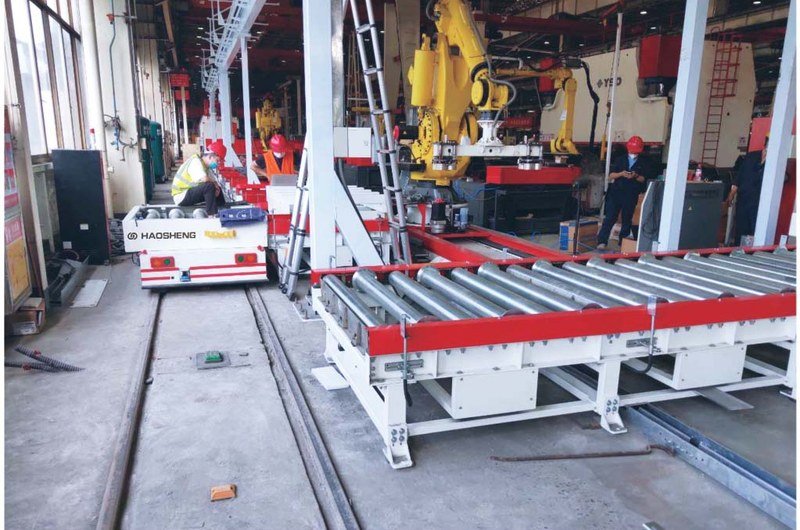
The last meter is where many automation projects quietly give up. An AGV or transfer cart delivers a pallet to the end of a production line — and then a forklift driver or two operators take over to move the load those final centimeters onto the line’s conveyor. The transport was automated; the transfer was not. Every such handover costs cycle time, labor and a chance of damage.
A roller-deck vehicle closes that gap. Instead of a flat platform, the AGV or RGV carries a powered roller conveyor as its deck. It docks against a stationary conveyor, the two sets of rollers run in sync, and the load drives itself across — no crane, no forklift, no hands. This article covers both trackless (AGV) and rail-guided (RGV) versions: how automatic docking works, the control handshake that makes it safe, how to size the deck, and where these vehicles fit.
What Is a Roller-Deck AGV or RGV?
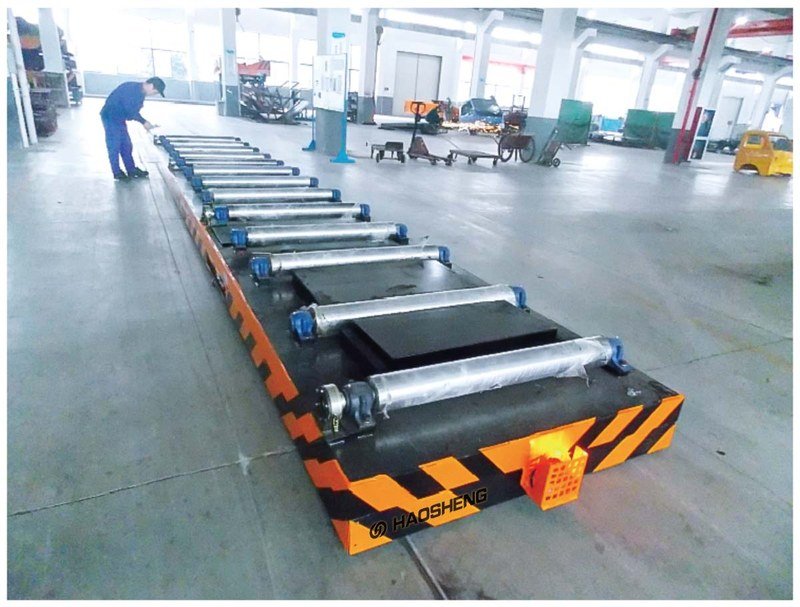
A roller-deck vehicle is a standard heavy transfer vehicle whose load platform has been replaced by a motorized roller (or chain) conveyor section. At each station, the vehicle aligns its deck with a fixed conveyor at matching height, establishes a control handshake, and the load — a pallet, a steel sheet stack, a coil cradle, a tote or a workpiece carrier — rolls on or off automatically. The vehicle is effectively a mobile segment of the plant’s conveyor network.
The deck concept is identical on both carrier types. Rail-guided RGVs run the deck along a fixed route between lines; trackless AGVs carry it anywhere navigation reaches. Platform capacities span the full heavy-duty range — RGVs from 1 to 500 tons, AGVs up to 800 tons — though most roller-deck applications sit at the lighter end of that scale, moving unit loads between conveyor-fed processes.
How Automatic Docking Works
A complete transfer cycle looks like this:
- 1. Task – the WMS/MES or scheduling system orders: collect the pallet from line 2 outfeed, deliver to line 5 infeed.
- 2. Travel – the vehicle runs to the station at up to 20 m/min with soft start and stop.
- 3. Positioning – the vehicle stops at the docking point and its position is verified against tolerance.
- 4. Handshake – vehicle and station controllers exchange permission signals; interlocks release only when both sides are ready.
- 5. Transfer – rollers on the vehicle and the stationary conveyor run synchronized until sensors confirm the load has fully crossed.
- 6. Confirmation – the load is checked in position, the handshake is closed, and the vehicle reports the task complete.
Stopping and alignment accuracy
Roller-to-roller transfer tolerates far less positioning error than a forklift pickup. On rails, the problem is essentially solved: an RGV combining RFID station identification with laser distance measurement stops within about ±5 mm, ready to dock directly. A trackless AGV on 3D SLAM laser navigation positions to roughly ±10-15 mm, so AGV docking stations add a final creep-speed approach and mechanical guidance — entry funnels, guide rollers or locating features — that absorb the residual offset. Deck height must match the fixed conveyor as well; where one vehicle serves conveyors at different heights, a lifting roller deck raises or lowers the rollers to each station’s level.
The Control Handshake, Signal by Signal
A roller transfer is only as reliable as its interlocks. Two machines are about to move one load simultaneously, so neither may act on assumption. The vehicle PLC and the station controller exchange a small set of signals — hardwired I/O at the dock, or telegrams over industrial WiFi/5G using TCP or MQTT — and every signal has one job:
| Signal | Direction | What it means |
| Vehicle in position | Vehicle to station | Stopped at dock, position verified, brakes applied |
| Ready to receive | Receiving side to sending side | Deck or conveyor empty, at height, no faults |
| Ready to send | Sending side to receiving side | Load present, sensors healthy, path clear |
| Transfer start | Master (usually station) to both | Both roller drives run, synchronized |
| Load transferred | Receiving side to both | Load fully aboard and in position |
| Fault / abort | Either side | Stop both drives immediately, hold load, alarm |
The four stages of a safe transfer
Permission
Nothing moves until both controllers prove their conditions: vehicle stopped and locked, both decks at matching height, one side loaded and one side empty. Permission is mutual — either side can withhold it.
Synchronized run
Both roller sets start together and run at the same speed in the same direction, so the load never bridges two surfaces moving differently. The run continues until the receiving side’s sensors take over responsibility for the load.
Confirmation
Photoelectric sensors on the receiving deck confirm the load is fully aboard and centered — no overhang over the joint. Only then is the handshake closed and the vehicle released to move.
Fault handling
A timeout, a jammed load or contradictory sensor states stops both drives instantly and raises an audible and visual alarm. The load stays where it is; nothing moves again until an operator resolves the fault and resets the sequence. A handshake without a designed fault path is not a handshake — it is an accident schedule.
AGV or RGV Under the Rollers?
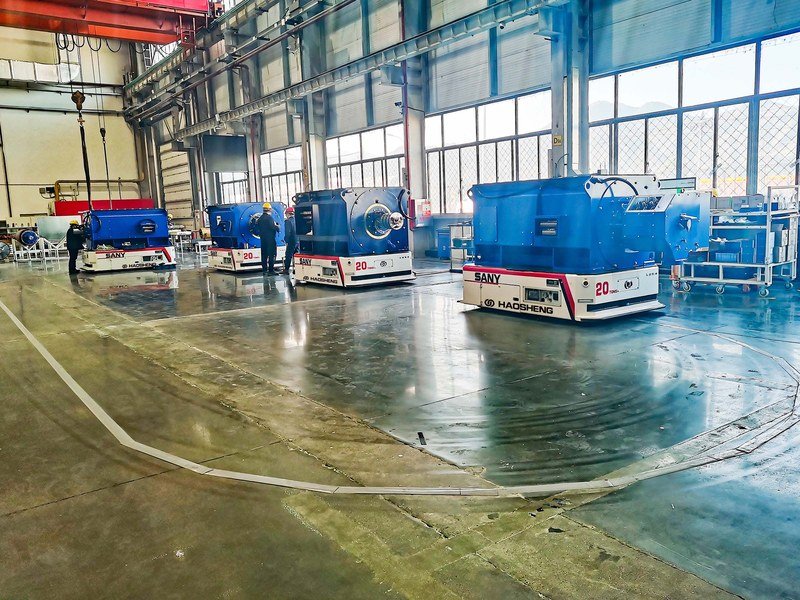
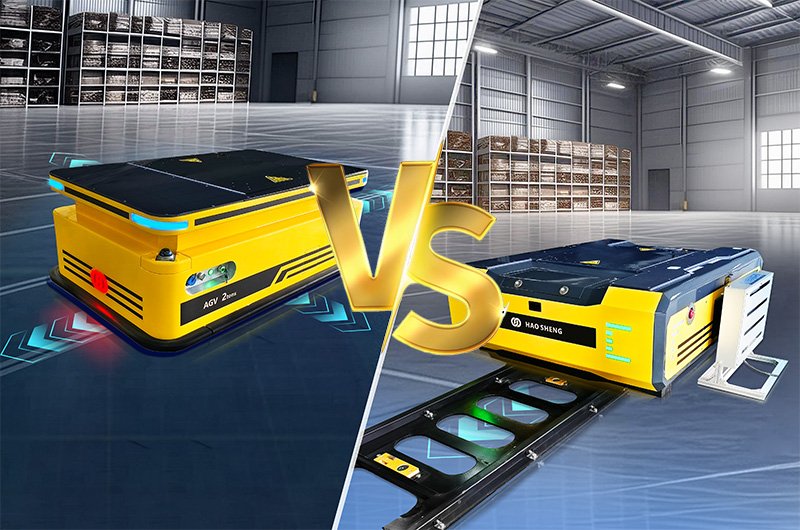
Choose the carrier by the route, not the deck. A fixed, repetitive shuttle between two or three conveyor stations favors the RGV: native ±5 mm stopping accuracy, simple docking, lower cost per move, and the option of AC36V rail power for true 24/7 duty without charging. Routes that change, cross open floor or serve many scattered stations favor the AGV, whose LiFePO4 battery with automatic opportunity charging supports round-the-clock schedules. The full trade-off between tracked and trackless carriers is covered in our complete RGV guide — for a roller-deck project, the deciding questions are usually just route stability and stopping accuracy at the dock.
Sizing the Deck and Typical Applications
Roller pitch and load footprint
The rule of thumb is that the load must always rest on at least three rollers, so roller pitch follows from the shortest load footprint in the mix. Closed pallet bottoms and rigid steel containers roll well; open-bottom skids, soft packaging or coils need chain conveyor decks, support cradles or V-shaped saddles instead — HENSEN has delivered V-deck rail carts for cable drums on exactly this logic. Motor sizing follows total load weight, and the deck structure beneath the rollers is a welded steel frame engineered like any other heavy vehicle platform.
Deck height and lifting rollers
Fixed-height decks are simplest and best when all stations match. Where conveyor heights differ, a lifting roller deck — hydraulic or scissor type with a 150-400 mm stroke — lets one vehicle serve them all, and doubles as a way to pick loads from stands.
Where roller-deck vehicles earn their keep
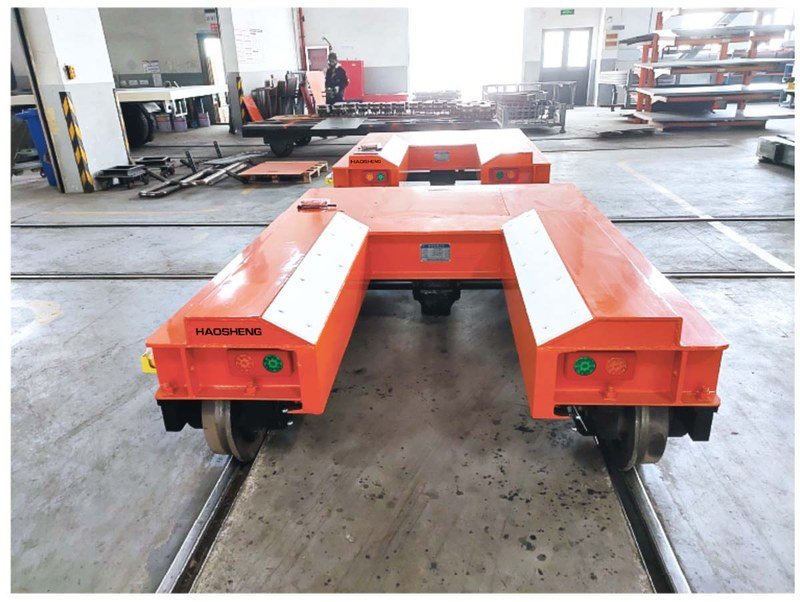
The classic applications are line-to-line and warehouse-to-line transfer in sheet metal and coil processing: feeding leveling and blanking lines, shuttling cut blanks to press or bending cells, and linking packing lines to palletizing. Roller and lifting decks also ride on mother-child shuttle systems — a 10-ton laser blanking line fed by a HENSEN mother-child cart is a delivered example — and on assembly lines where workpiece carriers must flow between conveyor loops without manual handling.
Integration and Specification Checklist
Every roller-deck vehicle carries an onboard PLC with a 7-inch touchscreen and runs in automatic, semi-automatic or manual mode; fleet scheduling talks to MES/WMS over industrial WiFi or 5G via TCP or MQTT. Safety equipment is the heavy-vehicle standard set: front and rear laser obstacle scanners covering 270 degrees, four-corner emergency stops, sound and light alarms, and electromagnetic braking. To get an accurate quotation, bring this list:
- Load data: unit load types, dimensions, weights, and bottom condition (pallet, skid, container, coil).
- Station map: number of docking stations, conveyor types, heights and interface ownership.
- Required stopping accuracy at each dock, and whether mechanical guidance can be added.
- The handshake signal list – and, critically, who programs each side (vehicle supplier, line builder, or integrator).
- Throughput: transfers per hour, route lengths, and duty schedule (single shift or 24/7).
- Power system: LiFePO4 battery with automatic charging, AC36V rail power on fixed routes, or drag cable for short straight runs.
- Environment: temperature, dust, washdown, and any ESD or cleanliness requirements around the rollers.
HENSEN (Hangzhou Haosheng Electric Vehicle Co., Ltd.) designs and builds roller-deck and lifting-roller AGVs and RGVs from 1 to 500 tons — plus heavy-duty AGVs up to 800 tons — with in-house control and scheduling software, CE marking and ISO 9001 certified manufacturing, delivered across wind power, metallurgy, sheet metal and construction machinery plants worldwide. Send us your station heights, load data and handshake requirements and our engineers will propose a docking concept with budget pricing.
FAQ
Q: How accurately must the vehicle stop to dock with a conveyor?
A: Rail-guided RGVs stop within about ±5 mm using RFID station identification plus laser distance measurement, which is docking-ready as-is. Trackless AGVs on 3D SLAM navigation position to roughly ±10-15 mm, so their docks add creep-speed approach and mechanical guides that absorb the remaining offset.
Q: What happens if a load jams halfway across the joint?
A: The handshake’s fault path triggers: both roller drives stop immediately, the load is held in place, and an audible-visual alarm calls an operator. Nothing on either side moves again until the fault is cleared and the sequence is reset — the load is never dragged or abandoned mid-transfer.
Q: Do the rollers need to be powered on the vehicle, the conveyor, or both?
A: Both. The vehicle deck and the station conveyor each drive their own rollers, and the handshake synchronizes them so the load crosses the joint on surfaces moving at the same speed. Gravity or push transfers are not used at this scale.
Q: Can roller-deck vehicles handle coils or loads without flat bottoms?
A: Not on plain rollers – open-bottom or round loads need chain conveyor decks, cradles or V-shaped saddle decks. Cable drum and coil transport on V-deck rail carts is a delivered HENSEN configuration; describe your load’s bottom surface early, because it drives the whole deck design.
Q: Who programs the handshake between vehicle and line?
A: It must be agreed, not assumed. Typically the vehicle supplier programs the vehicle side and the line builder or integrator programs the station side, against a jointly signed signal list. HENSEN provides the vehicle PLC logic and scheduling software in-house and supplies the interface specification for the station side.
Conclusion
A roller-deck AGV or RGV turns the last unautomated meter of material flow into a machine-to-machine transaction: dock, handshake, transfer, confirm. The mechanics are straightforward — matched heights, synchronized rollers, sensible roller pitch. The engineering that separates a reliable system from a temperamental one lives in the details this article has walked through: honest stopping-accuracy math at the dock, and a handshake with a designed fault path. Specify those two things precisely, and line-to-line transfer becomes the most boring part of your plant — which is exactly what it should be.

Leave a comment