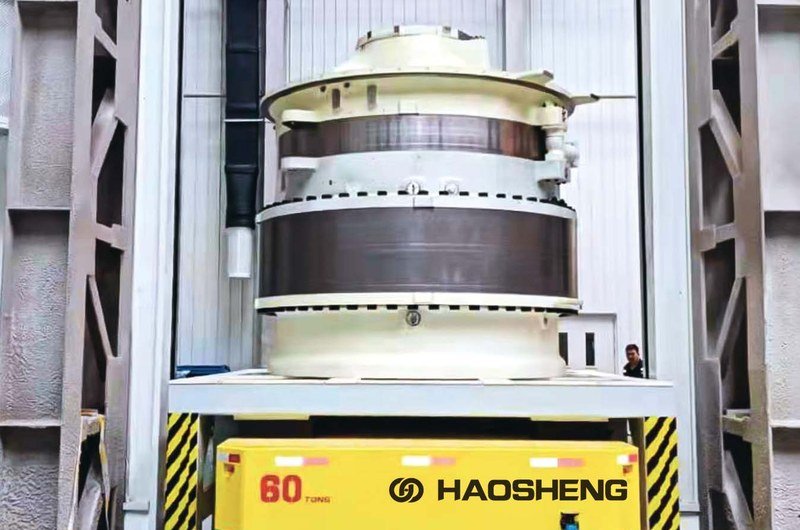
Moving a 50-ton fabrication normally means booking the overhead crane, waiting for it, rigging the load, and clearing everyone out from underneath. The crane is the busiest machine in the building, and every transport request joins its queue. An under-ride lifting AGV breaks that dependency: it drives beneath the load, jacks it straight up off its stands, and carries it away — automatically, with nobody rigging anything.
This pickup style — often called under-ride, tunneling, or jacking — is what makes heavy AGVs genuinely autonomous. A flat platform vehicle still needs a crane at both ends of every trip; an under-ride vehicle collects and delivers its own loads. This article explains how the automatic pickup cycle works in the 40-60 ton class, the hydraulic and scissor lifting mechanisms behind it, how to design the fixture interface, and the floor requirements that projects most often underestimate.
What Is an Under-Ride Lifting AGV?
An under-ride lifting AGV is a low-profile, trackless vehicle that drives into the tunnel beneath a load standing on fixed stands or tooling legs, raises its lifting deck through a stroke of typically 150-400 mm, takes the full weight, and drives off with the load a few centimeters clear of its stands. Setting down is the same cycle reversed. There are no hooks, slings, forks, or human intervention — the load’s own support structure is the pickup interface.
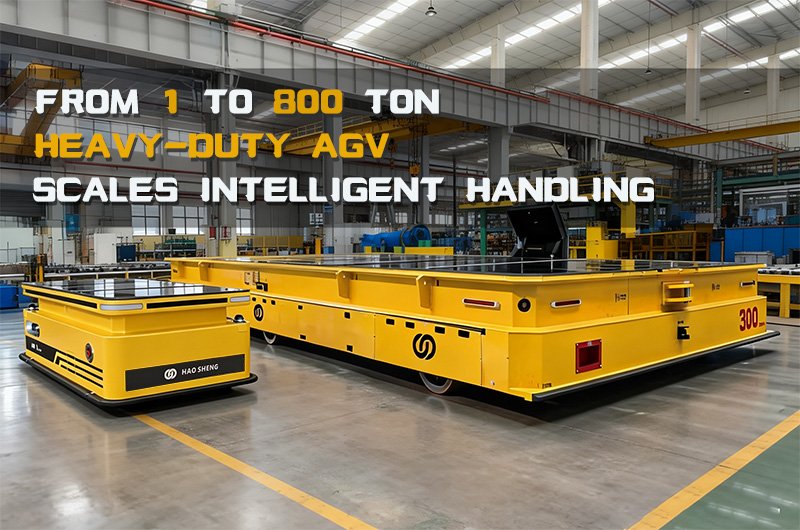
A close cousin runs on rails: hydraulic and scissor lifting transfer carts serving fixed routes, which we cover separately in our lifting RGV guide. This article is about the trackless version, where the vehicle navigates freely across the floor. HENSEN builds under-ride and platform AGVs from 2 tons up to 800 tons — the 40-60 tons class discussed here is the sweet spot for fabrications, machine bases, welded assemblies, BESS containers, and mold sets that are too heavy for forklifts and too frequent for the crane queue.
How an Automatic Pickup Works, Step by Step
- 1. Task – the scheduling system assigns: collect fixture 12 from welding cell 3, deliver to machining.
- 2. Approach – the AGV navigates to the pickup zone at up to 20 m/min with soft acceleration and braking.
- 3. Entry – at creep speed, the vehicle drives into the tunnel under the load, guided by navigation plus the fixture’s mechanical centering features.
- 4. Verification – the AGV confirms its position under the load is within tolerance; the lift is interlocked until this check passes.
- 5. Lift – hydraulic cylinders raise the deck in synchronization, taking the weight; sensors confirm the load is seated and fully clear of its stands.
- 6. Transport – the AGV carries the load to the destination, travels its route with obstacle scanning active.
- 7. Set-down – at the destination stands, the deck lowers until the stands take the weight, the deck retracts fully, and the AGV withdraws and reports done.
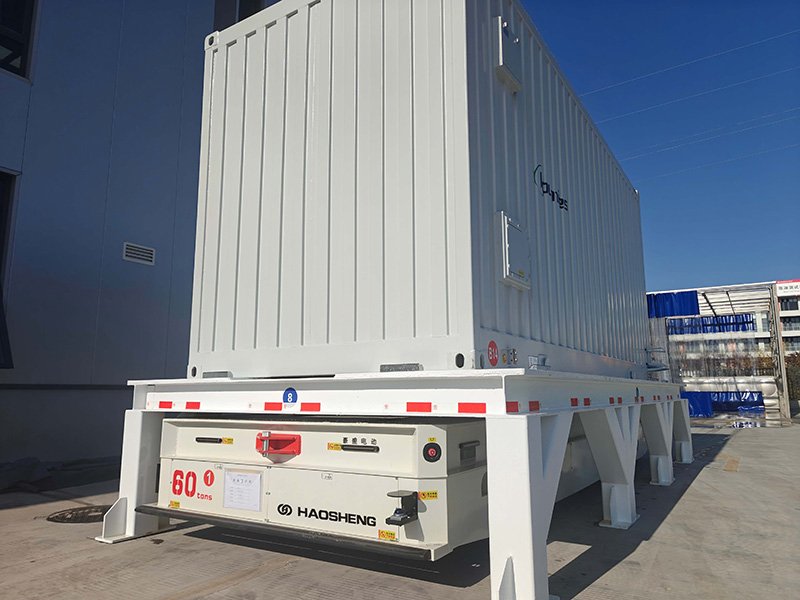
Safety around and under the load
The standard heavy-AGV safety set applies throughout: front and rear laser obstacle scanners covering 270 degrees, emergency stops at all four corners, sound and light alarms while moving, electromagnetic braking, and mechanical end stops on the lifting mechanism. The pickup adds its own interlocks — the deck will not lift unless position is verified, and will not lower at the destination unless the set-down zone is confirmed. The most important safety property is inherent: from lift to set-down the load rides centimeters above the floor, not meters below a crane hook.
Lifting Mechanisms for 40-60 Tons
Hydraulic jacking decks
The dominant solution in this weight class is direct hydraulic jacking: multiple cylinders distributed under a rigid lifting deck, fed by an onboard power pack. The layout puts cylinder groups near the load’s support points, so the force path from load to chassis is short and the deck between cylinders stays lightly stressed.
Cylinder synchronization
A 60-ton welded fixture is rigid; if one corner rises ahead of the others, the load tilts, weight concentrates on the high cylinders, and the workpiece can shift on its pads. Multi-cylinder synchronization holds the cylinders within about ±1 mm of each other through the whole stroke, so the load rises dead level regardless of where its center of gravity sits. This is a control achievement as much as a hydraulic one — and it presumes a chassis stiff enough to stay flat, which is why the frame’s L/1000 deflection budget (see our guide to AGV frame and chassis design) matters so much on lifting vehicles.
Stroke and the clearance budget
Typical lift strokes run 150-400 mm. The stroke has to pay for everything: the gap between the lowered deck and the load’s underside on entry, the pickup travel until the deck takes weight, and the running clearance between the raised load’s feet and the floor. Budget these numbers with the stand height at the very start of the project — the vehicle’s overall height, the stand design and the stroke are one calculation, not three.
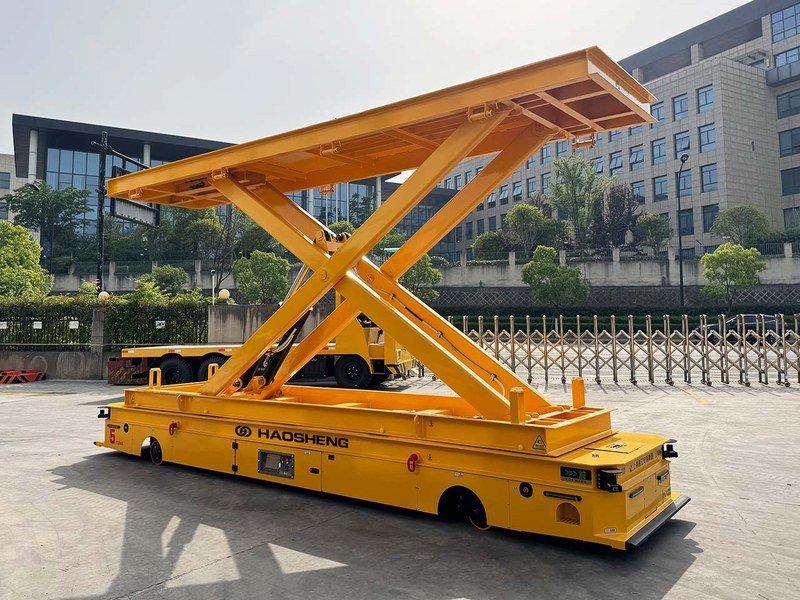
Scissor-lift decks
Where the application needs more stroke than direct jacking comfortably provides — matching stations at different heights, or serving both low stands and elevated positions — a scissor mechanism between chassis and deck delivers a longer, guided stroke while keeping the deck stable. The trade-off is mechanism height and complexity, so scissor decks appear where the clearance budget demands them rather than as the default.
The Fixture Interface: Where Load Meets AGV
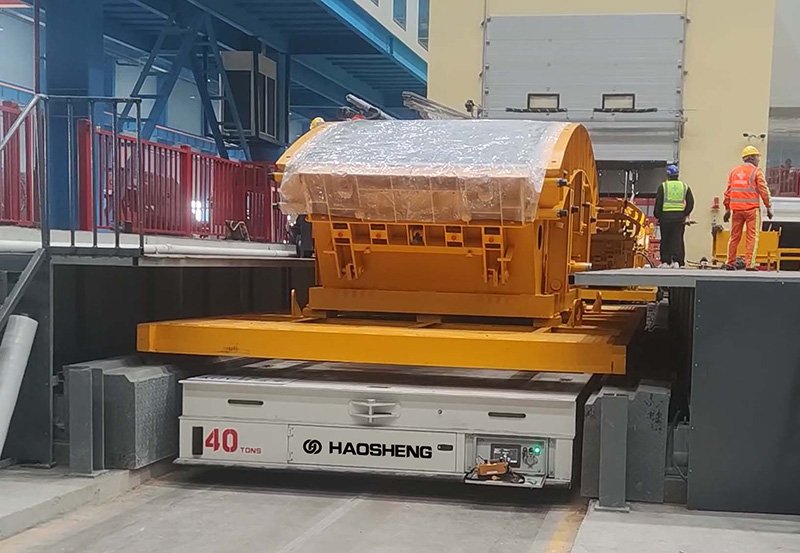
Under-ride pickup is a system design, not just a vehicle purchase, and the fixture is half of it. The load must stand on legs or stands that leave a clear tunnel — wide and tall enough for the vehicle plus working clearance — and present defined pickup points on its underside where the lifting deck takes the weight. Three rules make the interface reliable:
- Defined pickup pads: the load bears on engineered points aligned with the deck’s support pattern, never on random ribs or edges.
- Mechanical centering: cones, chamfered guides, or locating features on stands or fixtures absorb the last millimeters of positioning error, so navigation accuracy does not have to do the whole job alone.
- Standardization: one shop-wide stand and tunnel geometry lets one AGV serve every cell; every special fixture that breaks the standard costs flexibility for the life of the system.
Where products vary, the usual answer is a family of standard transport fixtures — the parts change, the interface to the AGV does not.
Navigation and Positioning Under the Load
HENSEN under-ride AGVs typically navigate by 3D SLAM laser navigation: no reflectors or floor magnets to install, positioning accuracy around ±10-15 mm, and free switching between indoor and outdoor zones. Laser reflector, magnetic, QR-code, and outdoor RTK satellite guidance remain available where a site standard or an outdoor yard demands them. The residual navigation error is absorbed by the fixture’s mechanical centering features, so the pickup succeeds every cycle, not just most cycles.
Just as important is how the vehicle moves: omnidirectional steer-wheel drive lets it crab sideways, travel diagonally and rotate in place. Aligning under a fixture in a crowded cell is usually not a straight-line approach — the ability to correct laterally at creep speed without maneuvering room is what makes tight layouts workable.
Floor Requirements: The Part Everyone Underestimates
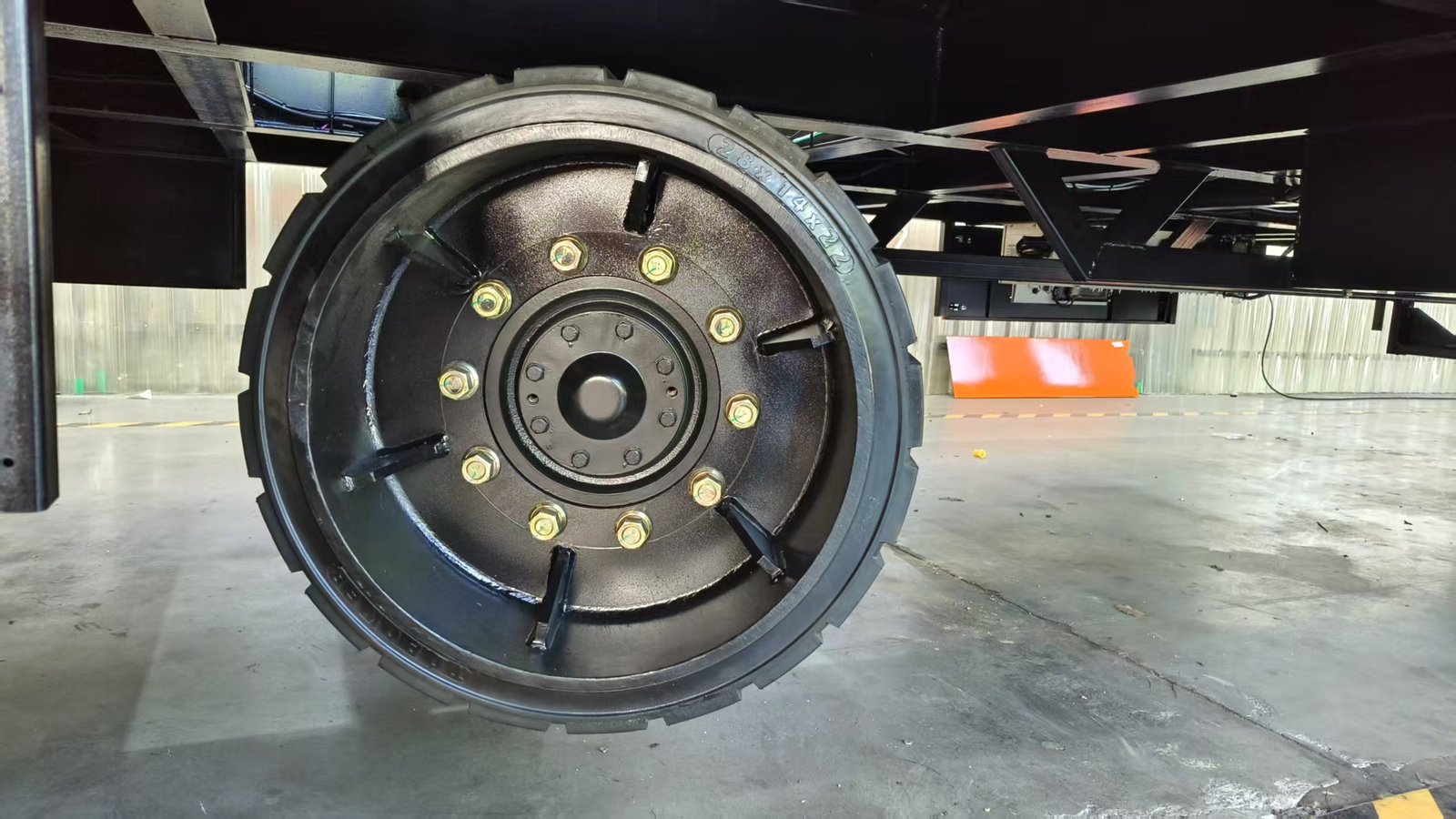
An under-ride AGV puts 40-60 tons of payload plus its own weight onto the floor through polyurethane wheels — and wheel pressure on the slab is a hard design constraint for every heavy AGV. Unlike a crane, whose loads go into building columns, the AGV loads the slab directly, everywhere it drives.
Before the vehicle is designed, the route needs an honest survey: slab capacity along the whole path, including corners where wheel loads concentrate during turns, floor flatness (a wavy floor eats into the lift stroke’s clearance budget and tilts the scanner geometry), the condition of joints, trench covers and ramps, and the surface quality polyurethane wheels need to last. None of this is exotic civil engineering, but it must happen before the wheel layout is frozen — the manufacturer distributes the load over the number, size, and spacing of wheels, and that distribution is designed around your floor, not despite it. HENSEN engineers wheel layouts against the customer’s slab data as standard project practice, on machines up to a delivered 300-ton wind power AGV and a 500-ton AGV.
HENSEN (Hangzhou Haosheng Electric Vehicles Co., Ltd.) designs and builds under-ride lifting AGVs and transfer vehicles from 1 to 500 tons — plus heavy-duty AGVs up to 800 tons — with in-house control and scheduling software, CE marking and ISO 9001 certified manufacturing, delivered across wind power, metallurgy, sheet metal and construction machinery plants worldwide. Send us your load weights, stand concept, and floor data, and our engineers will propose a lifting AGV configuration with clearance calculations and budget pricing.
FAQ
Q: How accurately does the AGV position itself under the fixture?
A: 3D SLAM laser navigation places the vehicle within about ±10-15 mm, and the fixture’s mechanical centering features – cones or chamfered guides – absorb the remainder. The lift is interlocked until the position check passes, so an imperfect approach results in a retry, never a bad pickup.
Q: What keeps a 60-ton load level while it is lifted?
A: Multi-cylinder hydraulic synchronization holds all cylinders within about ±1 mm of each other through the full 150-400 mm stroke, so the load rises evenly regardless of its center of gravity – supported by a machined box-beam chassis stiff enough to keep the deck flat under load.
Q: Do I need to modify my floor for a 40-60 ton lifting AGV?
A: Often not, but you must verify it. Slab capacity, flatness, joints and ramps along the route are surveyed before design, and the manufacturer distributes the load across the wheel layout to respect what your floor can carry. Weak zones are handled by rerouting, local repair or a wider wheel arrangement – decided on data, not discovered in service.
Q: How is this different from a lifting RGV?
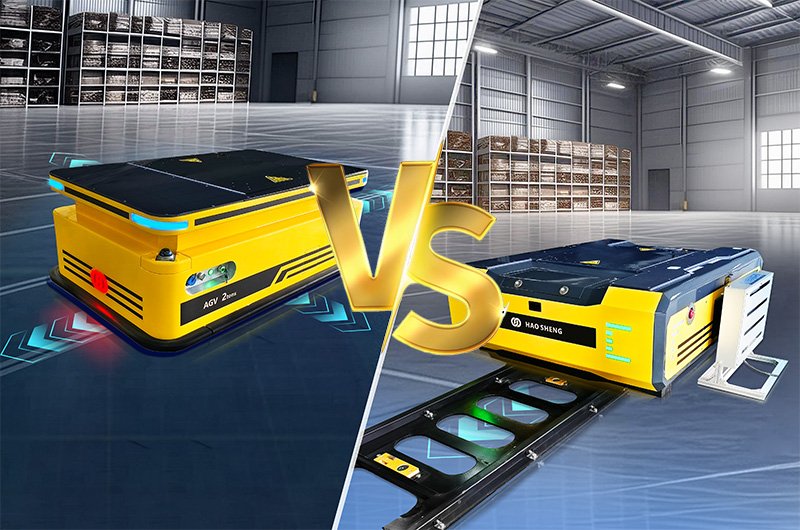
A: The mechanism is similar – synchronized hydraulic or scissor lifting – but an RGV runs on rails along a fixed route while an under-ride AGV navigates freely and can reach any cell on the floor. Fixed repetitive routes favor the RGV on cost; changing routes and many pickup points favor the AGV. See our lifting RGV guide for the rail-mounted side.
Q: How are these vehicles tested before delivery?
A: Every vehicle runs a factory load test at 1.1 times rated capacity, including lifting cycles with synchronization measured under load. Typical delivery is 3-4 months from signed technical agreement to factory acceptance, and the vehicles are built for a 10-15+ year service life.
Conclusion
An under-ride lifting AGV removes the crane from everyday heavy transport: drive under, verify, lift level, deliver, set down. The vehicle technology – synchronized cylinders, SLAM navigation, omnidirectional drive – is proven; what decides project success is the system engineering around it. Fix the stand geometry and pickup pads early, budget the lift stroke against real floor flatness, and survey the slab before the wheel layout is frozen. Do those three things with an experienced manufacturer, and 40-60 ton loads start moving on schedule instead of on the crane’s schedule.


Leave a comment