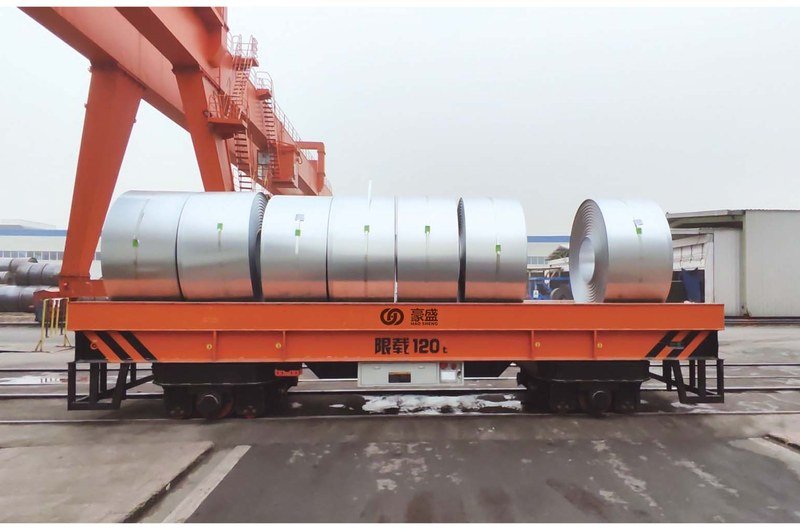
A Rail Guided Vehicle (RGV) is an electric transfer cart that travels on fixed steel rails to move heavy materials between workstations, production lines, bays, and warehouses. Because the vehicle is guided mechanically by the rails rather than by sensors alone, an RGV can carry extremely heavy loads — from 1 ton up to 500 tons — with repeatable, millimeter-level stopping accuracy that free-ranging vehicles struggle to match.
RGVs are one of the workhorses of heavy manufacturing. You will find them shuttling wind turbine nacelles between assembly stations, carrying ladles of molten steel through melt shops, feeding sheet metal to laser cutting lines, and moving 200-ton fabrications that no forklift could ever lift. This guide explains how RGV systems work, the main types available, typical payload capacities, and how to decide whether an RGV is the right solution for your facility.
RGV Meaning: Definition and Key Characteristics
RGV stands for Rail Guided Vehicle, sometimes called a rail transfer cart, rail guided cart, or transfer trolley on rails. Three characteristics define the category:
- Fixed guidance. The vehicle runs on steel rails embedded in or mounted on the floor, so its path is completely deterministic. It cannot drift, and its position along the route is always known.
- Heavy payloads. Because the load is transmitted through steel wheels into rails and a prepared foundation, RGVs handle payloads that would crush ordinary floors — 100, 200, even 500 tons.
- Automated or semi-automated operation. Modern RGVs are driven by PLC control with variable-frequency drives. They can run fully automatically under a scheduling system, semi-automatically from a touch screen, or manually from a remote control.
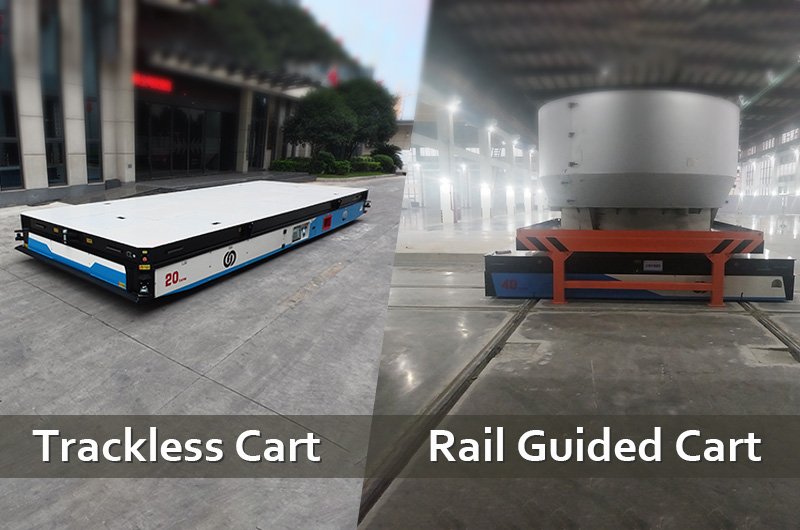
The trade-off is flexibility: an RGV only goes where its rails go. That makes RGVs ideal for fixed, repetitive, heavy transfer routes and less suitable for workflows that change layout frequently — a job better suited to AGVs (Automated Guided Vehicles), which navigate freely without rails.
How Does an RGV System Work?
A complete RGV system is more than the cart itself. Five subsystems work together:
1. Chassis and drive
The frame is a welded steel structure — typically box-beam construction using Q345-grade main beams — engineered so that deck deflection stays within strict limits (commonly L/1000 of the wheelbase at rated load). Forged steel wheels ride on crane-type rails, driven by variable-frequency motors that give smooth, stepless speed control, typically 0–20 m/min in automatic mode with soft start and soft stop to protect the load.
2. Positioning
RGVs stop at defined stations. Position feedback comes from RFID tags along the route for station identification, combined with laser distance measurement or encoders for fine positioning. A well-built RGV achieves repeatable stopping accuracy of about ±5 mm — accurate enough to hand a pallet to a conveyor or dock with an automated machining cell.
3. Power supply
There are three common ways to power an RGV, chosen mainly by travel distance and duty cycle:
Lithium battery (LiFePO4)
No cables or energized rails; best for long routes, transfer between buildings, and clean environments. Supports automatic opportunity charging for round-the-clock operation.
Low-voltage conductor rail
The track itself is energized at a safe low voltage (for example AC36V, stepped down from 380 V by transformers placed roughly every 50 m). Ideal for continuous, high-duty operation with unlimited runtime.
Festoon or drag-chain cable
A moving cable feeds the cart directly — simple and reliable for short, straight routes.
4. Control system
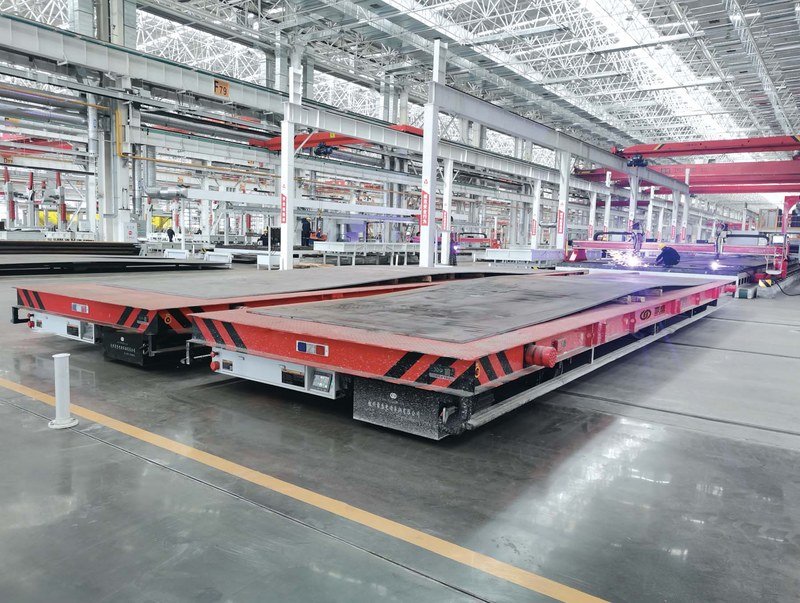
A PLC on board the vehicle manages drive, positioning, lifting functions, and safety devices. Operators interact through a 7-inch touch screen showing speed, station, fault codes, and operating mode. Laser obstacle scanners, bumpers, emergency stops on each corner, and audible warnings protect people working near the route.
5. Scheduling and integration
In automated plants, a scheduling system dispatches one or more RGVs, manages traffic on shared rails, and exchanges task data with the factory’s MES or WMS over WiFi or 5G. This is what turns a transfer cart into a fully integrated link in an automated production line.
The 8 Main Types of RGVs
RGV is a family of vehicles, not a single product. The main types are:
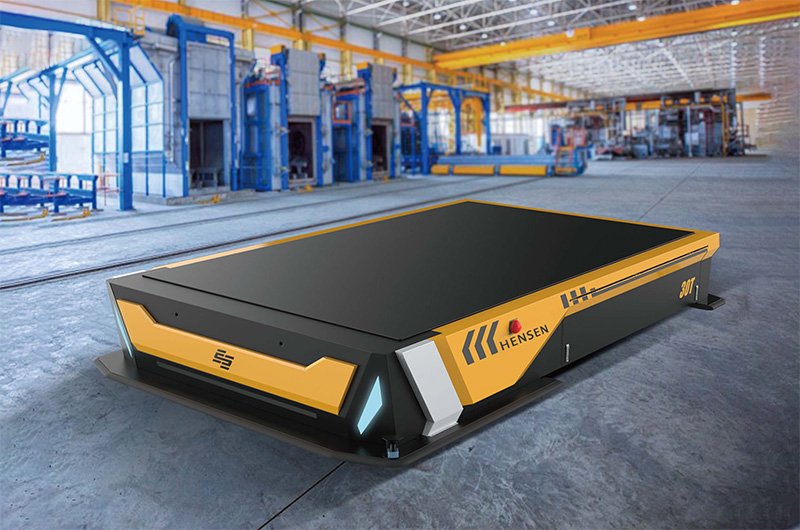
- Flatbed RGV — a plain heavy deck for general transfer; the most common configuration from 5 to 500 tons.
- Lifting RGV — a scissor-lift or hydraulic jacking deck raises and lowers the load to hand it over to stations at different heights.
- Roller-deck RGV — powered rollers on the deck let the cart load and unload automatically from conveyor lines.
- Mother-child (shuttle) RGV — a smaller child cart rides on the mother cart, then drives off perpendicular into storage lanes, curing ovens, or narrow aisles.
- Ferry (cross-bay) RGV — shuttles loads between parallel bays or buildings, docking with the rails or vehicles inside each bay.
- Track-change RGV — onboard mechanisms let the cart switch between longitudinal and transverse rails, so one vehicle covers a rail grid that would otherwise need several carts.
- Curved-rail RGV — steerable wheelsets or bogies allow travel through bends and ring-shaped routes, up to very heavy payloads such as 120 tons.
- Turntable RGV — the deck rotates to change load orientation or travel direction without extra rails.
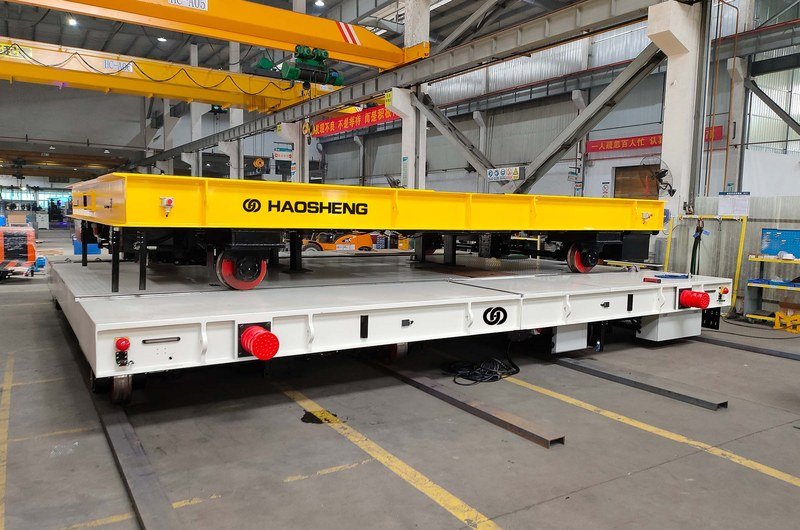
Special-duty variants extend the family further: high-temperature RGVs with heat shielding for ladle and hot-material transfer, and explosion-proof or outdoor versions for harsh environments.
RGV Payload Capacity: 1 to 500 Tons
Typical capacity bands and what they are used for:
| Capacity | Typical applications |
| 1–10 t | Sheet metal shuttles, cable reels, and line-side part delivery |
| 10–50 t | Steel plate and coil transfer, machinery components, molds |
| 50–150 t | Wind power nacelles and hubs, large fabrications, ladles |
| 150–500 t | Transformers, ship blocks, complete machines, and smelter loads |
Because the rails carry the load, floor pressure is manageable even at extreme weights — one reason RGVs dominate the ultra-heavy segment where cranes are slow and forklifts are impossible.
Where RGVs Are Used: Key Industries
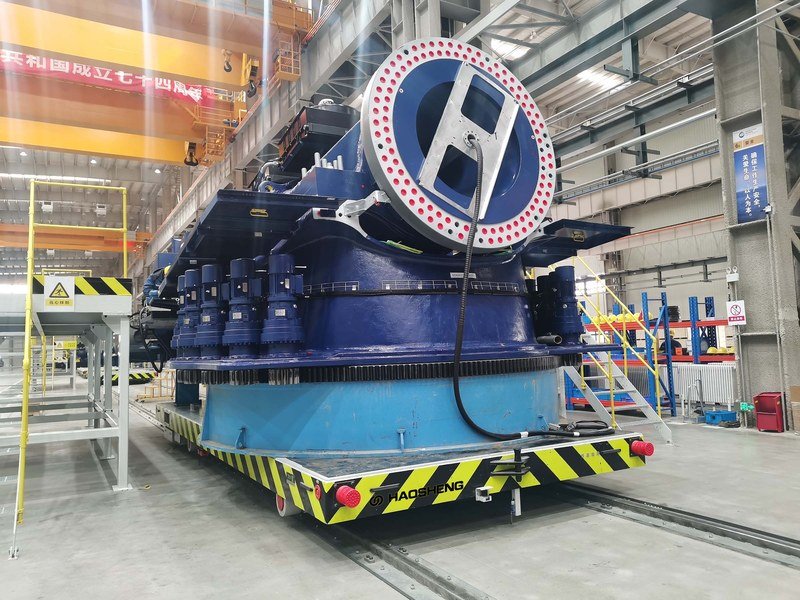
wind-turbine-nacelle-transfer-rgv.jpg | ALT: Custom RGV transferring a wind turbine nacelle between assembly stations
Industries with heavy, repetitive transfer routes get the most value from RGV systems:
- Wind power — moving nacelles, hubs, and generator frames between assembly stations, including 300-ton class vehicles.
- Steel and metallurgy — ladle transfer carts, steel plate warehouse feeding, coil transfer on V-decks, and 160-ton high-temperature carts in copper smelting.
- Sheet metal and laser cutting — mother-child shuttles feeding flexible blanking lines.
- Construction machinery — lifting RGVs carrying frames and booms down the assembly line.
- Cable and wire — V-deck RGVs cradling large reels between winding, testing, and storage.
- Prefab and infrastructure — precast concrete elements and tunnel segments on heavy decks.
RGV vs Crane, Conveyor, and Forklift
| Method | Strength | Weakness vs RGV |
| Overhead crane | Reaches anywhere under the runway | Slow cycles, operator-dependent, suspended-load risk |
| Roller conveyor | Continuous flow of uniform loads | Cost per meter over long distances; inflexible for very heavy items |
| Forklift | Total route flexibility | Impractical and unsafe above roughly 20 t; labor cost every shift |
| AGV | Free navigation, easy layout changes | Lower practical payload ceiling on normal floors; wheel loading limits |
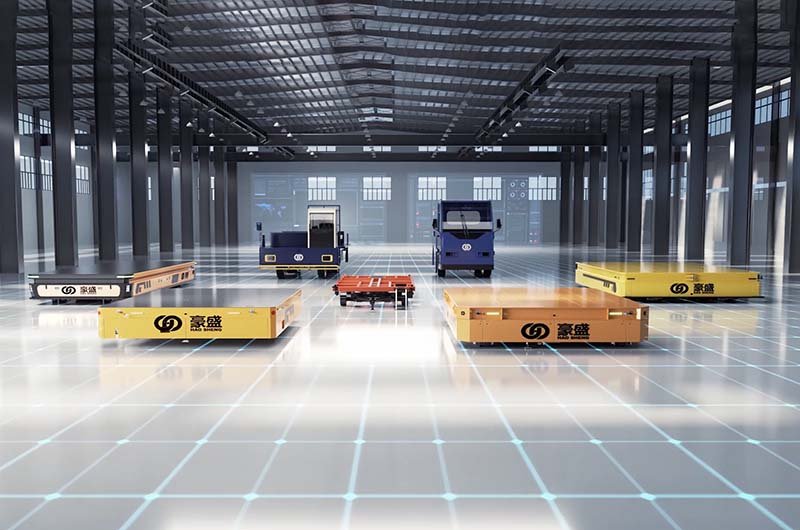
In many plants the best answer is a combination — for example an RGV covering the heavy fixed route, handing loads to AGVs for flexible distribution. Ferry carts that carry an AGV or dock with one are a proven pattern for linking the two worlds.
Advantages and Limitations of RGVs
Advantages: highest payload capability of any floor vehicle, millimeter-level repeatability, deterministic cycle times that can be synchronized with production takt, long service life with simple maintenance, and safe low-level transport of loads that would be dangerous to lift.
Limitations: the route is fixed by rails and changing it means civil works; rails require a proper foundation and periodic gauge and level checks; and crossing routes need engineered solutions such as track-change carts, turntables, or ferry transfers.
How to Specify an RGV for Your Project
A supplier will typically ask you to define: payload and load dimensions, deck size and any special tooling (V-blocks, saddles, fixtures), travel distance and route layout, power supply preference, number of stations and required stopping accuracy, operating environment (temperature, dust, indoor or outdoor), and how the vehicle must communicate with your line or warehouse systems. Getting these ten or so parameters right up front is the single best way to keep an RGV project on budget and on schedule.
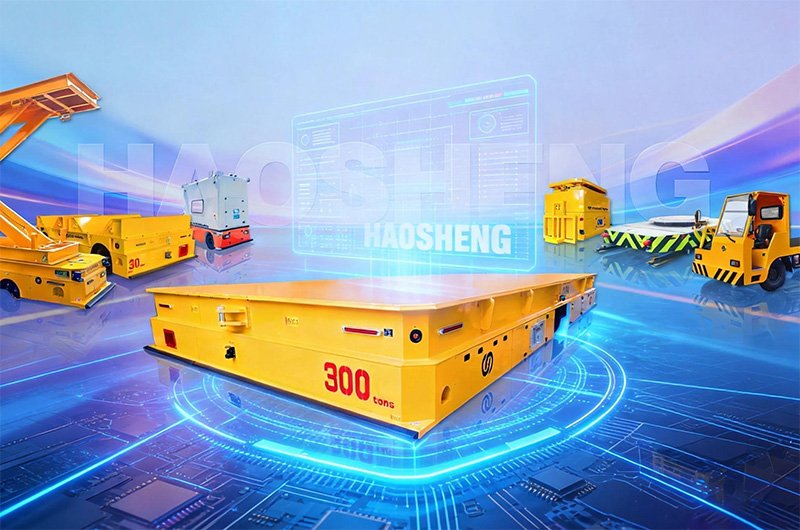
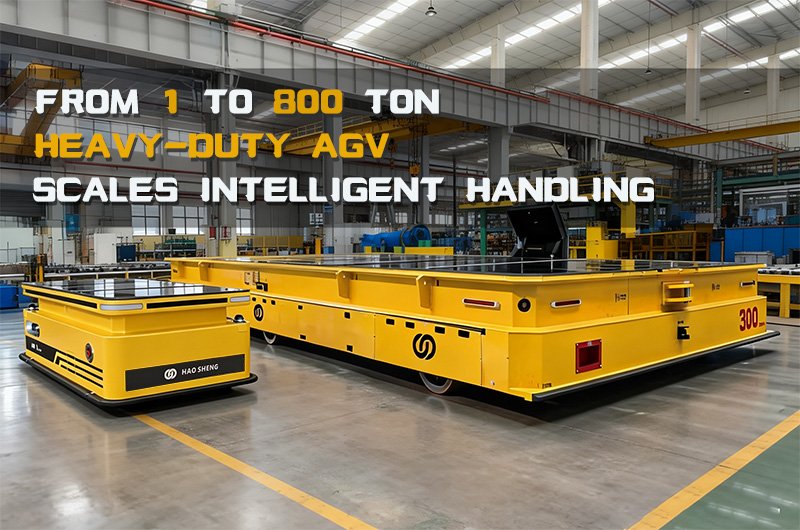
HENSEN (Hangzhou Haosheng Electric Vehicle Co., Ltd.) engineers custom RGVs from 1 to 500 tons — flatbed, lifting, shuttle, track-change, curved-rail, and high-temperature designs — alongside heavy-duty AGVs up to 800 tons, with CE marking and ISO 9001 certified manufacturing. If you are evaluating an RGV for a specific transfer task, share your load data and layout drawing and our engineers will propose a configuration with budget pricing.
FAQ About Rail Guided Vehicles
Q: What does RGV stand for?
A: RGV stands for Rail Guided Vehicle — an electric transfer cart that runs on fixed steel rails, also known as a rail transfer cart or rail guided cart.
Q: What is the difference between an RGV and an AGV?
A: An RGV is guided mechanically by rails and excels at heavy, fixed, high-precision routes. An AGV navigates freely using laser, SLAM, or magnetic guidance and excels at flexible routes. Many plants combine both.
Q: How much weight can an RGV carry?
A: Standard designs cover 1 to 500 tons. The most common industrial range is 10 to 100 tons; specialized vehicles for wind power, metallurgy, and infrastructure go far beyond that.
Q: How accurate is RGV positioning?
A: With RFID station identification plus laser ranging or encoders, a quality RGV stops repeatably within about ±5 mm — sufficient for automated handover to conveyors, machines, and robots.
Q: How are RGVs powered?
A: Three options: onboard lithium battery, low-voltage conductor rail (track power), or a festoon/drag-chain cable. The choice depends on travel distance, duty cycle, and environment.
Q: How fast does an RGV travel?
A: Typically 0–20 m/min in automatic mode and up to about 25 m/min in manual mode, with stepless variable-frequency speed control and soft start/stop.
Conclusion
A rail-guided vehicle is the most robust way to move very heavy loads over fixed routes: mechanically simple, extremely precise, and available in configurations — lifting, shuttle, track-change, high-temperature — that solve almost any in-plant transfer problem up to 500 tons. If your process moves heavy items between the same points every day, an RGV system will usually beat cranes and manual handling on safety, cycle time, and total cost within a few years of operation.

Leave a comment