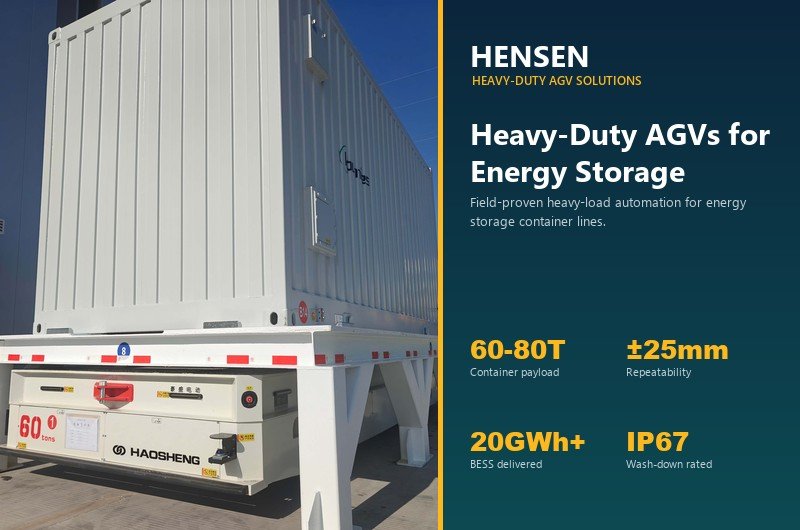
Energy storage is scaling faster than almost any factory floor was designed for. Walk into a modern battery energy storage system (BESS) plant and the front of the line—module assembly, cell stacking, inspection—is already highly automated. Then you reach the back end, where a finished 20-foot container weighs about 60 tonnes and a 40-foot unit can hit 80 tonnes, and the automation simply stops. Overhead cranes, forklifts, straddle carriers and crews of people take over. That hand-off is where throughput, safety, and cost all leak out at once.
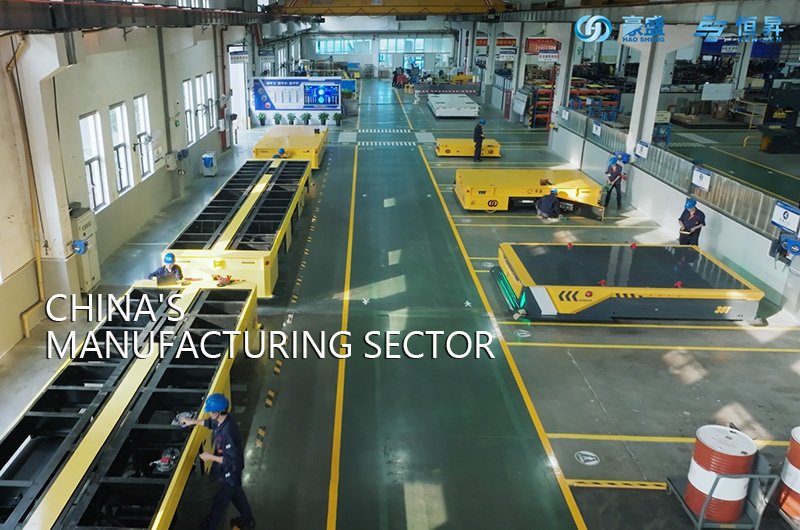
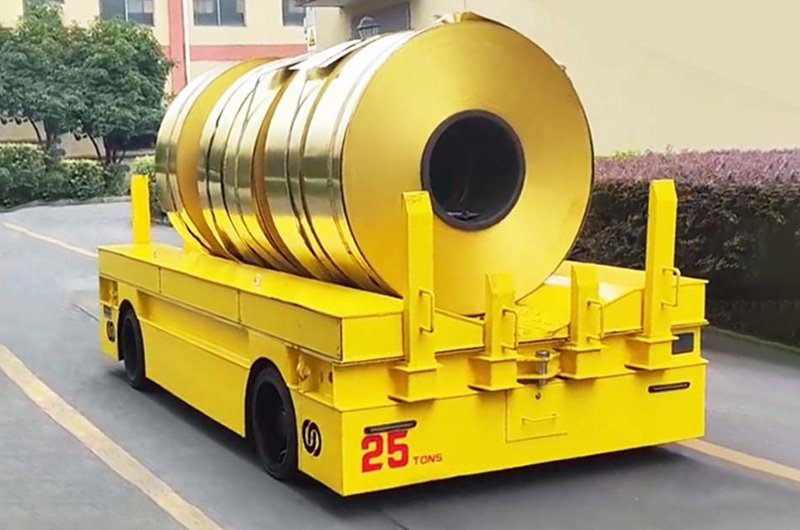
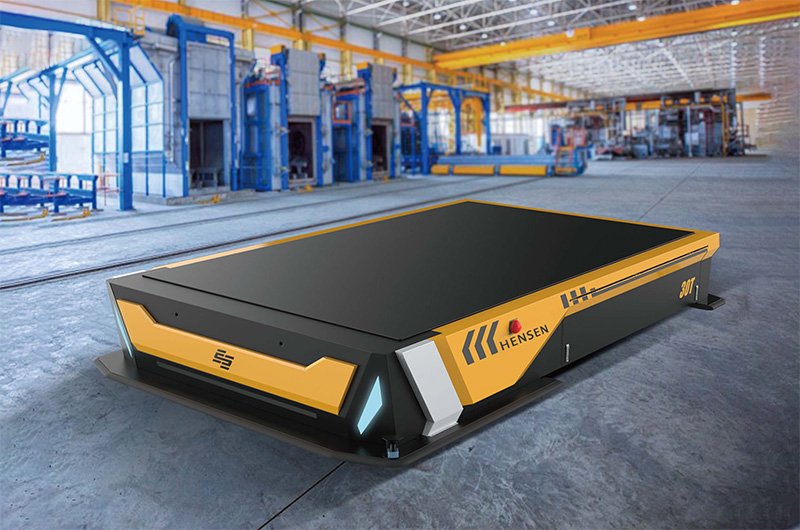
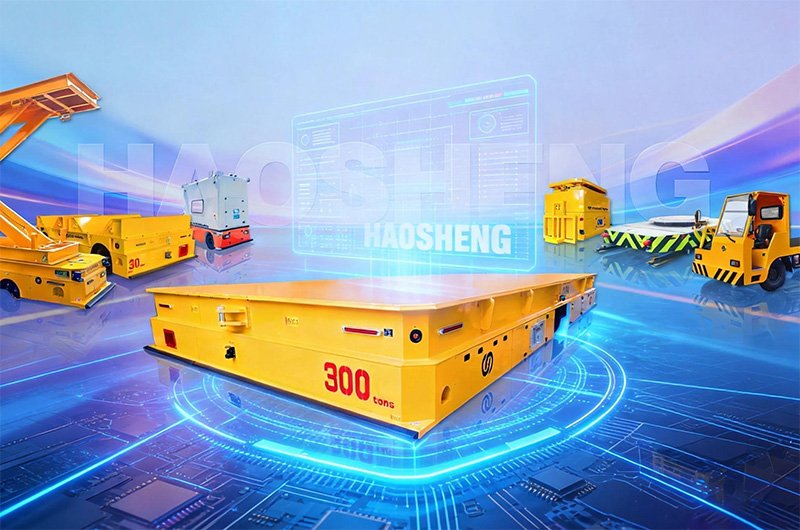
This is exactly the gap a heavy-duty AGV (automated guided vehicle) is built to close. Across nearly two decades and 1,000+ heavy-transport projects, we’ve put heavy-duty AGVs—engineered for anything from 1 to 800 tonnes—to work on real energy storage lines. This article is a field guide built from those deployments: where the demand is coming from, why cranes and straddle carriers fall short, what “heavy-duty” actually has to mean at 80 tonnes, and the hard-won lessons—including a few expensive mistakes—we now check on every project before go-live.
Key takeaways – The heavy-load back end—not the assembly line—is the real OEE bottleneck in energy storage manufacturing. – Most BESS plants are converted electrical-cabinet factories whose buildings can’t fit a 60–80 t overhead crane, so the cabinet gets stuck in one spot through every assembly step. – For roughly the cost of one straddle carrier, two heavy-duty AGVs plus a fleet scheduler can move the cabinet station-to-station instead. – A true energy storage AGV handles 60–80 t at ±25 mm with composite navigation and a low (~580 mm) body—and the projects that fail, fail on layout: clearance, ramp angles and wash-down protection.
Where is the energy storage demand really coming from
Under global energy-transition and “dual-carbon” pressure, lithium-battery costs have fallen year after year—close to lead-acid in some segments—and storage has moved into full-scale, continuous production. New lithium-battery plants are being built one after another. But the demand isn’t only grid-scale; on the lines we serve it splits roughly three ways:
- Renewables (the 20-ft container, ~60 t). Wind and solar farms need storage to capture generation and release it on demand.
- Marine and mobile power (the 40-ft container, ~80 t). Battery storage is moving into shipping: electric and hybrid vessels can carry dozens of containerized battery units that power the ship itself—the maritime equivalent of the new-energy-vehicle shift.
- Second-life and back-up. Some lines build new PACKs into large containers; others repackage second-life EV cells into smaller cabinets used as emergency or peak-shaving power for shops, malls and facilities.
The principle is the same everywhere: charge when power is cheap (overnight), discharge when it’s expensive or needed. As that logic spreads from the grid to the quayside, the number of multi-tonne containers a plant must build—and move—keeps climbing.
The real bottleneck: a 60–80 t cabinet that can’t move
Here’s the insight that took us time on the floor to fully appreciate. Most energy storage manufacturers are converted electrical cabinet makers. When they built their workshops, ceilings were sized for cabinets—about the height of a single-storey showroom—not for a gantry crane that can lift 60–80 tonnes. A crane that heavy needs a tall, heavily reinforced structure the building simply doesn’t have, and you can’t re-pour a factory around a crane.
So the cabinet stays put. A typical container moves through five fixed stations, and today it does so without really moving at all:
- Install the battery packs
- Install the wiring and cabling
- Install the fire-suppression system
- Power-on testing
- Spray / wash-down test
Everything is carried to the stationary cabinet by forklift and hand-cart, step by step. Meanwhile the front of the line—cell storage, cell assembly, PACK production—is fully automated with robotic arms and its own MES. The back end never got the same upgrade, so you get the classic stall our customers call “the line waiting for people.”
That stall is an OEE problem. OEE—overall equipment effectiveness—is simply how much real output you get from the equipment you paid for: an owner invests in lines and machines, and OEE measures how much of that potential capacity actually turns into product. When the heavy-load step is manual, OEE suffers no matter how automated the front end is. We’ve seen lines whose upstream MES is good enough that they could run as a 24-hour lights-out factory, yet they top out around 12 hours of real production—because the back-end hand-off isn’t connected.
Why cranes, forklifts and straddle carriers fall short
Before specifying an AGV, it’s worth being honest about what the incumbent methods actually cost on an energy storage line.
- Overhead cranes are height-limited. As covered above, the building usually can’t take a 60–80 t crane, and it can’t be rebuilt. This is the single biggest reason energy storage customers come looking for AGVs.
- Forklifts are a safety liability. Manually shuttling parts around a several-tonne cabinet in a dense workshop invites collisions, drops and tip-overs. A single impact can damage cells and trigger a quality or safety event—not just an injury.
- Straddle carriers are expensive and rigid. They were the early answer to moving finished cabinets, but a single 60 t straddle carrier runs to roughly the price at which we can deliver two heavy-duty AGVs plus a fleet scheduler. They also need wide lanes and big turning circles most converted workshops can’t spare, and their fixed routing can’t keep up with energy storage’s constant layout and order changes.
The legacy toolkit, in other words, is unsafe, capital-heavy or inflexible—often all three.
What “heavy-duty” really has to mean for an energy storage AGV
“Heavy-duty AGV” gets used loosely. On an energy storage line it has a specific, demanding definition. Here’s the spec envelope we hold ourselves to.
| Requirement | What it means on a BESS line |
|---|---|
| Payload 60–80 t | A 20-ft cabinet (deck ≈ 6.2 m × 2.25 m) ≈ 60 t; a 40-ft cabinet (≈ 9 m long) ≈ 80 t. The frame needs high-strength materials to stay stable fully loaded. |
| Low body (~580 mm) | A low deck (we build 60 t units down to ~580 mm) means the fixture on top sits at roughly waist height, so operators wire and fit the cabinet without climbing—and the AGV clears low ceilings. |
| ±25 mm repeatability | Even fully loaded, the AGV docks within ±25 mm using differential steering and servo control—accurate enough for cabinet-to-line and battery-insertion work. |
| Composite navigation | Laser SLAM fused with QR-code / RTK positioning, plus multi-sensor fusion, to stay precise through changing light, dust and floor conditions—indoors and out. |
| Dynamic stability control | A forklift struggles to move an over-tall, off-centre container safely. A heavy-duty AGV actively manages stability to prevent tipping in transit. |
| MES / WMS integration | The AGV takes jobs from and reports status back to MES/WMS (or runs on its own app-based scheduler), giving full PACK-to-container traceability. |
| Environmental protection | Lines include wash-down/spray rooms and outdoor yards, so sealing, corrosion resistance and navigation redundancy are non-negotiable (see the field lessons below). |
If a vehicle can’t hold all of these together—weight, low profile, precision, navigation, stability, integration and protection—it isn’t a heavy-duty energy storage AGV; it’s a forklift with extra steps.
Two AGV form factors we deploy—and when to use each
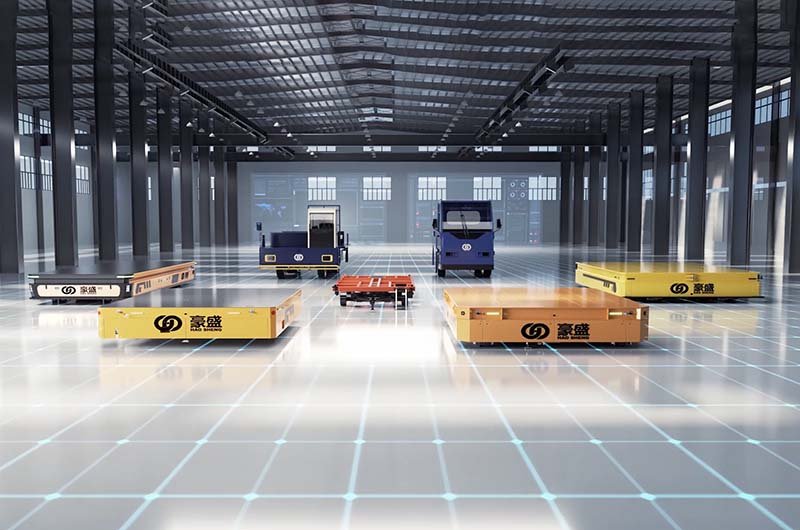
There is no single “best” AGV for energy storage. We run two form factors in parallel because they solve different problems, and the strongest lines often use both under one scheduler.
| Backpack (load-carrying) AGV | Submersible (latent-lift) AGV | |
|---|---|---|
| Body | Tall, rigid, high-stability deck | Low profile (~580–600 mm) |
| Best at | Full-auto, long-distance container transport; flow-line loops of 5–6 units | Auto-jacking fixtures in low-ceiling space |
| Payload focus | Largest 20-/40-ft containers (60–80 t) | Tall cabinets, lift to 1.2 m+ |
| Movement | Stable straight-line and turning hauls | Spin-in-place 90° and strafe (lateral move) |
| Precision | Reliable transport docking | Higher, for the heaviest transport |
| Capex profile | Higher, for heaviest transport | Lower entry cost—attractive for SMEs |
Rule of thumb from the field: use backpack AGVs for the heavy, long hauls (and for true flow-line loops where five or six vehicles cycle through the stations), and submersible AGVs for precision, low-ceiling transfers. Because the submersible can rotate in place and move sideways, it thrives in the cramped, reconfigured layouts that are normal in converted energy storage plants. A central scheduler then coordinates the fleet, deconflicts paths and balances load across both types.
Field case: automating a 20 GWh+ BESS line (anonymized)
On one project with a leading energy storage manufacturer in East China, the brief was simple to state and hard to do: take the manual heavy-load step out of a high-volume line without disrupting takt.
We linked the cell-assembly and wiring/layout stations into one automated flow using a pair of 60 t heavy-duty AGVs. Notably, this customer had no MES—the AGVs ran entirely on our own app-based fleet scheduler, issuing jobs in production sequence, planning routes and handling obstacle avoidance, with execution visible in real time. On a different plant, we did the opposite: the AGV fleet was integrated in parallel with a system integrator’s MES, acting as the line’s scheduling hub and taking commands from the front-end production system. Same vehicles, two integration models—because flexibility is the point.
The outcome that mattered wasn’t a single headline number—it was consistency at scale. Automating the heavy hand-off smoothed takt variability between stations, removed the “line waiting for people” stall, and supported large, stable output as the plant pushed past 20 GWh of cumulative delivery, putting it in the industry’s first tier. The same pattern—two or more heavy-duty AGVs stitching automated islands into a continuous flow—has since repeated across other BESS customers and adjacent heavy-industry lines.
Field lessons: what we check before every go-live
Most heavy-duty AGV projects don’t fail on the vehicle—they fail on the layout and environment around it. These are the checks we now run on every energy storage deployment, several of them learned the hard way. Treat them as a pre-install checklist.
1. Push standardized, container-sized models
Energy storage is, mercifully, fairly standard: the cabinets are built to ship inside ISO containers (many are exported, and standard widths around 2,100–2,250 mm drop into a sea container cleanly). So specify a standard AGV model wherever you can. When a customer asks for an odd footprint “to be safe,” it usually just complicates shipping and service for no real gain—steer them back to standard dimensions.
2. Let the AGV partner design the fixtures
Ask for the customer’s layout drawing early and have the tooling fixtures (the racks the cabinet sits on) designed together with the AGV. When the vehicle and the fixture are engineered as one system, you avoid the finger-pointing and rework that show up later when they were specified separately.
3. Space fixtures at least one AGV length + 1 metre apart
This one we learned from a jam. On an early line, the racks were spaced just 0.5 m apart, and the AGV had no room to adjust its posture, turning into the next bay. The rule we now enforce: adjacent fixtures must be more than one AGV body length plus one metre apart. A 6.2 m vehicle, for example, needs at least 7.2 m rack-to-rack so it can complete its turn and settle its heading before docking. The same clearance leaves room for maintenance access later.
4. Plan the turns: spin-in-place and lateral moves
Where the aisle won’t allow a normal turn, design the path around a 90° spin-in-place or a sideways (lateral) move—and prefer the lateral move where you can. Pair it with soft bumper strips and laser scanners for dual-layer collision protection. Keep at least 250 mm of clearance on each side of every fixture to absorb positioning drift and vibration under load.
5. On any indoor↔outdoor path, ask for the biggest load—and check ramp angles
Finished cabinets often have to leave the building to be loaded into containers, so the route crosses an indoor-to-outdoor ramp. On one line the customer only mentioned the outdoor leg after the fact; going down the slope, the front legs of the fixture grounded on the concrete—because the wheels sit back from the fixture’s front edge, those front corners touched down before the vehicle had finished the ramp. The lesson is twofold:
- Model the approach angle, departure angle, motion envelope and minimum ground clearance before deployment, and measure the real ramp gradient on site. Where needed, raise the lift height so the fixture clears.
- Whenever a vehicle crosses indoors↔outdoors, ask for the single largest load on that path. If the biggest load clears the ramp, every smaller one will too.
6. Spec wash-down and spray areas seriously—our rust lesson
If the cabinet is dragged through a spray/wash-down room, the AGV gets wet, and we have the scars to prove why this matters. On one project, the freshly sprayed fixture was still dripping when the AGV picked it up, then sat for a long dwell at an inspection station—water ran down the fixture onto the AGV deck. Our coating had no primer/filler layer, and friction between the cabinet and fixture had already scratched the paint film, so the water got under it and the whole deck rusted. What we now do as standard:
- IP67 or higher, validated with a real spray test—not just a datasheet number.
- Sealed drive wheels, waterproof (automotive-grade) connectors, sealed junction boxes and battery compartments, plus a waterproof cover plate over the deck.
- Stainless or anti-corrosion-coated bodywork, and a process rule: don’t park a dripping fixture on the AGV for an extended dwell.
7. For open outdoor yards, build navigation redundancy
Open storage yards are the hardest case. On one site the outdoor area was a wide-open yard with no reference surfaces, and pure laser navigation lost its fix. Our interim fix was a defined outdoor drop point at the top of the ramp—the AGV set the cabinet down there and a straddle carrier took it onward—but large bases increasingly want the AGV to go all the way into the yard. For that, build redundant, fused navigation (laser + RTK + IMU) that switches automatically when the primary signal drops, and plan routes around glare, standing water and soft ground. (Magnetic-tape guidance is one alternative, but it damages the floor over time, so we avoid it where we can.) Also scope dynamic obstacle handling explicitly: a shared lane where third-party trucks park for unloading needs either a guaranteed-clear path or genuine dynamic re-routing—don’t assume it.
The payoff: OEE, safety, labour and traceability
When the heavy-load step finally matches the pace of the automated line, the benefits compound:
- Higher OEE. Continuous, automated transfer removes the “line waiting for people” stall and lifts equipment effectiveness across the whole line—closing the gap toward genuine lights-out running.
- Lower risk, lower labour. Replacing manual heavy handling cuts both the safety exposure and the headcount tied to moving multi-tonne loads.
- Better quality. Fewer impacts mean fewer damaged cells and a more consistent product—critical when a single knock can become a safety event.
- Full traceability. Tight MES (or app-scheduler) integration tracks material from PACK to finished container, giving quality control and lean management the data they never had with cranes and forklifts.
How to choose a heavy-duty AGV for your energy storage line
If you’re scoping a project, work through these in order:
- Container spec and payload. 20-ft (~60 t) vs 40-ft (~80 t) sets the structural class—and lean toward standard, container-shippable dimensions.
- Ceiling height and aisle width. Tight or low converted workshops push you toward low-profile submersible units.
- Navigation environment. Indoor laser/QR is straightforward; outdoor yards demand fusion and redundancy.
- Integration depth. Decide between a turnkey app scheduler and full MES/WMS handshakes—both are valid.
- Service and customization. Heavy-load energy storage work is bespoke; prioritize a partner who designs the vehicle and the fixtures to your layout and supports it long-term.
Matching vehicle type to load, environment and integration up front is what protects utilization, uptime and equipment life later.
FAQ
What payload does an energy storage AGV need? Plan for 60–80 tonnes: a 20-ft container is roughly 60 t, and a 40-ft unit can reach 80 t. Standard AGVs and most forklifts can’t handle this safely, which is why heavy-duty, stability-controlled vehicles are used.
Why can’t I just use my existing overhead crane? Because most energy storage plants are converted electrical-cabinet factories with low ceilings. A 60–80 t crane needs a tall, heavily reinforced structure the building doesn’t have—and rebuilding the factory isn’t realistic. A low-profile heavy-duty AGV moves the cabinet without any overhead lift.
Is an AGV really cheaper than a straddle carrier? For most plants, yes. A single 60 t straddle carrier costs roughly what it takes to deploy two heavy-duty AGVs plus a fleet scheduler, and it needs wide lanes and rigid routing the AGVs don’t—while the AGVs add flexibility, safety and traceability.
Backpack vs submersible AGV—which should I choose? Use backpack (load-carrying) AGVs for long-distance, heaviest transport and flow-line loops, and submersible (latent-lift) AGVs for low-ceiling spaces and precision docking such as battery insertion. Many lines run under a single scheduler.
Do AGVs work in wash-down or spray areas? They can, if rated for it—target IP67 or higher with sealed drives, automotive-grade waterproof connectors, a corrosion-resistant body and a deck cover plate, validated by a real spray test. Don’t let a dripping fixture dwell on an unrated vehicle.
What about outdoor storage yards? Open yards lack reference surfaces, so plain laser navigation can drift or drop out. Use redundant fused navigation (laser + RTK + IMU), plan routes around glare and standing water, and scope dynamic obstacle handling explicitly for shared lanes.
Conclusion
The energy storage boom has automated everything except the heaviest, most dangerous step—and that’s precisely the step that caps OEE. Heavy-duty AGVs close the gap by moving 60–80 t containers safely, precisely and continuously inside buildings that were never designed for a crane, while feeding the data backbone that modern BESS quality and scheduling depend on. Get the vehicle class right, plan the layout around clearance, ramps and wash-down, and the heavy-load bottleneck becomes the part of the line you stop thinking about.
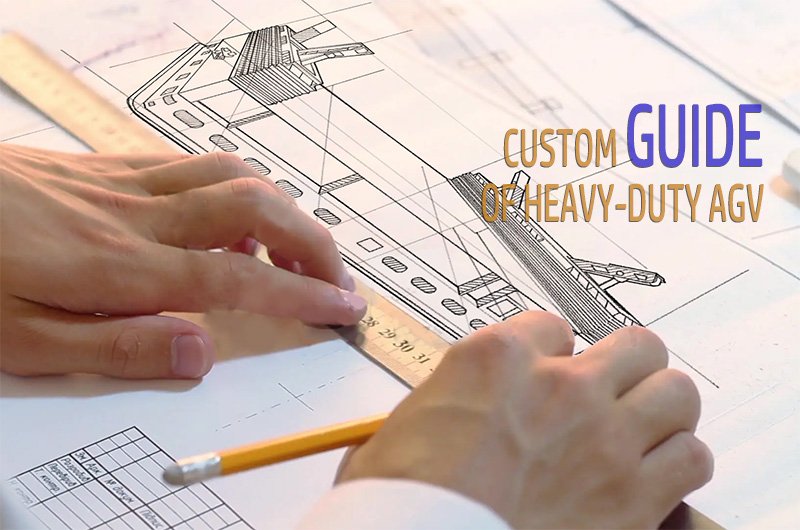
Planning a heavy-load automation project for an energy storage line? When standard isn’t enough, go custom—talk to the HENSEN AGV engineering team about a layout-specific assessment.

Leave a comment